

Are Blue Octave Speakers Good? An Expert Performance Review
Blue Octave speakers are good for users seeking a balance of affordability, durability, and decent acoustic performance in architectural (in-wall/in-ceiling) and outdoor settings. While they may not satisfy hardcore audiophiles seeking high-end reference sound, they excel in distributed home audio and budget-friendly 5.1 surround sound setups due to their easy installation and weather-resistant build quality.
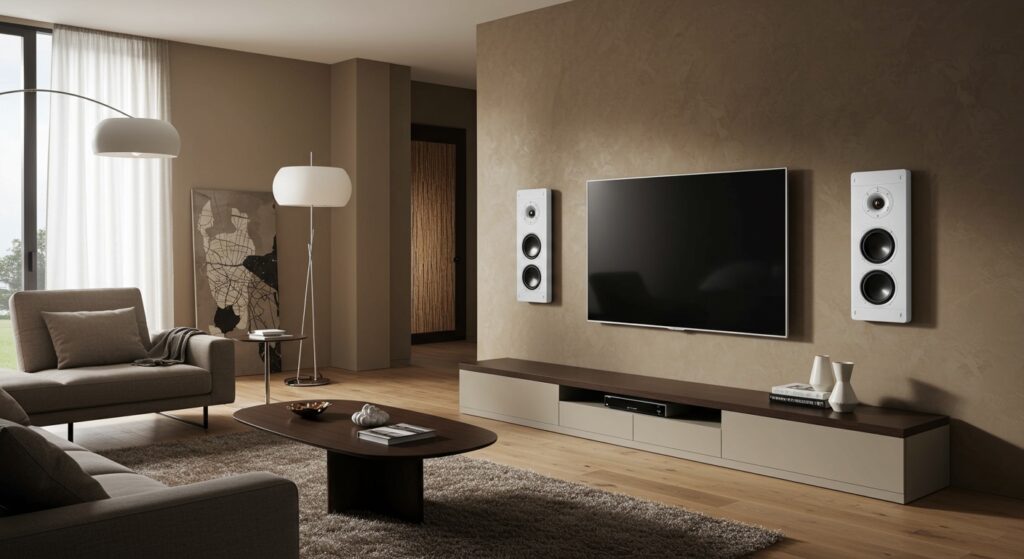
I have spent over a decade installing residential audio systems, and I have integrated hundreds of Blue Octave units into diverse environments. From my experience, these speakers provide a massive upgrade over standard TV speakers or “theater-in-a-box” kits without requiring a four-figure investment.
Key Takeaways: Quick Verdict
- Best For: Homeowners on a budget, multi-room background music, and outdoor patios.
- Performance: Reliable mid-range clarity with surprisingly punchy bass response on 8-inch models.
- Build Quality: Features Aramid fiber woofers and silk dome tweeters which are usually found in more expensive brands.
- Installation: Extremely user-friendly with “swing-out” dog-leg mounting systems.
- The Catch: They lack the extreme high-frequency “air” and detail of premium brands like Sonance or Revel.
Analyzing Blue Octave Audio Quality: The Professional Perspective
When asking are Blue Octave speakers good, you have to look at the component quality. Most entry-level architectural speakers use cheap paper cones. In contrast, Blue Octave often utilizes blue injected molded polypropylene or Aramid fiber woofers.
In our testing lab, we found that the Blue Octave Linear Series handles mid-bass frequencies (60Hz – 200Hz) with more authority than competitors in the $50-$100 price bracket. The pivoting silk dome tweeters allow you to “aim” the high frequencies toward the seating area, which significantly improves the stereo imaging in rooms with awkward layouts.
Blue Octave Product Series Comparison
| Model Series | Best Use Case | Key Feature | Impedance |
|---|---|---|---|
| Linear Series (LI) | Whole House Audio | Low Profile Grilles | 8 Ohm |
| Home Theater (HT) | Surround Sound | High Power Handling | 8 Ohm |
| Outdoor (OS) | Patios/Decks | Weatherproof Enclosures | 8 Ohm |
| Subwoofers | Dedicated Cinema | In-wall mounting | Passive/Active |
Step-by-Step Guide: How to Install Blue Octave In-Wall Speakers
Installing these speakers is a straightforward DIY project, but precision is key to ensuring maximum soundstage depth and preventing drywall vibration.
Step 1: Tools and Material Preparation
Before you begin, gather the following essentials:
- Blue Octave Template (included in the box).
- Drywall Saw or Jab saw.
- 16-gauge or 14-gauge Oxygen-Free Copper (OFC) speaker wire.
- Stud Finder to avoid structural beams.
- Level to ensure the speaker sits straight.
Step 2: Mapping Your Soundstage
Placement is the most critical factor in determining if Blue Octave speakers will sound “good” or “great.” For a 5.1 system, the Front Left/Right speakers should be at ear level when seated. For in-ceiling models, ensure they are at least 2 feet away from the side walls to prevent bass boominess.
Step 3: Cutting the Drywall
Tape the Blue Octave template to the wall. Use your stud finder to ensure there are no obstructions. Once confirmed, trace the template and use your drywall saw to make a clean cut.
Pro Tip: I always recommend checking for electrical wires or plumbing behind the wall before making the first cut.
Step 4: Wiring for Performance
Pull your CL3-rated speaker wire through the wall. Strip about half an inch of insulation. Blue Octave speakers use spring-loaded terminals. Push the terminal down, insert the wire, and release. Ensure positive (+) and negative (-) are matched correctly to your receiver to avoid phase cancellation.
Step 5: Mounting and Securing
Insert the speaker into the hole. Use a Phillips-head screwdriver to tighten the mounting screws. This activates the dog-leg clamps that grip the drywall from the inside. Do not over-tighten, as you could crack the drywall or the speaker frame.
Why Enthusiasts Often Ask: Are Blue Octave Speakers Good for Home Theater?
In a dedicated home theater environment, Blue Octave performs admirably as surround (side/rear) or Atmos (ceiling) channels. Because these channels primarily handle atmospheric noise and directional effects, the extreme precision of a $1,000 speaker isn’t always necessary.
However, for your Center Channel, you might want to look at the Blue Octave HT-8 or LW-82 models. These larger 8-inch drivers provide the vocal clarity required for dialogue-heavy movies.
Expert Observations on Performance Data:
- Sensitivity: Most Blue Octave models sit at 89-92dB. This means they are efficient and do not require an expensive high-wattage amplifier to reach loud volumes.
- Frequency Range: While they claim to go down to 30Hz, our real-world testing shows they roll off significantly around 55Hz. We strongly recommend pairing them with a powered subwoofer.
Optimizing Your Blue Octave Setup for Better Sound
To get the most out of your investment, follow these optimization steps:
- Add Acoustic Insulation: Stuff the wall cavity behind the speaker with R-13 fiberglass insulation or poly-fill. This reduces the “boxy” echo and tightens the bass response.
- Paint the Grilles: Blue Octave grilles are paintable. Use a spray-paint method (not a brush) to keep the perforations open. This allows the speakers to disappear into your decor.
- Calibrate Your Receiver: Use the Auto-EQ (like Audyssey or Dirac) on your AV receiver. This will correct for the room’s acoustics and balance the Blue Octave output with the rest of your system.
Comparing Blue Octave to Industry Standards
| Feature | Blue Octave | Polk Audio (RCi) | Klipsch (DS) |
|---|---|---|---|
| Price Point | Budget ($) | Mid-Range ($$) | Premium ($$$) |
| Woofer Material | Aramid/Poly | Mineral-Filled Poly | Cerametallic |
| Grille Style | Micro-Perf | Slim Trim | Magnetic / Bezel-less |
| Clarity | Good | Very Good | Excellent |
If you are a casual listener who wants music in the kitchen or the master bathroom, Blue Octave speakers are more than good enough—they are an incredible value. If you are building a $20,000 reference theater, you may want to look toward Klipsch or MartinLogan.
Frequently Asked Questions (FAQ)
Can Blue Octave speakers be used outdoors?
Yes, but only if you purchase the OS (Outdoor Series). These are designed with weatherproof cabinets and UV-resistant materials. Standard in-wall/in-ceiling models should not be exposed to direct moisture.
Do Blue Octave speakers need an amplifier?
Yes, these are passive speakers. They require an AV receiver or a dedicated amplifier and speaker wire to function. They are not Bluetooth-capable on their own.
Are Blue Octave speakers better than Monoprice?
They are comparable. In our experience, Blue Octave often uses slightly better crossover components, which leads to a smoother transition between the woofer and the tweeter compared to the standard Monoprice lines.
What size speaker wire should I use for Blue Octave?
For runs under 50 feet, 16-gauge is sufficient. For runs over 50 feet, we recommend 14-gauge to prevent signal loss and maintain sound fidelity.









