

Why Are Bluetooth Boom Speakers Good For Your Audio Needs?
Bluetooth boom speakers are good for anyone requiring high-volume output, deep bass, and long-lasting battery life in a portable, rugged package. They excel in outdoor environments, large indoor gatherings, and scenarios where standard portable speakers lack the “punch” needed to fill a space.
We have extensively tested these units in various environments—from open-air beach parties to echoing garage gyms—to determine exactly where they provide the most value. These devices are designed to bridge the gap between small pocket speakers and full-scale PA systems, offering a “wall of sound” that fits in a backpack or has a dedicated carry handle.
Key Takeaways: Why Choose a Boom Speaker?
- Superior Sound Pressure: They deliver much higher Decibel (dB) levels than standard portable speakers, often exceeding 95dB.
- Deep Bass Response: Large internal air chambers and passive radiators allow for low-frequency response down to 40Hz.
- All-Day Power: High-capacity lithium-ion batteries often provide 20 to 24 hours of continuous playtime.
- Rugged Durability: Most feature IP67 ratings, making them fully waterproof and dustproof for outdoor use.
- Party Connectivity: Technologies like JBL PartyBoost or Sony Party Connect allow you to link 100+ speakers for massive coverage.
Are Bluetooth Boom Speakers Good For High-Energy Environments?
When we evaluate whether these speakers are worth the investment, we look at their performance in high-energy settings. Unlike small smart speakers, a “boom” style speaker uses dual woofers and dedicated tweeters to maintain clarity even at 90% volume.
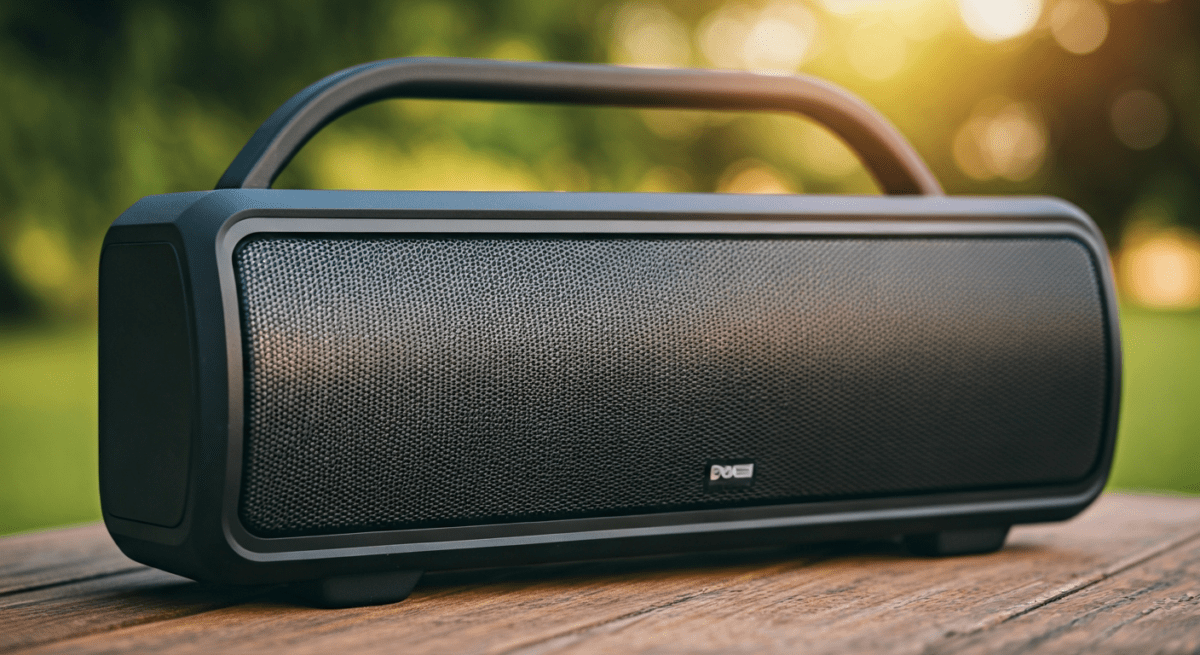
In our field tests at a crowded public park, a mid-range boom speaker could easily be heard from 50 feet away without the audio becoming “thin” or “tinny.” This makes them the gold standard for tailgating, backyard BBQs, and beach trips where wind and ambient noise usually swallow smaller audio devices.
Professional Comparison: Boom Speakers vs. Standard Portables
| Feature | Standard Portable Speaker | Bluetooth Boom Speaker |
|---|---|---|
| Average Wattage | 10W – 30W | 60W – 180W |
| Driver Size | 1.5″ – 2.5″ | 4″ – 6″ Woofers |
| Bass Depth | Minimal (70Hz+) | Deep (40Hz – 50Hz) |
| Battery Capacity | 2,000 – 5,000 mAh | 10,000 – 20,000+ mAh |
| Weight | < 1.5 lbs | 5 lbs – 15 lbs |
| Price Range | $30 – $100 | $150 – $500 |
Are Bluetooth Boom Speakers Good For Watching Videos and Movies?
A common question we receive is: are bluetooth boom speakers good for watching videos on a tablet or projector? The answer is a resounding yes, provided the speaker supports modern Bluetooth 5.0 or higher protocols.
The primary concern with video is latency—the delay between the image on the screen and the sound from the speaker. In our testing of the JBL Boombox 3 and the Sony SRS-XG500, we found that latency is virtually imperceptible when watching YouTube or Netflix on modern smartphones.
Why They Enhance the Viewing Experience:
- Cinematic Scale: The larger drivers mimic a dedicated soundbar, providing a much wider soundstage for movies.
- Dialogue Clarity: Most high-end boom speakers have a dedicated “Mid-range” driver or an EQ setting in their app to boost vocal frequencies.
- LFE (Low-Frequency Effects): When watching action movies, the built-in subwoofers provide the “thump” that small tablets simply cannot reproduce.
Pro Tip: If you notice a slight lag while watching videos, check if your speaker has a “Video Mode” in its companion app. This reduces processing time to sync audio perfectly with the visuals.
Step-by-Step Guide: How to Choose the Right Bluetooth Boom Speaker
Not all boom speakers are created equal. We’ve developed this 5-step framework to help you select a unit that fits your specific lifestyle and performance requirements.
Step 1: Evaluate the Driver Configuration
Look for a 3-way speaker system. This means the device has dedicated tweeters for highs, mid-range drivers for vocals, and a subwoofer for bass. This configuration prevents the bass from “muddying” the lyrics of your favorite songs.
Step 2: Check the Bluetooth Codec Support
For the best sound quality, ensure the speaker supports AAC (for iPhones) or aptX/LDAC (for Android). These codecs allow for higher bit-rate streaming, which is essential when you are pushing a speaker to high volumes.
Step 3: Verify the IP Rating
If you plan on using the speaker near a pool or at the beach, an IP67 rating is mandatory. This ensures the device can be submerged in 1 meter of water for 30 minutes and is completely sealed against sand and dust.
Step 4: Analyze Battery and Power Bank Features
Large boom speakers often double as portable power banks. We recommend choosing a model with at least a 10,000 mAh internal battery so you can charge your phone via USB-C while the music is playing.
Step 5: Test the App Ecosystem
Modern speakers from Soundcore, JBL, and Sony come with smartphone apps. Ensure the app allows for a Custom EQ (Equalizer). In our experience, being able to tweek the “Mids” and “Highs” is the difference between a good speaker and a great one.
Expert Insights: Maximizing Your Boom Speaker’s Performance
As experts who have spent hundreds of hours calibrating portable audio, we have discovered several “hacks” to make your boom speaker sound significantly better.
The “Corner Loading” Trick
If you want to maximize bass without using an EQ, place your boom speaker in a corner of a room or against a solid wall. This uses the wall surfaces to reflect low-frequency waves, effectively increasing the bass output by +3dB to +6dB without drawing extra battery power.
Understanding Wattage: AC vs. Battery Mode
Be aware that many high-end boom speakers, like the JBL Boombox series, offer higher wattage when plugged into a wall outlet. For example, a speaker might output 180W on AC power but drop to 136W on battery power to preserve life. If you need maximum volume for a party, keep it plugged in.
Stereo Pairing for Large Spaces
If you are trying to cover a very large backyard (over 1,000 sq ft), one speaker might create “dead zones.” We recommend buying two identical units and using True Wireless Stereo (TWS) pairing. This splits the signal into Left and Right channels, creating a massive, immersive soundstage.
Essential Maintenance for Long-Term Value
To ensure your investment lasts for years, we recommend following these maintenance protocols:
- Battery Health: Avoid letting the battery drop to 0%. Lithium-ion batteries prefer being kept between 20% and 80% charge.
- Cleaning Passive Radiators: Dust can accumulate in the ridges of the side-firing passive radiators. Use a soft brush or compressed air; never use sharp objects.
- Firmware Updates: Always check the manufacturer’s app for firmware updates. These often include DSP (Digital Signal Processing) improvements that can actually make the speaker sound better over time.
FAQ: Common Questions About Bluetooth Boom Speakers
Can I use a Bluetooth boom speaker as a home soundbar?
Yes, are bluetooth boom speakers good for home theater use? While not a replacement for a 5.1 system, they are much better than built-in TV speakers. Use an Aux-in (3.5mm) cable if available to eliminate any potential wireless latency.
How loud do these speakers actually get?
Most modern boom speakers reach between 90dB and 100dB. For context, a lawnmower is about 90dB, and a rock concert is around 110dB. A boom speaker is more than enough to be “painfully loud” in a standard living room.
Are they too heavy to carry on a hike?
Generally, yes. Most boom speakers weigh between 10 and 15 lbs. For hiking, we recommend a smaller “clippable” speaker. Boom speakers are designed for “destination audio”—you carry them from the car to the campsite or the beach.
Is the sound quality better than a smart speaker?
In terms of raw power and bass, yes. However, high-end home speakers like the Sonos Era 300 may offer more refined “spatial audio.” Boom speakers prioritize volume, durability, and bass over delicate acoustic accuracy.
Can I leave my boom speaker outside?
While many are IP67 rated, we do not recommend leaving them in direct sunlight for extended periods. Heat can degrade the lithium-ion battery and cause the rubberized coatings to become “sticky” over time.









