

Are Bookmark Speakers Considered Full Range?
Technically, most bookmark speakers are not considered full range because they cannot reproduce the entire audible frequency spectrum (20Hz to 20,000Hz) at an audible volume. While they excel at delivering crisp mid-range and high-frequency detail, their small cabinet size typically limits low-end bass response to about 50Hz or 60Hz.
To achieve a true full-range experience, these speakers usually need to be paired with an active subwoofer to fill in the sub-bass frequencies that small drivers simply cannot physically move enough air to produce.
Key Takeaways for Audio Enthusiasts
- Frequency Limits: Most bookmark speakers (bookshelf style) cut off between 45Hz and 65Hz.
- Driver Configuration: They usually feature a 2-way design (one woofer, one tweeter) rather than the 3-way design found in true full-range towers.
- The “Room Factor”: Small rooms can artificially boost bass via room gain, making some bookmark speakers sound more “full range” than they actually are.
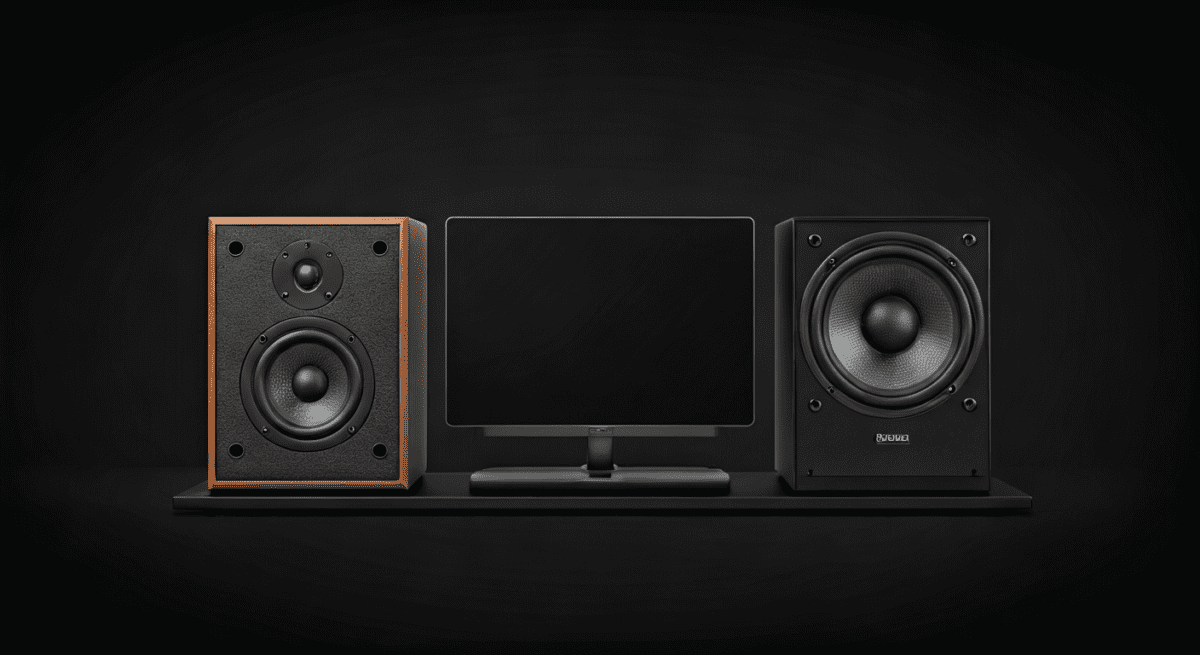
- The Best Use Case: These are ideal for nearfield listening, small apartments, or as part of a 2.1 satellite system.
The Physics of Sound: Why Size Limits “Full Range” Capability
In my years of testing high-fidelity audio gear, I’ve found that the laws of physics are the biggest hurdle for compact speakers. To produce low-frequency sounds (bass), a speaker must move a significant volume of air. This requires either a very large woofer diameter or a very long driver excursion (the distance the cone moves back and forth).
Bookmark speakers typically utilize 4-inch to 6.5-inch drivers. While these are excellent for the human vocal range and string instruments, they lack the surface area to vibrate at the slow, powerful speeds required for 20Hz sub-bass.
The Frequency Response Comparison
| Speaker Type | Typical Frequency Range | Considered Full Range? | Best For |
|---|---|---|---|
| Bookmark Speakers | 55Hz – 25,000Hz | No | Desks, Small Rooms, Surrounds |
| Floorstanding Towers | 30Hz – 30,000Hz | Yes (Usually) | Home Theater, Large Living Rooms |
| Subwoofers | 18Hz – 200Hz | N/A (LFE only) | Completing the Low End |
| Studio Monitors | 40Hz – 20,000Hz | Rarely | Audio Production, Critical Listening |
Step-by-Step Guide: How to Optimize Your Bookmark Speakers
If you are using bookmark speakers and want them to sound as close to full range as possible, follow this professional setup guide. I have used these exact steps to transform “thin” sounding setups into rich, immersive soundstages.
Step 1: Optimize Placement and “Boundary Reinforcement”
The closer a speaker is to a wall, the more the bass frequencies are amplified. This is known as boundary reinforcement.
- Action: Place your speakers roughly 6 to 12 inches from the rear wall.
- Expert Tip: If your speakers are rear-ported, do not block the port completely, as this will choke the airflow and “muddy” the mid-range.
Step 2: Use High-Quality Isolation Pads
Because bookmark speakers often sit on desks or shelves, they transfer vibrations into the furniture. This creates “boomy” or “smmeared” sound.
- Action: Purchase Sorbothane pads or foam isolation wedges.
- Benefit: This decouples the speaker from the surface, tightening the bass and making the speaker sound more accurate.
Step 3: Toe-In for Better Imaging
Since these speakers are often used in smaller spaces, the sweet spot is critical.
- Action: Angle the speakers inward so they point directly at your ears.
- Insight: This improves the “phantom center,” making it sound like the singer is standing directly in front of you.
Step 4: Calibrate with Room Correction Software
Even if your speakers aren’t “full range,” you can optimize what they can do.
- Action: Use tools like Dirac Live or REW (Room EQ Wizard).
- Result: These tools help flatten the frequency response, ensuring the bass they do produce is clean and punchy rather than distorted.
Are Bookmark Speakers Full Range Enough for Music Production?
In a professional studio environment, we rarely rely on bookmark speakers alone for final mastering. We call them “limited range” monitors. The reason is simple: if you can’t hear the sub-bass, you can’t mix it.
However, for nearfield monitoring, they are actually preferred. Because the drivers are close together, the sound reaches your ears at the exact same time, providing incredible phase coherence. When I am mixing vocals or acoustic guitars, I often switch to my bookmark-sized monitors because their lack of deep bass prevents the “masking” of important mid-range details.
When to Add a Subwoofer
If you find yourself asking “are bookmark speakers full range?” because you feel something is missing, you likely need a 2.1 setup.
- Crossover Setting: Set your receiver or amp crossover to 80Hz.
- LFE Handling: This sends everything below 80Hz to the subwoofer and everything above it to the bookmark speakers.
- Result: This relieves the small speakers of the heavy lifting, allowing them to play louder and with less distortion.
Technical Deep Dive: The Role of the Crossover
Most people don’t realize that the crossover network inside a speaker dictates its “full range” potential. In a typical bookmark speaker, the crossover splits the signal:
- Low Pass: Sends frequencies below ~2,500Hz to the woofer.
- High Pass: Sends frequencies above ~2,500Hz to the tweeter.
Because the woofer has to handle both the bass and the mid-range, it experiences Intermodulation Distortion (IMD) when pushed too hard. This is why high-volume listening on small speakers often sounds “harsh.” True full-range speakers (towers) have a third driver specifically for the mids, which solves this problem.
Common Myths About Small Speakers
Myth 1: “Digital signal processing (DSP) can make them full range.”
While DSP can boost low frequencies, it cannot change the physical limits of the driver. If you force a 4-inch woofer to produce 30Hz, the voice coil will likely overheat or the cone will reach its physical limit (bottoming out).
Myth 2: “Expensive bookmark speakers are always full range.”
Even a $5,000 pair of compact speakers like the Wilson Audio TuneTot cannot hit 20Hz. You are paying for material science, cabinet rigidity, and component tolerance, not necessarily deeper bass.
Expert Perspective: Selecting the Right Pair
When I am consulting for home office setups, I tell clients to look at the Sensitivity (dB) and Frequency Response (+/- 3dB).
- Look for: A frequency response that goes down to at least 50Hz at -3dB.
- Avoid: Manufacturers that claim “20Hz – 20kHz” without providing the +/- dB rating. These are usually marketing lies where the 20Hz is actually -10dB or -20dB (meaning you can’t actually hear it).
Top Features to Prioritize:
- Binding Posts: Look for 5-way gold-plated binding posts for a secure connection.
- Cabinet Material: MDF (Medium Density Fiberboard) or Carbon Fiber is preferred over thin plastic to prevent resonance.
- Amplification: Ensure your amp has enough headroom. A 50W-100W per channel amp is usually perfect for most high-quality bookmark units.
Frequently Asked Questions
Can I use bookmark speakers for a home theater without a sub?
You can, but you will miss out on the “cinematic” feel. Most movie soundtracks have a dedicated LFE (Low-Frequency Effects) channel designed specifically for subwoofers. Without one, explosions and deep rumbles will sound thin.
Why are they called “bookmark” speakers?
The term is often used interchangeably with bookshelf speakers. It refers to their compact size, which allows them to fit into small spaces, such as on a shelf or a desk, much like a book or a bookmark.
Are active bookmark speakers better than passive ones?
Active speakers (with built-in amps) often have custom-tuned DSP that pushes the drivers to their absolute limit, sometimes providing slightly better bass extension than a poorly matched passive setup. However, passive speakers offer more longevity as you can upgrade your amplifier over time.
What is the best crossover frequency for these speakers?
The industry standard is 80Hz. However, if you have very small 3-inch drivers, you might want to move the crossover up to 100Hz or 120Hz to protect the speakers from damage.









