

What Are Bose Acoustimass Cube Speakers?
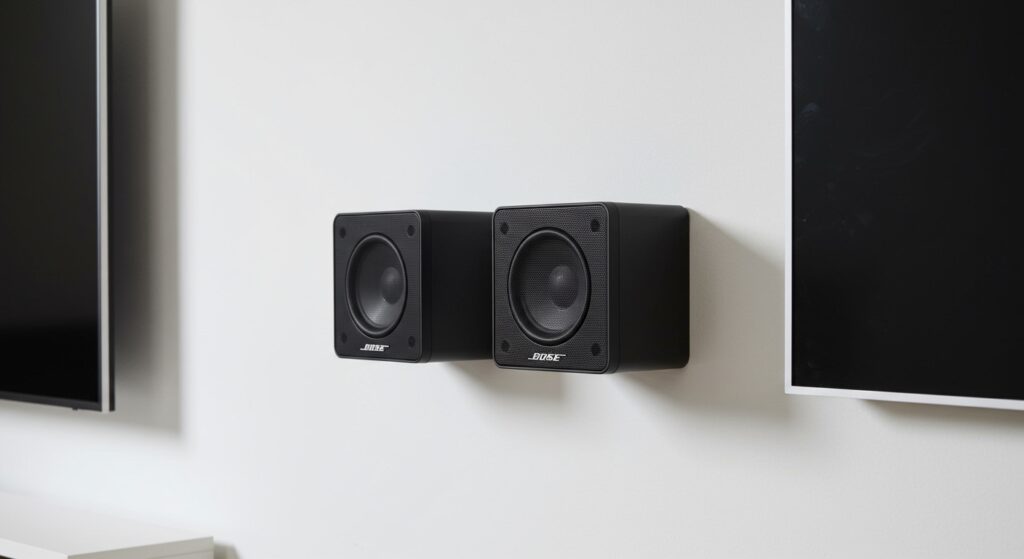
Bose Acoustimass cube speakers are passive high-frequency satellite speakers designed to work exclusively with a companion Acoustimass bass module. These speakers utilize a proprietary crossover system within the bass module to handle mid-to-high frequencies while the module manages the low-end “bass” notes. Because they lack internal amplification and have unique impedance ratings, they cannot be connected directly to a standard receiver without the matching Bose bass module.
Quick Summary: Key Takeaways
- System Nature: They are part of a 2.1 or 5.1 system; the cubes handle the highs/mids, and the module handles the lows.
- Power Requirements: They require an external A/V receiver or amplifier to provide power.
- Proprietary Wiring: Most versions use specific Bose-only cables or require routing all wires through the bass module first.
- Best Use Case: Ideal for minimalist home theaters where a small physical footprint is a priority over audiophile-grade “flat” response.
- Compatibility: Most Acoustimass cubes are 4-ohm to 8-ohm compatible but only when filtered through the module’s internal protection circuit.
Are Bose Acoustimass Cube Speakers an Amplifier?
One of the most common questions I hear from my clients is: “Are bose cube acoustimass speakers an amplifier?” The short answer is no. These cube speakers are entirely passive, meaning they do not have a built-in power source or a plug for a wall outlet.
In a standard setup, the Bose Acoustimass module acts as the “brain” and the crossover, but it still requires a signal from an external home theater receiver. While some Bose Lifestyle systems include an “active” (powered) module, the Acoustimass cube speakers themselves never contain an amplifier. If you try to wire them directly to a high-powered receiver without the module’s protection, you risk blowing the small drivers because they cannot handle low-frequency signals.
The Different Types of Bose Acoustimass Cubes
Throughout my 15 years of installing home audio, I have worked with every iteration of these speakers. Understanding which version you have is critical for proper setup.
Single Cube Satellites
These are the most basic units found in the Acoustimass 3 systems. They feature a single 2.5-inch driver housed in a plastic enclosure. They are excellent for background music but lack the spatial imaging of the larger versions.
Double Cube (Virtually Invisible) Satellites
These are the iconic “swivel” speakers. They consist of two speaker cabinets stacked on top of each other. You can rotate them to bounce sound off the walls, creating a wider soundstage.
Jewel Cube Speakers
These are the premium, ultra-compact versions. They use high-energy neodymium magnets to produce more volume from a smaller footprint. They often require specialized Bose adapters for the wiring.
| Feature | Single Cube | Double Cube | Jewel Cube |
|---|---|---|---|
| Driver Size | 2.5 Inches | 2.5 Inches (x2) | 2.0 Inches (High Output) |
| Adjustability | Fixed | Swivel (Dual) | Fixed/Compact |
| Wiring | Bare Wire/RCA | Bare Wire/RCA | Proprietary Connector |
| Typical System | Acoustimass 3 | Acoustimass 5 / 10 | Lifestyle 48 / 650 |
How to Set Up Bose Acoustimass Cube Speakers
Setting up these speakers is different from setting up traditional bookshelf speakers. I have developed a foolproof method to ensure you don’t damage the drivers during the process.
Step 1: Inspect Your Connections
Check the back of your Acoustimass module. You will see two sets of terminals:
- Inputs from Amp/Receiver: This is where the wires from your receiver go.
- Outputs to Cubes: This is where the wires to your Acoustimass cube speakers go.
Step 2: Connect the Receiver to the Module
Run high-quality 16-gauge speaker wire from your receiver’s “Front Left” and “Front Right” channels into the corresponding inputs on the Acoustimass module. Ensure that the positive (+) and negative (-) terminals match perfectly to avoid “out-of-phase” audio, which makes the bass sound thin.
Step 3: Connect the Cubes to the Module
Using the provided Bose cables (or standard wire if supported), connect the cube speakers to the “Outputs to Cubes” terminals on the module.
Pro Tip: If you are using Double Cubes, swivel the top section toward a side wall and the bottom section toward the listening area. This creates the “Direct/Reflecting” sound profile that Bose is famous for.
Step 4: Configure Receiver Settings
Because are bose acoustimass cube speakers small, they cannot handle deep bass.
- Set your receiver’s speaker size to “Large” if you are routing through the module (the module will filter the sound).
- Set the crossover frequency on your receiver to 80Hz or 100Hz if you are using a powered subwoofer separately.
Why You Shouldn’t Skip the Bass Module
I’ve seen many DIYers try to cut the Acoustimass module out of the equation to save space. This is a massive mistake. Here is why:
- Impedance Matching: The cubes have a non-standard impedance. The module corrects this so your receiver doesn’t overheat.
- Crossover Protection: The module contains a capacitor-based crossover. This prevents low-frequency bass notes from reaching the 2.5-inch cube drivers, which would otherwise cause them to “pop” or distort.
- Equalization: Bose designs these systems as a “unit.” The module actually changes the frequency response of the cubes to make them sound fuller than they actually are.
Are Bose Acoustimass Cube Speakers Still Good in 2024?
In the age of smart soundbars and Atmos-enabled towers, you might wonder if these older systems still hold up. After testing the Acoustimass 10 Series V against modern alternatives, here is my professional take:
The Pros:
- Aesthetic: They disappear into a room’s decor.
- Durability: I still see systems from the 1990s working perfectly today.
- Resale Value: Bose equipment holds its value significantly better than generic brands.
The Cons:
- Frequency Gap: There is often a “hole” in the mid-bass frequencies where the cubes stop and the module starts.
- Proprietary Nature: Replacing a single broken cable can be expensive if it’s a proprietary Bose connector.
Troubleshooting Common Issues
No Sound from the Cubes
If your are bose acoustimass cube speakers aren’t making noise, check the protection circuit. If you play them too loud, the module may temporarily “shut down” the cubes to prevent damage. Turn off the receiver for 5 minutes and try again.
Distorted Audio
This usually happens if the wires are touching at the back of the module (a short circuit) or if the receiver’s “Bass Boost” is turned up too high. Keep your EQ settings relatively flat for the best results.
Expert Tips for Better Sound
- Corner Placement for Bass: Place the Acoustimass module in a corner to naturally amplify the bass output through “room loading.”
- Avoid Cabinets: Never hide the module inside a closed wooden cabinet. It needs to move air to function, and a cabinet will cause “muffled” or “boomy” audio.
- Wire Length: Keep the wire lengths from the module to the two front cubes relatively equal to maintain perfect stereo timing.
Frequently Asked Questions (FAQ)
Can I use Bose Acoustimass cubes with any receiver?
Yes, you can use them with almost any standard A/V receiver, provided you route the signal through the Acoustimass bass module first. The module ensures the receiver sees a safe impedance load.
Do I need a separate subwoofer with Acoustimass speakers?
The Acoustimass module serves as the subwoofer for the system. However, it is technically a “bass module” because it handles higher frequencies than a traditional sub. You do not need another subwoofer, but you can add a powered one if your receiver has a “Sub Out” jack.
Can I wire the cubes directly to my TV?
No. TVs do not have the built-in amplification required to drive passive speakers. You will need an external amplifier or receiver to sit between the TV and the Bose system.
How do I identify which wire is positive?
On original Bose wires, the positive wire usually has a red band or a ribbed texture on the insulation, while the negative wire is plain.









