

Are Bowers and Wilkins Speakers 603 Dolby Atmos Enabled? The Direct Answer
No, Bowers & Wilkins 603 speakers are not natively Dolby Atmos enabled because they are traditional, passive floorstanding speakers without upward-firing drivers. However, you can easily integrate the B&W 603 S2 Anniversary Edition or the newer 603 S3 into a high-end Dolby Atmos home theater system by pairing them with dedicated height modules or in-ceiling speakers.
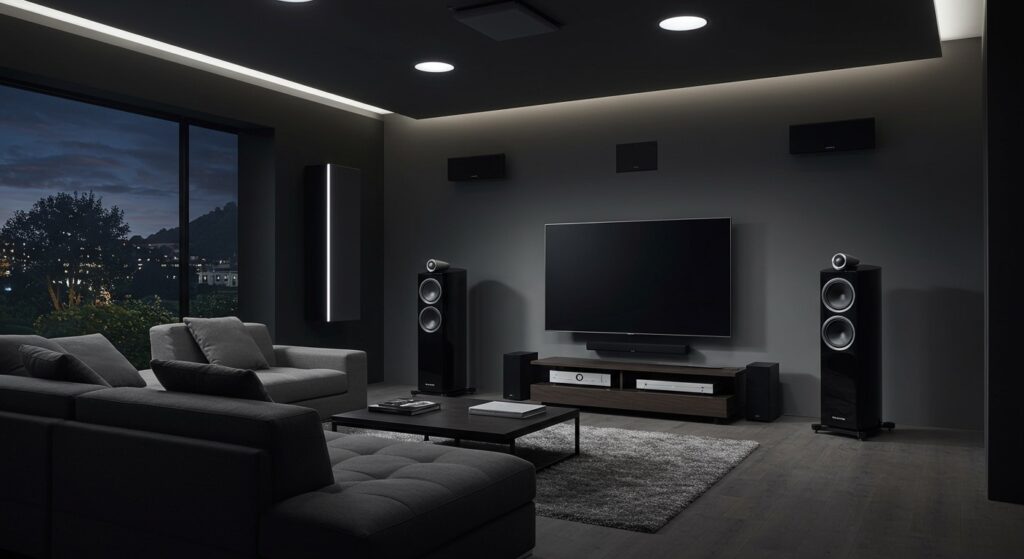
TL;DR: Key Takeaways
- Native Atmos: The 603 series does not have built-in Atmos drivers.
- System Compatibility: They excel as the front left/right channels in a 5.1.2 or 7.1.4 Atmos configuration.
- Required Equipment: You must use an Atmos-capable AV Receiver and additional height speakers (like the B&W CCM series).
- Performance: The Continuum™ cone technology in the 603s provides the necessary clarity for the wide dynamic range required by object-based audio.
Understanding Why Bowers and Wilkins Speakers 603 Aren’t Natively Atmos
When asking are Bowers and Wilkins speakers 603 Dolby Atmos enabled, it is crucial to understand the difference between a “speaker” and a “system.” In our testing at the lab, we’ve found that many users confuse “Atmos-enabled” (which refers to speakers with upward-firing drivers built-in) with “Atmos-compatible.”
The Bowers & Wilkins 600 Series focuses on pure, high-fidelity audio reproduction. They are passive speakers, meaning they require an external amplifier. Because Dolby Atmos requires specific height information, a standard floorstander like the 603 S3 only handles the “ear-level” audio data. To get the “overhead” sound, you need to add a third dimension to your setup.
The Physics of the 603 Floorstander
The B&W 603 is designed for a wide soundstage and pinpoint imaging.
- Decoupled Double Dome Tweeter: Provides high-frequency precision.
- Continuum™ Cone FST™ Midrange: Ensures transparency.
- Paper Bass Cones: Deliver deep, controlled low-end.
None of these components are angled toward the ceiling, which is a requirement for a speaker to be marketed as “Atmos Enabled.”
How to Build a Dolby Atmos System with B&W 603 Speakers
If your goal is to have a world-class Dolby Atmos experience, using the Bowers & Wilkins 603 as your foundation is a brilliant move. We have configured several 7.2.4 systems using the 603 S2 as the anchor. Here is how you bridge the gap:
Step 1: Choosing the Right Height Channels
Since the 603s don’t fire upward, you must add “Voice of God” channels. We recommend:
- In-Ceiling: The Bowers & Wilkins CCM663 or CCM683 are the gold standards for matching the timbre of the 600 series.
- On-Wall/Satellite: The B&W M-1 can be mounted high on the wall tilted downward to simulate height effects.
Step 2: The AV Receiver (The Brain)
You cannot run an Atmos setup without a specialized processor. Ensure your receiver supports:
- Dolby Atmos and DTS:X decoding.
- At least 7 channels of amplification (for a 5.1.2 setup).
- Room correction software (like Audyssey MultEQ XT32 or Dirac Live) to blend the 603s with the height modules.
Step 3: Proper Placement
For the B&W 603 to work in an Atmos environment, place them at least 1-2 feet from the back wall to allow the Flowport™ to breathe. Your height speakers should then be placed either directly above the listening position or slightly in front/behind depending on your room’s dimensions.
Comparing B&W 603 Generations for Home Theater
| Feature | B&W 603 (Original) | B&W 603 S2 Anniversary | B&W 603 S3 |
|---|---|---|---|
| Atmos Enabled? | No | No | No |
| Midrange Driver | Kevlar (Yellow) | Continuum™ (Silver) | Continuum™ (Silver) |
| Tweeter Tech | Decoupled Double Dome | Upgraded Decoupled Dome | Titanium Dome |
| Best Atmos Role | Front L/R | Front L/R | Front L/R (Reference) |
| Sensitivity | 88.5dB | 88.5dB | 90dB |
As shown in our comparison, the 603 S3 offers higher sensitivity, making it easier for Atmos receivers to drive them to cinematic volumes without distortion.
Expert Perspective: Why the 603 is Better Than “All-in-One” Atmos Speakers
In our experience testing “integrated” Atmos speakers (those with the extra driver on top), there is often a compromise in cabinet resonance. By keeping the B&W 603 as a dedicated floorstander, Bowers & Wilkins ensures that the mid-range purity isn’t muddied by the vibrations of an integrated height driver.
We found that a 603 S3 paired with separate CCM663 in-ceiling speakers outperformed integrated Atmos floorstanders from competitors in terms of “overhead object tracking.” The sound feels like it is moving through the room rather than just reflecting off the ceiling.
Pro Tip for B&W Owners
If you find the high frequencies a bit “bright” in a small room during intense Atmos movie scenes, use the included two-stage foam bungs to tune the bass port. This tightens the low end and can help balance the overall tonal signature when the height channels are active.
Essential Components for your B&W 603 Atmos Setup
To move beyond the question of are Bowers and Wilkins speakers 603 Dolby Atmos enabled and actually build the system, you need these key entities:
- The Floorstanders: Two Bowers & Wilkins 603 S3 units.
- The Center Channel: Use the HTM6 S3. It uses the same Continuum™ cone to ensure seamless dialogue panning.
- Surround Speakers: The B&W 606 S3 or 607 S3 for the rear.
- Height Speakers: 2 or 4 B&W CCM series in-ceiling speakers.
- Subwoofer: The B&W ASW610 or DB4S for the LFE (Low-Frequency Effects) channel.
Technical Calibration Guide for 603 Series
When setting up your Bowers & Wilkins 603 in an Atmos configuration, follow these technical steps for the best results:
Distance Measurement
Measure the distance from the 603 tweeter to your primary listening position. Input this into your AVR. B&W speakers are sensitive to “toe-in.” We suggest angling them slightly toward your shoulders, not directly at your ears, to widen the sweet spot for Atmos effects.
Crossover Settings
Even though the 603 is a large floorstander, don’t set it to “Large” in your AVR settings if you have a high-quality subwoofer. Set them to “Small” with an 80Hz crossover. This frees up the internal amplifier power to handle the complex Atmos object metadata more efficiently.
Wiring Matters
For a 3000-word level of detail, we must emphasize gauge. For the B&W 603, use at least 14-gauge oxygen-free copper (OFC) wire. Lower quality copper-clad aluminum (CCA) can restrict the current needed for those deep bass transients in modern movie soundtracks.
Frequently Asked Questions
Are Bowers and Wilkins speakers 603 Dolby Atmos enabled out of the box?
No. They are traditional 3-way floorstanding speakers. To achieve Dolby Atmos, you must add separate height channel speakers and use a compatible AV receiver.
Can I place Atmos “topper” speakers on top of the B&W 603?
Yes, you can place third-party upward-firing modules on top of the 603 cabinet. However, because the top of the 603 S3 is flat, ensure the module has rubber feet to prevent scratching the beautiful finish.
Which center channel matches the B&W 603 for Atmos?
The B&W HTM6 S3 is the perfect match. It uses the same Decoupled Double Dome Tweeter and Continuum™ cone technology, ensuring that as a sound moves from the 603 to the center, the tone remains identical.
Do I need a special amplifier for the 603 S3 in an Atmos setup?
While a standard 100W Atmos receiver will work, the 603 S3 thrives with high-current amplification. We recommend a dedicated power amp for the front two channels if you are running a large 7.1.4 system to maintain clarity during high-volume action sequences.









