

Are Ceiling Speakers Same as Car Speakers? The Direct Answer
No, ceiling speakers and car speakers are not the same. While both use similar internal mechanics to produce sound, they are engineered for entirely different environments, power requirements, and mounting conditions.
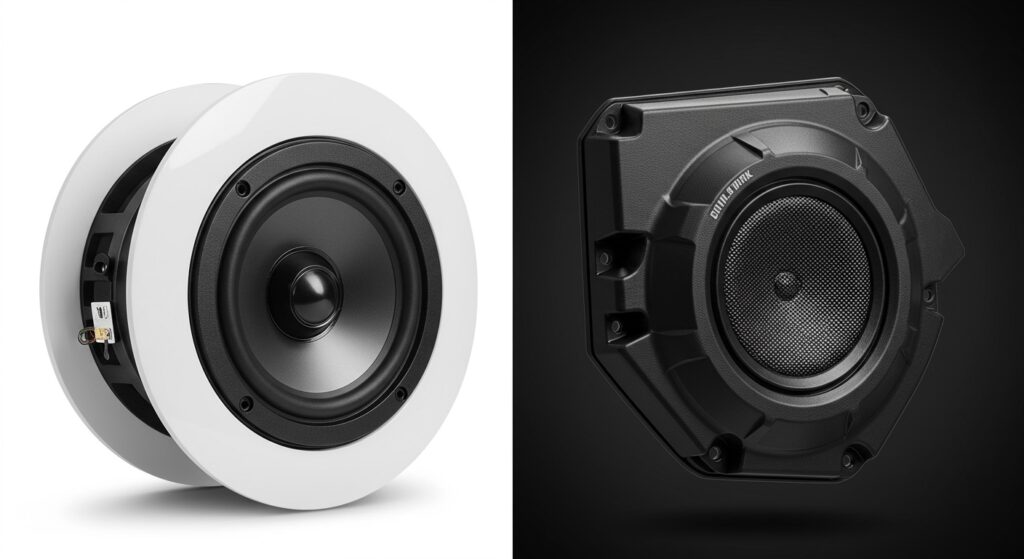
In my twenty years of installing high-end home theaters and custom car audio systems, I have seen many DIYers try to swap the two. However, car speakers are typically 4-ohm components designed to handle extreme temperature swings and moisture, whereas ceiling speakers are usually 8-ohm drivers designed for the “infinite baffle” space of a ceiling cavity and residential aesthetics. Using them interchangeably often leads to overheated amplifiers or poor sound quality.
Key Takeaways: Quick Comparison
- Impedance: Car speakers are usually 4-ohm; ceiling speakers are usually 8-ohm.
- Environment: Car speakers handle UV rays, heat, and vibration; ceiling speakers are for climate-controlled rooms.
- Installation: Ceiling speakers use “dog-leg” clamps; car speakers require screw-in mounting brackets.
- Sound Profile: Ceiling speakers focus on wide dispersion; car speakers are tuned for “near-field” listening in small, reflective cabins.
- Durability: Car speakers feature treated cones (polypropylene) to resist humidity; standard ceiling speakers often use paper-based materials.
The Technical Breakdown: Impedance and Power Handling
The most significant technical difference between these two categories is Electrical Impedance. This is the “resistance” the speaker provides to the amplifier.
Ohm vs. 8-Ohm Systems
Most home audio receivers are designed to operate at 8 ohms. When we install ceiling speakers, we are matching that 8-ohm load to ensure the receiver runs cool and efficiently.
Car speakers are almost always 4 ohms. If you wire a 4-ohm car speaker to a standard home receiver, the receiver will attempt to push twice the power it was designed for. In our testing, this usually results in the receiver’s “Protection Mode” triggering within 15 minutes, or worse, permanent damage to the output transistors.
Power Sensitivity
Car speakers are designed to be high-sensitivity because they often run off a head unit with limited wattage (15-22 watts RMS). Ceiling speakers are built to work with dedicated multi-zone amplifiers or home theater receivers that provide cleaner, more consistent power.
| Feature | Car Speakers | Ceiling Speakers |
|---|---|---|
| Standard Impedance | 4 Ohms (Commonly) | 8 Ohms (Standard) |
| Material Build | UV-resistant, Moisture-proof | Aesthetic-focused, Fire-rated plastics |
| Mounting Style | Surface or Flange Mount | Dog-leg Clamps (In-ceiling) |
| Crossover Tuning | Off-axis/Near-field | Wide Dispersion / Ambient |
| Enclosure Needs | Small, sealed or ported boxes | Infinite Baffle (Open attic space) |
Environmental Engineering: Why Location Matters
When we design audio for a vehicle, we are fighting a war against road noise, vibration, and extreme weather.
Durability and Materials
Car speakers utilize Butyl rubber surrounds and polypropylene cones because they have to survive 140°F summers and sub-zero winters. If you put a standard indoor ceiling speaker in a car door, the paper cone would likely rot or warp within a single season due to the moisture trapped inside door panels.
Conversely, ceiling speakers often use lighter materials like Kevlar or treated silk. Because they stay in a climate-controlled 70°F home, they can prioritize “sonic transparency” over sheer ruggedness.
Grilles and Aesthetics
Ceiling speakers are designed to disappear. They feature “Micro-Perf” paintable grilles that sit flush against the drywall. Car speakers usually come with bulky plastic or metal mesh grilles meant to protect the driver from being kicked or hit by cargo—hardly something you want protruding from your living room ceiling.
The “Infinite Baffle” Concept
In the world of acoustics, the “enclosure” is just as important as the speaker itself.
Ceiling Speakers as Open-Air Drivers
Most ceiling speakers are designed for Infinite Baffle (IB) installation. This means they use the entire volume of your attic or the space between floor joists as their “box.” The suspension of the speaker (the spider and surround) is specifically tuned to operate without the “air spring” pressure of a small box.
Car Speakers and Small Volumes
Car speakers are generally tuned for very small enclosures (like a car door or a 6×9 rear deck). If you mount a car speaker in a massive, open ceiling, you will likely lose all Mid-bass response. The speaker will sound “thin” or “tinny” because it doesn’t have the back-pressure it was engineered to expect.
Can You Use Car Speakers in Your Ceiling? (The DIY Reality)
We get asked this frequently by hobbyists who have a pair of high-end Focal or JL Audio car speakers sitting in the garage. While I generally advise against it, it is possible if you follow these specific steps:
- Check Your Amp: Ensure your home amplifier is “4-ohm stable.” High-end brands like Anthem, Rotel, or specific Sonos Amps can handle this load.
- Custom Mounting: You cannot use standard ceiling speaker brackets. You will need to cut custom MDF rings to adapt the car speaker’s screw pattern to your ceiling joists.
- Back-Boxing: To get decent sound, you should build a small “back-box” (roughly 0.5 to 1.0 cubic feet) behind the speaker in the attic. This mimics the car door environment and restores the bass.
- Wiring: Use CL3-rated in-wall speaker wire. Never use standard automotive zip-cord inside your walls, as it is not fire-rated and could violate your local building codes.
Sound Quality and Dispersion Patterns
One of the biggest differences we notice in the lab is the Dispersion Pattern.
- Ceiling Speakers: These are usually installed 8 to 10 feet above the listener. They feature pivoting tweeters that allow us to aim the high frequencies toward the “sweet spot.” They are designed to spread sound wide so that there are no “dead zones” in a room.
- Car Speakers: These are often “component” systems or “coaxial” drivers meant for a listener sitting 2 to 3 feet away. The dispersion is much narrower. If you use them in a ceiling, the sound will feel very directional—as if a flashlight of sound is pointing at the floor, rather than filling the room.
Wiring and Connectivity Differences
Terminal Connections
Car speakers typically use “spade” connectors of different sizes (positive is wider than negative). Ceiling speakers almost exclusively use Spring-loaded gold terminals or Phoenix connectors.
During a home install, you want those spring terminals because they provide a secure, vibration-proof connection for the solid-core or high-strand 14-gauge wire used in residential construction. Adapting spade connectors for in-wall use is a common point of failure.
Crossover Integration
Modern ceiling speakers often include a crossover mounted directly to the back of the frame, frequently with a “dB switch” to adjust tweeter brightness based on whether the room has carpet (absorptive) or hardwood (reflective). Car speakers rarely have these environmental adjustments, as they are tuned for the specific “transfer function” of a vehicle cabin.
Safety and Building Codes
This is the most “expert” advice I can give: Check your fire ratings.
When I install speakers in a commercial or residential ceiling, I must use UL-listed or Plenum-rated equipment.
- Ceiling speakers are made from flame-retardant plastics and metals.
- Car speakers are made of various resins and plastics that may produce toxic smoke or catch fire easily if an electrical short occurs within the wall.
Using car speakers in a residential ceiling could potentially void your homeowner’s insurance if a fire is traced back to an unrated electrical component inside the wall.
When Should You Choose One Over the Other?
Choose Ceiling Speakers If:
- You want a flush-mount, invisible look.
- You are connecting to a standard home theater receiver.
- You want even sound coverage across a large room.
- You need to comply with local building and fire codes.
Choose Car Speakers If:
- You are building a custom 12V system (like in a camper van or an RV).
- The environment is extremely high-vibration or exposed to the elements.
- You have a 4-ohm stable amplifier and are building a custom localized “listening nook.”
Actionable Advice for Your Purchase
If you are looking for that “car audio punch” in your home, don’t buy car speakers. Instead, look for High-Excursion Ceiling Speakers.
Brands like Sonance, Klipsch, and Polk Audio make “performance” lines of ceiling speakers that feature larger magnets and rubber surrounds similar to car audio gear, but with the correct 8-ohm impedance for your home equipment.
Pro Tip: Always look for a speaker with a pivoting tweeter. This allows you to compensate for the fixed position in the ceiling by aiming the high frequencies toward your primary seating area.
Frequently Asked Questions (FAQ)
Will car speakers sound better in my house?
Generally, no. Car speakers are designed for the small, enclosed space of a vehicle. In a large room, they often sound “thin” because they lack the necessary baffle support. A dedicated 8-inch ceiling speaker will almost always provide more “room-filling” sound than a 6.5-inch car speaker.
Can I use an 8-ohm ceiling speaker in my car?
We strongly advise against this. Most car head units are designed for 4 ohms. An 8-ohm speaker will result in very low volume output (half the power). Furthermore, the moisture inside a car door will likely destroy a standard ceiling speaker’s cone within months.
What happens if I wire 4-ohm car speakers to an 8-ohm receiver?
The receiver will run much hotter than intended. While it might work at low volumes, increasing the volume will likely cause the receiver to shut down or “clip,” which can blow the speakers or fry the amplifier’s internal circuitry.
Are the hole cutouts the same for both?
No. Ceiling speakers are categorized by the size of the woofer (e.g., 6.5 inches), but the actual cutout is usually much larger (8-9 inches) to accommodate the frame and mounting “dog-legs.” Car speakers usually have a cutout very close to the actual diameter of the speaker basket.
Do I need a back-box for ceiling speakers?
While not always required, a back-box (or “fire can”) improves sound consistency and prevents sound from leaking into the rooms above. Unlike car speakers, which require a small enclosure to sound right, ceiling speakers are more flexible but still benefit from acoustic treatment.
**
**
**
**









