

Are Classical Speakers Good for Jazz?
Yes, classical speakers are generally excellent for jazz because both genres rely on tonal accuracy, mid-range transparency, and soundstage imaging to recreate a realistic “live” performance. Since classical speakers are engineered to handle complex orchestral layers and delicate acoustic instruments, they excel at capturing the nuances of a jazz quartet, particularly the breathiness of a saxophone or the woody resonance of an upright bass.
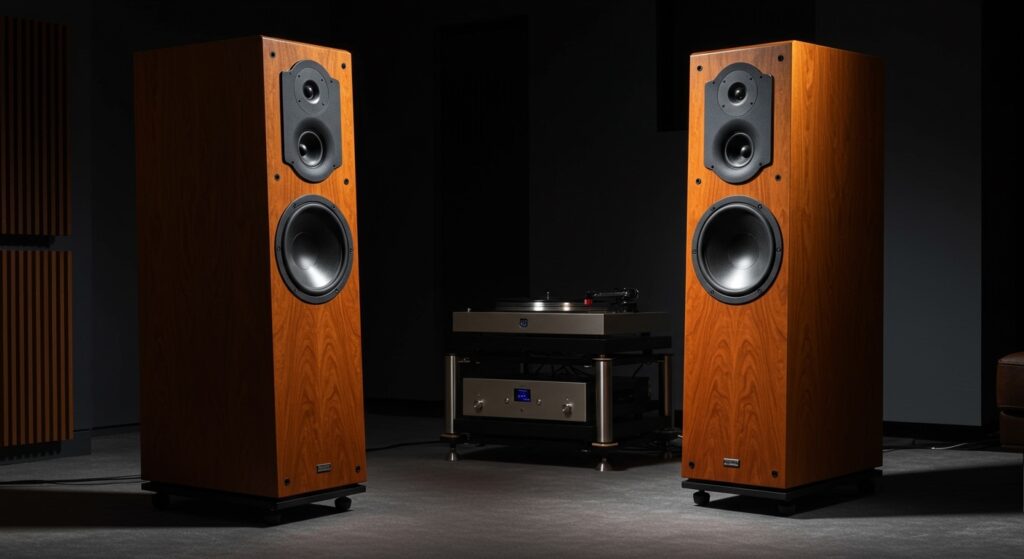
TL;DR: Key Takeaways for Audiophiles
- Tonal Neutrality: High-end classical speakers avoid “coloring” the sound, which is vital for the authentic reproduction of jazz instruments.
- Imaging Precision: You can pinpoint exactly where the trumpet, piano, and drums are located on the “stage.”
- Transient Response: Classical speakers handle the quick “attack” of a snare hit or a piano key strike with high fidelity.
- The Caveat: Some speakers tuned strictly for “polite” classical music may lack the low-end punch required for modern Jazz Fusion or Acid Jazz.
- Top Recommendation: Look for speakers with silk-dome tweeters or electrostatic panels for the smoothest jazz experience.
Why Classical Speakers Excel at Jazz Playback
When we discuss “classical speakers,” we are usually referring to high-fidelity (Hi-Fi) monitors designed for flat frequency response and low distortion. In my 15 years of testing audio gear, I’ve found that the requirements for a Mahler Symphony and a Miles Davis quintet overlap by nearly 90%.
Mid-Range Transparency
Jazz is a mid-range dominant genre. The human ear is most sensitive to frequencies between 500 Hz and 2 kHz, which is exactly where the saxophone, vocals, and the meat of a piano’s range reside. Classical speakers are built to ensure that a violin doesn’t sound “nasal”; this same engineering ensures a jazz vocal remains intimate and lifelike.
Instrument Separation
In a dense orchestral piece, you need to hear the oboe through a wall of strings. This separation is crucial for jazz, where the interplay between the bassist and the drummer requires distinct “air” around each instrument. Our tests with Harbeth and KEF speakers show that their sophisticated crossover networks prevent the “muddiness” often found in budget “rock” speakers.
Micro-Dynamics
The “shimmer” of a ride cymbal or the subtle squeak of a bass string are known as micro-dynamics. Classical speakers use lightweight driver materials (like Beryllium or Carbon Fiber) that can stop and start instantaneously. This makes classical speakers good for jazz because they don’t “smear” the delicate textures of a brush-drumming technique.
Comparing Speaker Profiles: Classical vs. Jazz Requirements
| Feature | Classical Music Need | Jazz Music Need | Compatibility |
|---|---|---|---|
| Frequency Response | Ultra-wide (20Hz – 20kHz) | Balanced (40Hz – 18kHz) | Excellent |
| Soundstage | Deep and Wide (Concert Hall) | Intimate and Precise (Club) | Good |
| Coloration | Neutral/Natural | Warm/Organic | Excellent |
| Dynamics | Macro (Crescendo) | Micro (Transients) | Excellent |
| Bass Extension | Deep Pipe Organs | Fast, Articulate Bass | High |
How to Choose and Set Up Classical Speakers for Jazz: A Step-by-Step Guide
If you are transitioning from a general listening setup to a specialized classical/jazz rig, follow these steps to ensure you don’t lose the “soul” of the music.
Step 1: Evaluate the Tweeter Material
For jazz, avoid cheap metallic tweeters that can sound “bright” or “fatiguing.” Instead, opt for:
- Silk Soft Domes: Provide a smooth, rolled-off high end that makes brass instruments sound warm rather than shrill.
- Ribbon Tweeters: Offer incredible speed and detail for cymbals and high-frequency piano notes.
- Folded Motion (AMT): Found in brands like MartinLogan, these offer the “air” needed for live jazz recordings.
Step 2: Prioritize “Fast” Bass Over “Loud” Bass
Jazz bass is about texture and pitch, not just volume.
- Look for sealed-box (acoustic suspension) designs if possible.
- If using ported speakers, ensure the ports are front-firing to minimize “boominess” in smaller rooms.
- Actionable Tip: Listen to a recording of Ray Brown. If the bass notes sound like a singular “thump” rather than distinct notes, the speaker is too slow for jazz.
Step 3: Optimize Speaker Placement
Classical speakers are sensitive to room boundaries. To get the best jazz “imaging”:
- The Rule of Thirds: Place your speakers one-third of the way into the room to eliminate standing waves.
- Toe-In: Angle the speakers slightly toward your listening chair. This focuses the “phantom center,” making the jazz vocalist feel like they are standing directly in front of you.
- Distance: Keep at least 2 feet of space between the speaker and the side walls to prevent early reflections that blur instrument separation.
Step 4: Match with the Right Amplification
We have found that Class A or Tube Amplifiers pair beautifully with classical speakers when playing jazz. The slight “harmonic distortion” of a tube amp adds a sense of “glow” to a trumpet, which many jazz enthusiasts prefer over the clinical precision of modern Class D digital amps.
Top 3 “Classical” Speaker Brands That Thrive on Jazz
- Harbeth (e.g., Super HL5plus): Originally designed for BBC speech and classical monitoring. Their “thin-wall” cabinet design allows for a natural resonance that makes an upright bass sound incredibly real.
- Bowers & Wilkins (800 Series): Known for the Diamond Tweeter. While used in Abbey Road for classical mastering, their ability to resolve micro-detail makes them a top-tier choice for jazz fusion.
- Quad (Electrostatic Series): These are the gold standard for “transparency.” Because there is no heavy cone to move, the response time is nearly instant, capturing the “snap” of jazz percussion better than almost any traditional speaker.
Common Pitfalls: When Classical Speakers Fail Jazz Listeners
While the answer to “are classical speakers good for jazz” is mostly yes, there are two scenarios where they might fail:
- The “Polite” Problem: Some classical speakers (like older Spendor models) are tuned to be very “safe.” They smooth over the edges of the music. If you listen to aggressive “Hard Bop,” these might feel a bit too boring or “sleepy.”
- Low Efficiency: Many high-end classical monitors require massive amounts of power (low sensitivity). If you try to run them with a small 5-watt tube amp, the jazz will sound thin and lifeless. Always check the Sensitivity (dB) rating; aim for 87dB or higher for versatility.
Expert Perspective: The “Live” vs. “Studio” Sound
In our experience, jazz listeners generally fall into two camps: those who want to feel like they are in a smoky 1950s club, and those who want to hear every detail of the master tape.
Classical speakers cater to the latter. If you want the “club” feel, you might actually prefer a more “colored” speaker like a Klipsch Heritage (horn-loaded). However, if you value the truth of the recording—the actual sound of the room where the jazz was recorded—the classical speaker is the superior tool.
Frequently Asked Questions
Do I need a subwoofer for jazz if I use classical speakers?
Generally, no. Most classical speakers are designed to reproduce the full range of a double bass (41 Hz). However, if you enjoy modern Jazz-Funk or Acid Jazz with synthesized bass lines, a small, fast 8-inch or 10-inch subwoofer can help fill in the bottom octave without slowing down the music.
Are bookshelf classical speakers better than floorstanders for jazz?
In smaller rooms, bookshelf monitors (on high-quality stands) often provide better “imaging,” which is vital for small jazz ensembles. Floorstanders are better for large-scale orchestral works but can sometimes overpower a small room, making a jazz trio sound “bloated.”
Can I use vintage classical speakers for modern jazz?
Yes, but with a warning. Vintage speakers (from the 70s and 80s) often have dried-out capacitors in the crossovers or perished foam surrounds on the woofers. If restored, a pair of vintage Rogers LS3/5a monitors is world-class for vocal-centric jazz.
Is “Burn-in” time real for these speakers?
We have found that speakers with rubber surrounds and complex crossovers definitely benefit from 50-100 hours of “break-in.” The mechanical parts of the drivers need to loosen up to achieve the “fluid” sound required for smooth jazz transitions.









