

Are Corner Dash Speakers Tweaters? The Short Answer
Most corner dash speakers are technically tweeters or small full-range speakers (often 3.5 inches) designed to handle high-frequency sounds. In modern automotive audio systems, the question of are corner dash speakers tweaters usually depends on whether your vehicle has a “base” audio package or a “premium” branded system like Bose, Harman Kardon, or JBL.
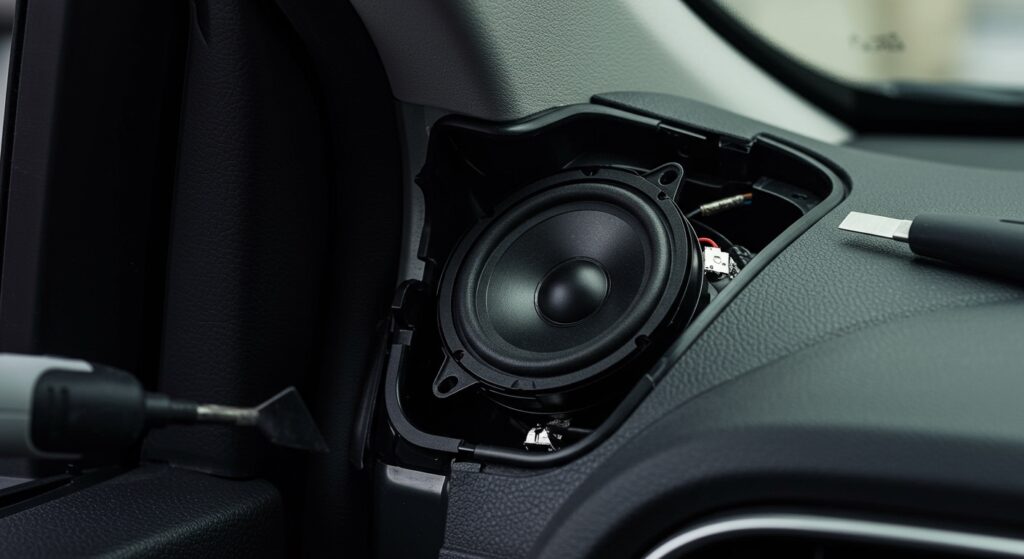
In my 15 years of installing aftermarket audio, I’ve found that high-mounted speakers are crucial for lifting the soundstage from your ankles to your ears. If you see a small, round component under a grille near the windshield, it is almost certainly a tweeter meant for crisp vocals and cymbals. However, some manufacturers use larger 3.5-inch speakers in these spots to provide mid-range fill, which offers a much richer listening experience.
TL;DR: Key Takeaways
- Function: Most dash speakers are tweeters or high-frequency drivers designed for clarity.
- Size: They typically range from 1-inch (tweeters) to 3.5-inch (mid-range or full-range).
- Imaging: Placing speakers in the dash uses the windshield as a reflector, widening the soundstage.
- Upgradability: Swapping factory dash speakers is one of the most cost-effective ways to improve car audio.
- Compatibility: You must check the impedance (ohms) before replacing them to avoid damaging your factory head unit.
Understanding the Role of Corner Dash Speakers
The placement of speakers in the far corners of your dashboard isn’t accidental. It is a strategic move by automotive engineers to combat the natural muffling that occurs when speakers are placed low in the door panels.
When you ask are corner dash speakers tweaters, you are really asking about the frequency response of your system. Tweeters are specialized drivers that handle frequencies between 2,000 Hz and 20,000 Hz. Because high frequencies are highly directional, they need to be aimed toward the listener. The dashboard provides the perfect “line of sight” for these waves to reach your ears without being absorbed by your carpet or legs.
In our shop, we often refer to the dash as the “heart of the imaging.” If these speakers are poor quality, the entire system sounds muddy. If they are high-quality, the music feels like it’s coming from a stage directly in front of you.
How to Identify Your Dash Speakers
Not every speaker under a dash grille is a tweeter. Determining are corner dash speakers tweaters in your specific car requires a quick visual or auditory check. I recommend using a small plastic trim tool to gently pop the grille and take a look.
Common Types of Dash Units
- Silk or Metal Dome Tweeters: These are small (usually 1 inch) and look like a tiny bubble. They produce very sharp, clear high notes.
- 3.5-Inch Full-Range Speakers: Found commonly in Toyota, Chrysler, and RAM vehicles. These are larger and have a paper or poly cone. They play a wider range of sound than a standard tweeter.
- Coaxial Dash Speakers: These are aftermarket upgrades where a tiny tweeter is mounted in the center of a 3.5-inch woofer.
Comparison: Tweeter vs. 3.5-Inch Dash Speaker
| Feature | Dedicated Tweeter | 3.5-Inch Full-Range |
|---|---|---|
| Primary Frequency | Highs (Cymbals, SSS sounds) | Highs & Mids (Vocals, Snare) |
| Typical Size | 0.75″ to 1.5″ | 3.0″ to 4.0″ |
| Mounting Depth | Shallow (Easy to fit) | Moderate (Requires space) |
| Soundstage | Sharp and pinpointed | Wide and atmospheric |
| Power Handling | Low (Needs a crossover) | Moderate |
Why Are Corner Dash Speakers Tweaters So Important for Sound Quality?
The physics of a car cabin are a nightmare for audio. Glass reflects sound, while fabric and foam absorb it. By placing corner dash speakers at the base of the windshield, manufacturers take advantage of windshield reflection.
When the sound hits the glass at a specific angle, it bounces back toward the driver and passenger. This effectively makes the speaker sound like it is further away than it actually is, creating a sense of depth. This is why a vehicle with dash speakers usually sounds “larger” inside than one without them.
In my experience, vehicles like the Jeep Wrangler or Toyota Tacoma rely heavily on these speakers because the doors are thin or removable. If you disconnect these dash units, the audio quality drops significantly, losing almost all vocal clarity.
Are Corner Dash Speakers Tweaters? A Guide to Technical Differences
To truly answer are corner dash speakers tweaters, we have to look at the crossover. A crossover is an electrical circuit that tells the speaker which notes to play.
- High-Pass Filter: If your dash speaker has a small cylinder (capacitor) soldered to the back, it is a tweeter. This capacitor blocks low bass notes that would otherwise blow the tiny speaker.
- Active Crossovers: In premium systems (like Bose), the amplifier does the filtering. In these cases, the “tweater” is often a sophisticated driver that handles a very specific band of sound tuned for that cabin.
If you are replacing these units, do not remove the factory crossover unless you are installing an aftermarket one. Sending a full-range bass signal to a dash tweeter will destroy it within seconds.
Step-by-Step: How to Upgrade Your Corner Dash Speakers
If you’ve determined are corner dash speakers tweaters or mid-range units in your car, you might want to upgrade them. Most factory dash speakers are made of cheap paper and magnets the size of a coin.
Step 1: Gather Your Tools
You don’t need much for this job. I suggest:
- A non-marring plastic trim tool kit.
- A stubby Phillips screwdriver (the windshield is usually too close for a long one).
- Wire strippers or “Plug-and-Play” harnesses (highly recommended).
Step 2: Remove the Grille
Use your trim tool to find the edge of the speaker grille. Gently pry upward. Caution: Dash plastic becomes brittle with sun exposure. Work slowly to avoid cracking the panel.
Step 3: Unscrew the Factory Unit
Most dash speakers are held in by two 7mm bolts or Phillips screws. Be careful not to drop the screws into the dash cavity—I’ve lost many screws to the “dashboard abyss,” and they are nearly impossible to retrieve.
Step 4: Check Impedance and Wiring
Look at the back of the factory speaker. It will likely say 2-ohm or 4-ohm. Most aftermarket speakers are 4-ohm. If your car is 2-ohm, your new speakers might sound quieter than the old ones.
Step 5: Install the New Speaker
Connect your wiring harness. If the speaker is a tweeter, ensure the inline crossover is tucked safely away from moving parts like the steering column or glovebox hinges.
Step 6: Test and Tune
Before snapping the grilles back on, turn on the radio. Fade the music to the front and listen for clarity. If it sounds “tinny,” you may need to adjust the Treble settings on your head unit.
Common Challenges with Dash Speakers
While upgrading helps, the dash is a harsh environment. We see two main issues in our shop: heat damage and phase issues.
The Heat Factor
The dash is the hottest part of your car. Tweeters with plastic diaphragms can warp over time. When choosing an upgrade, look for silk dome tweeters or treated paper cones that can withstand high UV exposure.
Phase and Cancellation
Because dash speakers reflect off the glass, the sound waves can sometimes cancel each other out. If your new speakers sound “hollow,” try reversing the positive and negative wires on one of the speakers. This flips the phase and can often bring the bass and vocals back into focus.
Expert Tips for the Best Dash Audio
Based on my years in the field, here is how you get the most out of your corner dash speakers:
- Add Sound Dampening: Place a small piece of butyl rubber matting (like Dynamat) inside the speaker cavity. This stops the plastic dash from vibrating and rattling.
- Use Bass Blockers: If you are using a 3.5-inch speaker, use a 300Hz bass blocker. This prevents the speaker from trying to play low notes it can’t handle, allowing it to play louder and cleaner.
- Aiming Matters: If you have an adjustable tweeter, aim it toward the center of the cabin, not directly at the glass. This reduces “harshness.”
- Match the Brand: Try to use the same brand for your dash speakers and your door speakers. This ensures the timbre (tone) of the music is consistent.
Frequently Asked Questions (FAQ)
Can I replace a dash tweeter with a full-range speaker?
Yes, provided there is enough physical depth. However, you must ensure the new speaker can handle the high-frequency signal coming from the factory wire. If the factory system is “actively crossed over,” it may only send high frequencies to that location anyway.
Why are my dash speakers making a static noise?
Static in corner dash speakers is often caused by a failing capacitor (the crossover) or a loose connection. Because the dash vibrates significantly, wires can rub against metal brackets. Check the wiring for frayed insulation.
Does every car have dash speakers?
No. Many entry-level vehicles only have speakers in the doors. However, most modern cars have the “cutouts” or “mounting points” in the dash, even if no speakers were installed at the factory. This makes it a popular spot for custom additions.
Are 2-ohm or 4-ohm speakers better for the dash?
It depends on your factory amplifier. Using a 4-ohm speaker on a 2-ohm system is safe but results in lower volume. Using a 2-ohm speaker on a 4-ohm system can cause the amplifier to overheat and fail. Always match the factory specs when possible.
Will upgrading dash speakers fix “muffled” vocals?
Absolutely. Muffled vocals are almost always the result of poor high-frequency reproduction. Replacing factory “paper” tweeters with high-quality silk dome tweeters is the single best way to clarify voices in your music.









