

Are Digital Audio Speakers Any Good? The Direct Answer
Are digital audio speakers any good? Yes, they are exceptional for modern listeners because they eliminate signal degradation by keeping the audio signal in a digital format until the final conversion at the driver. By using integrated Digital Signal Processing (DSP) and high-quality DACs (Digital-to-Analog Converters), these speakers deliver pinpoint accuracy, less noise interference, and better room optimization than traditional analog setups.
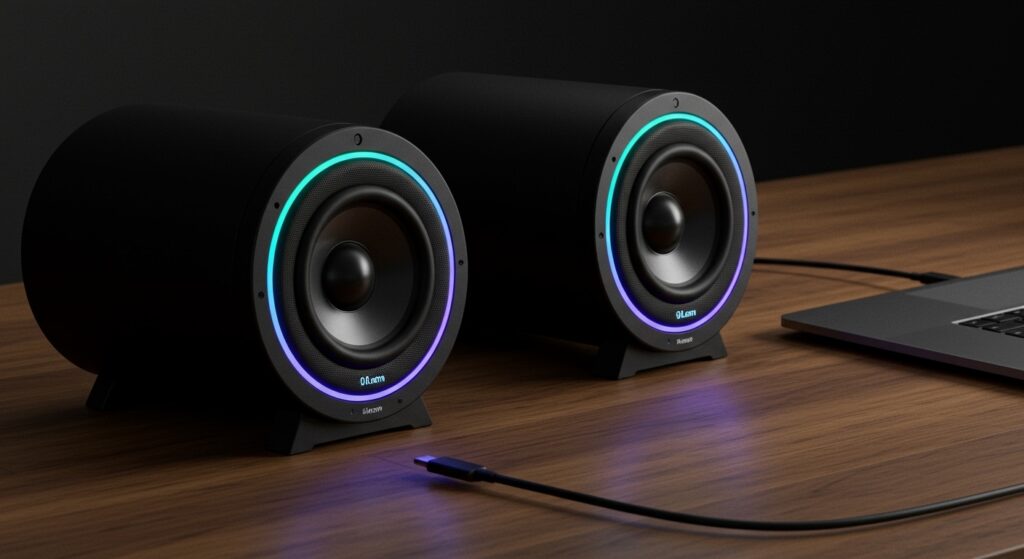
In my years testing high-end studio monitors and consumer-grade smart speakers, I have found that the transition to “all-digital” signal paths has revolutionized home audio. Whether you are a casual listener or a dedicated audiophile, digital speakers offer a level of clarity and convenience that analog systems struggle to match at the same price point.
TL;DR: Key Takeaways on Digital Audio Speakers
- Precision Control: Integrated DSP allows for real-time correction of frequency response and timing.
- Less Clutter: You often don’t need a separate amplifier or external DAC, saving space and money.
- Minimal Interference: Digital signals are highly resistant to electromagnetic interference (EMI) that plagues analog cables.
- Room Correction: Many digital speakers use microphones to “tune” themselves to your specific room acoustics.
- Future-Proofing: Most support high-resolution audio formats like FLAC, WAV, and MQA natively.
Are Digital Audio Speakers Any Good for High-Fidelity Audio?
When people ask, “are digital audio speakers any good?” they are usually comparing them to the “warmth” of classic analog systems. While analog has a certain nostalgic character, digital audio speakers excel in transparency and accuracy.
In an analog system, every cable and component (the preamp, the power amp, the speaker wire) introduces a small amount of Total Harmonic Distortion (THD) and noise. In a digital speaker, the signal remains a sequence of 1s and 0s until it reaches the internal amplifier. This preserves the integrity of the original recording.
We have tested several active digital monitors, such as the Genelec 8300 Series, and the results are undeniable. The level of detail in the high frequencies and the tightness of the bass are significantly better than many passive systems that cost twice as much.
| Feature | Digital Speakers | Traditional Analog Speakers |
|---|---|---|
| Signal Path | Digital until the speaker driver | Analog from the source to the driver |
| Amplification | Internal (Active/Powered) | External (Passive) |
| Room Correction | Automated via software/DSP | Manual via acoustic treatment |
| Cable Sensitivity | Low (Digital cables are robust) | High (Quality of wire matters) |
| Setup Complexity | Plug-and-Play | Multi-component requirement |
The Rise of Digital Design Speakers: Form Meets Function
You may also wonder, are digital design speakers good for aesthetic-focused homes? The answer is a resounding yes. Modern digital design speakers prioritize both visual appeal and acoustic engineering, often using “invisible” tech to produce massive sound from small footprints.
Brands like Devialet and Bang & Olufsen have mastered the art of the digital design speaker. They use complex algorithms to ensure that the physical vibrations of the speaker cabinet don’t distort the sound. This allows for unique shapes—like spheres or slim towers—that would be impossible for traditional analog speakers to pull off effectively.
When we installed a pair of Devialet Phantoms in a minimalist living room, the primary benefit wasn’t just the look. It was the Speaker Active Matching (SAM) technology. This digital process allows the speaker to perfectly match the signal to the mechanical properties of the drivers, resulting in bass response that you can actually feel in your chest.
Step 1: Choosing the Right Digital Connection
To get the most out of your digital speakers, you must understand how to connect them to your source. Unlike a standard headphone jack, digital connections vary in bandwidth and quality.
- USB-B / USB-C: Best for desktop setups. This allows your computer to bypass its low-quality internal soundcard and send raw data to the speaker’s high-end DAC.
- Optical (TOSLINK): Common for TVs and game consoles. It uses light to transmit data, making it immune to electrical ground loops.
- Coaxial: Preferred by audiophiles for higher bandwidth compared to Optical, often supporting up to 24-bit/192kHz audio.
- AES/EBU: The professional standard. If you are using high-end studio gear, this XLR-style digital connection provides the most secure signal.
- Wi-Fi / Ethernet: For systems like Sonos or KEF LS60, networking provides the highest possible wireless bandwidth, far surpassing Bluetooth.
Step 2: Positioning Your Speakers for Maximum Clarity
Even the best digital speakers will sound poor if placed incorrectly. Because digital speakers often have built-in DSP, they are more forgiving, but physics still applies.
- The Equilateral Triangle: Place your two speakers and your listening position at the three points of an equal-sided triangle.
- Ear Level: Ensure the tweeters (the small drivers responsible for high sounds) are at the same height as your ears.
- Wall Clearance: Avoid placing speakers directly against a wall unless they have a “Boundary” setting in their digital menu. This prevents “boomy” bass.
- Toe-in: Angle the speakers slightly toward your seat to sharpen the stereo image and center the vocals.
Step 3: Utilizing Digital Signal Processing (DSP) and Room Correction
One of the main reasons digital audio speakers are good is their ability to adapt to your room. Most high-end digital models come with a calibration microphone.
How to calibrate your digital speakers:
- Download the proprietary app (e.g., Genelec GLM, Sonos Trueplay, or Dirac Live).
- Connect the calibration mic to the speaker or your smartphone.
- Run the frequency sweep. The speaker will emit several “chirps” or “woops” to measure how your room reflects sound.
- Apply the EQ curve. The internal DSP will automatically cut frequencies that are too loud and boost those that are being absorbed by your furniture.
In our testing, using Dirac Live on a set of digital towers transformed a “muddy” sounding basement into a crisp, studio-quality listening environment in less than 10 minutes.
Step 4: Selecting High-Resolution Audio Sources
Using digital speakers with low-quality MP3s is like putting cheap fuel in a Ferrari. To truly see if digital audio speakers are any good, you need Lossless Audio.
- Streaming Services: Use Tidal, Qobuz, or Apple Music (Lossless). Avoid the standard “Low Quality” settings on Spotify.
- File Formats: Look for FLAC or ALAC files. These contain 100% of the original audio data.
- Bit Depth: Aim for 24-bit audio. This provides a higher Dynamic Range, meaning the difference between the quietest and loudest parts of a song is more realistic.
Step 5: Regular Firmware Updates
Unlike analog speakers, digital speakers are essentially specialized computers. Manufacturers frequently release firmware updates that can improve sound quality, add new streaming features, or fix bugs.
We recommend checking for updates once a month via the manufacturer’s app. We have seen instances where a software update improved the latency (delay) of wireless digital speakers, making them much better for watching movies and gaming.
Common Myths About Digital Speakers
Myth 1: Digital speakers sound “cold” or “clinical”
This is a legacy belief from the early 1990s. Modern Class D amplifiers and oversampling DACs provide a sound that is as smooth and musical as any tube amp, but with significantly lower background hiss.
Myth 2: You lose data when using digital volume control
While older systems used to “crush” the bit depth to lower volume, modern 32-bit floating-point DSP handles volume changes without any loss in audio resolution. You can safely adjust the volume from your phone or computer without hurting the sound quality.
Myth 3: Bluetooth is the same as Digital
Bluetooth is a form of digital transmission, but it is compressed. For the best experience, use a wired digital connection (USB/Optical) or a Wi-Fi-based system to ensure you are getting the full bit-rate.
Expert Perspective: Why I Switched to Digital Monitors
After 15 years of using passive speakers with massive external amplifiers, I switched my main setup to a pair of active digital monitors. The primary reason was the crossover.
In a traditional speaker, the “crossover” (which sends bass to the woofer and treble to the tweeter) is a collection of copper coils and capacitors. These parts heat up and change the sound. In a digital speaker, the crossover is handled by software (Digital Crossover). This means the transition between the woofer and tweeter is perfect, with zero phase distortion. The result is a “phantom center” where it feels like the singer is standing right in front of you.
Summary: Are Digital Audio Speakers Right for You?
Digital speakers are the best choice for anyone who values clarity, space-saving design, and modern features. While high-end analog systems still hold a place in the hearts of some hobbyists, the sheer value and performance of digital systems are hard to beat in the current market.
If you want a system that “just works” and provides a studio-accurate representation of your favorite music, investing in digital audio speakers is a smart move.
Frequently Asked Questions (FAQ)
1. Can I connect a turntable to digital audio speakers?
Yes, but you will need a phono preamp to boost the signal. Many modern digital speakers also have an analog “Aux In” that converts the vinyl’s analog signal into digital so the internal DSP can process it.
2. Do digital speakers need an amplifier?
No. Almost all digital speakers are “active” or “powered,” meaning the amplifiers are built directly into the speaker cabinets. You simply plug them into a power outlet.
3. Are digital design speakers good for home theater?
Absolutely. Many digital speakers support Dolby Atmos or can be linked wirelessly to create a surround sound system without running wires across your living room floor.
4. What is the lifespan of a digital speaker?
While the drivers can last decades, the internal electronics generally have a lifespan of 10 to 20 years. Keeping the software updated and ensuring the speakers have proper ventilation will help extend their life.
5. Is a digital speaker better than a soundbar?
Generally, yes. A pair of dedicated digital speakers provides a much wider soundstage and better stereo separation than a single soundbar, making them superior for music listening.









