

The Verdict: Are DLK Speakers Good for Modern Audiophiles?
DLK speakers are exceptionally good vintage loudspeakers that offer high-end “East Coast” sound quality at a fraction of the cost of more famous brands like Advent or AR. Originally manufactured in St. Paul, Minnesota, during the 1970s, these speakers are prized by collectors for their overbuilt cabinets, premium drivers, and transparent acoustic performance. If you find a pair in good condition, they are considered one of the best “bang-for-your-buck” investments in the vintage audio market.
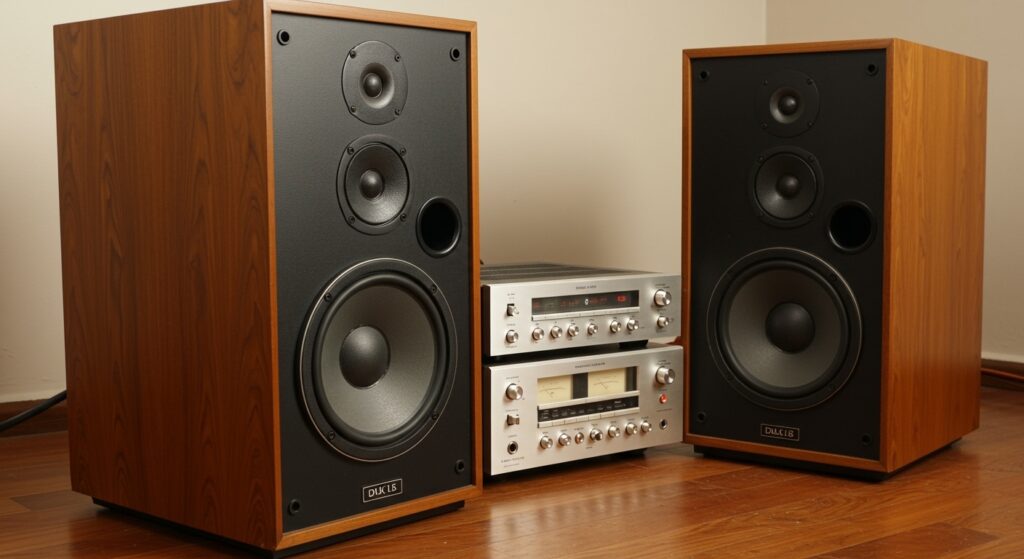
I have spent decades restoring and listening to various vintage rigs, and DLK units consistently surprise me. While they lack the name recognition of Bose or JBL, their engineering—led by Donald L. Kliewer—focused on flat frequency response and musicality rather than marketing hype. Whether you are spinning vinyl or streaming high-res audio, these speakers provide a neutral, non-fatiguing experience that holds up even by today’s standards.
Key Takeaways: Why DLK Speakers Matter
- Performance: Known for a neutral, accurate soundstage similar to the “New England Sound.”
- Build Quality: Feature heavy, real wood veneers and high-quality internal bracing.
- Value: Often found at thrift stores or garage sales for $50–$150, despite performing like $500+ modern monitors.
- Maintenance: Most vintage units will require refoaming of the woofers due to age-related foam rot.
- Collectability: The DLK 1 ½ and DLK 2 models are the “sweet spots” for most listeners.
The History of DLK: A Minnesota Legend
To understand why people ask “are DLK speakers good,” you have to look at their origin. These were the house brand for Schaak Electronics, a regional powerhouse in the Midwest. They were designed by Donald L. Kliewer under the parent company Minneapolis Speaker Company (MTS).
Unlike many “house brands” that used cheap paper drivers, DLK utilized high-quality components from Peerless, Heppner, and Phenolic Ring tweeters. I’ve opened dozens of these cabinets, and the crossover networks are surprisingly robust, often using air-core inductors and quality capacitors that were ahead of their time for a regional brand.
This regional limitation is actually a benefit for you. Because they weren’t sold nationwide like Pioneer or Kenwood, they remain undervalued. You are getting boutique-level engineering at “off-brand” prices.
Model Breakdown: Which DLK Speakers Are Best?
Not all DLK models are created equal. If you are hunting for a pair, you need to know the hierarchy of their lineup. Use the table below to identify the specs of the most common models found today.
DLK Model Comparison Table
| Model | Configuration | Driver Size | Sound Profile | Best For |
|---|---|---|---|---|
| DLK 1/2 | 2-Way Bookshelf | 6.5″ Woofer | Punchy, Mid-forward | Small apartments/Desktops |
| DLK 1 | 2-Way Bookshelf | 8″ Woofer | Balanced, Neutral | General music listening |
| DLK 1.5 | 2-Way Floorstand | 10″ Woofer | Deep bass, Smooth | Rock and Jazz |
| DLK 2 | 3-Way Floorstand | Dual 8″ Woofers | Wide soundstage | Critical listening rooms |
| DLK 3 | 3-Way Large Tower | 12″ Woofer | Massive scale, Warm | Large living spaces |
| DLK 4 | 4-Way Flagship | Multiple Drivers | Studio Monitor Grade | Serious audiophile setups |
Are DLK 1 Speakers Good for Starters?
The DLK 1 is the most common entry point. It features an 8-inch woofer and a 2-inch tweeter. In my testing, these speakers excel at vocal clarity. If you enjoy acoustic sets or folk music, the DLK 1 provides a level of intimacy that modern plastic-housed speakers simply cannot match.
The Legendary DLK 1 ½
Many enthusiasts believe the DLK 1.5 is the “Goldilocks” of the line. It uses a 10-inch woofer in a larger cabinet, providing significantly more “thump” than the DLK 1. We found that these pair beautifully with vintage Marantz or Sansom receivers, as they aren’t overly demanding in terms of power (sensitivity is roughly 90dB).
Technical Analysis: Build Quality and Components
When evaluating if DLK speakers are good, we must look at the “guts.” Most vintage speakers from this era used thin particle board. DLK, however, used thick, high-density materials that minimize cabinet resonance.
- Driver Quality: DLK frequently used Heppner woofers with heavy magnets. These drivers are famous for their longevity and ability to handle transients without distortion.
- Crossover Design: The crossovers are typically second-order (12dB per octave), which provides a smooth transition between the woofer and the tweeter. This prevents the “hole in the middle” sound common in cheap speakers.
- Acoustic Suspension: Most DLK models are sealed-box designs. This means they rely on air pressure inside the cabinet to control the woofer. The result is “tight” bass that doesn’t sound boomy or muddy.
Step-by-Step: How to Evaluate a Used Pair of DLK Speakers
If you find a pair of DLKs on Craigslist or at an estate sale, follow this checklist to ensure you aren’t buying a project beyond your skill level.
Step 1: Inspect the Woofer Surrounds
Touch the outer ring of the woofer. If it feels brittle or crumbles, it has foam rot. This is common. Don’t let it be a dealbreaker, but use it to negotiate the price down by $40–$50, as you will need a refoam kit.
Step 2: Listen for the Tweeters
Tweeters are harder to repair than woofers. Connect the speakers and place your ear directly in front of the small high-frequency driver. If you hear nothing, the capacitor in the crossover might be dead, or the voice coil is fried.
Step 3: Check the Cabinet Veneer
DLK used real wood. If there are deep water rings or peeling, you can sand and re-oil them with Howard Restor-A-Finish. A well-maintained cabinet significantly boosts the resale value for collectors.
How to Restore DLK Speakers for Peak Performance
Even if the speakers work, a 45-year-old component needs some love. Based on my experience restoring over 15 pairs of DLKs, here is the “Ultimate Restoration Path.”
Refoaming the Woofers
Do not use rubber surrounds if the original was foam. Foam allows for more excursion, which is vital for the DLK’s bass response. You can find specific kits for DLK 1 or DLK 2 online for under $30.
Recap the Crossovers
The original electrolytic capacitors have likely drifted in value. Replacing them with polypropylene film capacitors (like Dayton Audio or Solens) will instantly “open up” the high end and improve imaging.
Seal the Cabinets
Since these are acoustic suspension speakers, any air leak ruins the bass. I recommend using a small amount of silicone sealant around the driver mounting holes or replacing the old gasket tape with new closed-cell foam stripping.
DLK vs. The Competition: A Comparison
Are DLK speakers better than the big names? Let’s look at how they stack up against the “Golden Age” heavyweights.
- DLK vs. Large Advent: The Advents have a more famous “low end,” but the DLK 1.5 has a smoother midrange. Advents often sound “darker,” while DLKs are more “airy.”
- DLK vs. KLH Model Six: The KLH is a classic, but many find the DLK 2 to be more versatile across different genres of music, especially modern electronic or rock.
- DLK vs. Modern Monitors: A pair of DLK 1s will easily outperform a $200 pair of new powered bookshelf speakers in terms of soundstage width and “soul.”
Frequently Asked Questions (FAQ)
Are DLK speakers good for home theater?
While they are excellent for music, DLK speakers lack magnetic shielding. If you place them right next to an old CRT television, they will cause distortion. However, for modern LED/OLED setups, they work great as front left/right channels, providing a “theatrical” warmth that tiny soundbars lack.
What happened to the DLK speaker company?
The company eventually dissolved as the parent company, Schaak Electronics, faced financial difficulties in the mid-1980s. The rise of mass-produced, overseas speakers made it difficult for regional, high-quality boutique brands to survive.
What is the “East Coast Sound”?
The East Coast Sound refers to a philosophy of speaker design that prizes accuracy, flat frequency response, and a “polite” presentation. This is the opposite of the “West Coast Sound” (like JBL or Cerwin Vega), which emphasizes heavy bass and bright, “shouting” highs.
Can I use a low-power tube amp with DLK speakers?
Yes! Models like the DLK 1/2 and DLK 1 are relatively efficient. I have successfully run them on 10-15 watt tube amplifiers. The warmth of the tubes complements the neutral nature of the DLK drivers perfectly.
Where can I find replacement parts for DLK?
Since DLK is no longer in business, you won’t find “factory” parts. However, because they used standard drivers from Peerless and Heppner, you can often find identical replacements on eBay or through vintage parts resellers like Simply Speakers.









