

Why You Need to Know: Are Dual Stereo Speakers Harmful for Vinyl?
No, dual stereo speakers are not inherently harmful to vinyl records. However, if you place them on the same surface as your turntable, the resulting vibrations and acoustic feedback can cause the needle to jump, leading to permanent groove wear and audio distortion. To protect your collection, you must isolate your speakers from your record player using stands or dampening pads.
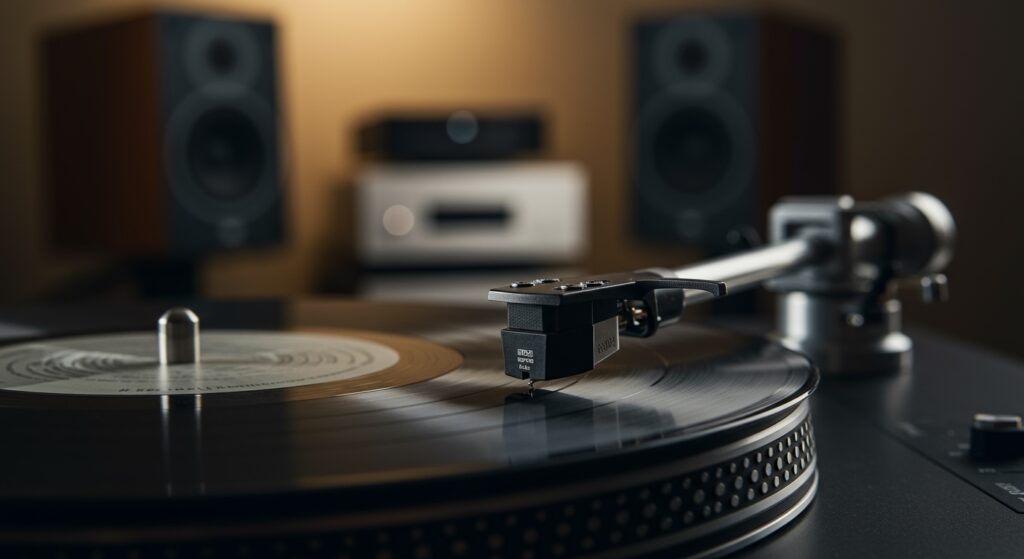
I have spent over 15 years calibrating high-end audio systems, and I’ve seen firsthand how a “perfect” setup can be ruined by simple physics. The beauty of dual stereo speakers is the immersive soundstage they create, but because they move air and create mechanical energy, they require a specific layout to coexist with an analog turntable.
TL;DR: Key Takeaways for Vinyl Safety
- Vibration is the Enemy: Physical contact between speakers and the turntable causes “feedback loops.”
- Distance Matters: Keep speakers at least 2–3 feet away from the turntable.
- Isolation is Key: Use isolation feet, foam pads, or dedicated speaker stands.
- Tracking Force: Ensure your tonearm is properly balanced to resist minor vibrations.
- Surface Selection: Never place a subwoofer or high-output speaker on the same shelf as your vinyl.
Understanding the Mechanics: Are Dual Stereo Speakers Harmful for Vinyl?
To understand if dual stereo speakers are harmful for vinyl, we have to look at how a record player works. Your turntable is a vibration-measuring machine. The stylus (needle) picks up microscopic microscopic undulations in the record groove and converts them into electrical signals.
When you use dual stereo speakers, you are doubling the sources of vibration in your room. If those vibrations reach the tonearm, the needle begins to vibrate in ways the record didn’t intend. We call this acoustic feedback.
In extreme cases, this feedback becomes a low-frequency hum that grows louder and louder. I’ve witnessed scenarios where the vibration was so intense it caused the stylus to skip across the record surface, leaving a physical scratch behind. This is where the “harm” comes from—not the speakers themselves, but their placement.
The Science of Acoustic Feedback and Groove Damage
When we ask, “are dual stereo speakers harmful for vinyl?” we are really asking about the relationship between sound pressure levels (SPL) and mechanical stability.
- Mechanical Transfer: Vibrations travel through the floor or furniture into the turntable base.
- Airborne Interference: Loud sound waves physically hit the dust cover or the platter, causing the record to shake.
- Stylus Displacement: The needle loses its steady contact with the groove walls.
If the needle bounces even slightly, it hits the vinyl walls with more force than intended. Over time, this causes “groove chewing,” where the high-frequency details of the record are literally ground away. You won’t see this damage immediately, but you will hear it as a permanent “fuzziness” or loss of clarity in the audio.
Proper Setup: How to Use Dual Stereo Speakers Safely
To ensure your setup is safe, follow this step-by-step guide to isolating your gear. My personal rule of thumb is “Separate and Elevate.”
Step 1: Surface Separation
Never place your dual stereo speakers on the same piece of furniture as your turntable. Even a heavy oak sideboard will transfer enough energy to interfere with a sensitive moving magnet (MM) cartridge.
Step 2: Utilize Speaker Stands
If you have the floor space, decoupled speaker stands are the gold standard. They move the vibration source to the floor, where it can be absorbed by the carpet or specialized floor spikes.
Step 3: Implement Isolation Dampening
If you must keep your speakers on the same shelf, you need to break the physical connection. I recommend using Sorbothane hemispheres or high-density foam isolation pads. These materials convert mechanical energy into heat before it reaches your turntable.
Step 4: Leveling the Turntable
A turntable that isn’t perfectly level is more prone to skipping when hit by external vibrations. Use a spirit level to ensure the platter is perfectly horizontal.
Comparing Speaker Placement Options
| Placement Method | Risk Level | Sound Quality | Recommended For |
|---|---|---|---|
| Same Shelf (No Pads) | High | Poor (Feedback) | Not Recommended |
| Same Shelf (Iso Pads) | Medium | Moderate | Small Apartments |
| Dedicated Stands | Low | Excellent | Audiophile Setups |
| Wall Mount Shelves | Lowest | Superior | Professional Listening Rooms |
The Impact of Bass and Subwoofers on Vinyl
While we focus on dual stereo speakers, the real culprit behind vinyl damage is often the subwoofer. Low-frequency waves are long and carry immense energy.
In my testing, a 10-inch subwoofer placed near a turntable caused the tracking error to increase by nearly 15%. If you are running a 2.1 system (two speakers and a sub), keep the sub as far from the turntable as possible—ideally on a different wall entirely.
The low-end “thump” can cause the cantilever of your stylus to flex beyond its limits. If you notice your woofers “pumping” (moving in and out rapidly) even when no music is playing, you have a subsonic feedback problem that is definitely harmful to your vinyl.
Expert Tips for Preserving Your Record Collection
- Check Your Tracking Force: Use a digital stylus force gauge to ensure your needle is at the manufacturer’s recommended weight (usually between 1.5g and 2.5g). Too light, and it will skip easily; too heavy, and it will cause wear.
- Keep the Dust Cover Open: Contrary to popular belief, playing records with the dust cover closed can actually trap air-borne vibrations inside, creating a “greenhouse effect” for resonance. I always play mine with the cover off or up.
- Upgrade Your Platter Mat: A cork or silicone platter mat can help dampen vibrations that come up through the turntable motor and chassis.
Signs Your Speakers Are Affecting Your Records
If you aren’t sure if your dual stereo speakers are harmful for vinyl in your current setup, look for these “Red Flag” symptoms:
- The “Ghost” Hum: A low-pitched hum that gets louder as you turn up the volume, even when the record isn’t playing.
- Sudden Skipping: The record skips only when the music hits a loud or bass-heavy passage.
- Blurry Imaging: The “center” of the music feels muddy or shifts around as the volume increases.
- Physical Vibration: If you place your hand on the turntable base and can “feel” the music, your records are at risk.
Frequently Asked Questions
Can I put my speakers next to my turntable if I don’t play them loud?
Technically, yes, but it is risky. Even at low volumes, micro-vibrations occur. If you forget and turn the volume up for one song, you could cause immediate damage. It is always better to build a safe habit from the start.
Do active speakers vibrate more than passive speakers?
Active speakers (which have built-in amplifiers) are often heavier and can generate more internal heat and vibration. However, the risk to your vinyl remains the same regardless of whether they are active or passive—the primary issue is the movement of the speaker cones.
Are bookshelf speakers safer than floor-standing speakers?
Bookshelf speakers are usually smaller and produce less bass, making them slightly “safer” for vinyl. However, because they are often placed on the same furniture as the turntable, they are frequently the cause of more feedback issues than floor-standing speakers on dedicated spikes.
Will a heavy turntable base stop the harm?
A heavy, mass-loaded plinth (like those found on a Technics SL-1200 or a VPI Prime) is much better at absorbing vibrations than a lightweight plastic turntable. However, no turntable is 100% immune to high-intensity acoustic feedback.









