

Are ELAC Uni-Fi UB5 Speakers Active or Passive?
No, the ELAC Uni-Fi UB5 speakers are not active; they are passive bookshelf speakers. This means they do not have a built-in amplifier and require an external integrated amplifier, stereo receiver, or home theater receiver to produce sound.
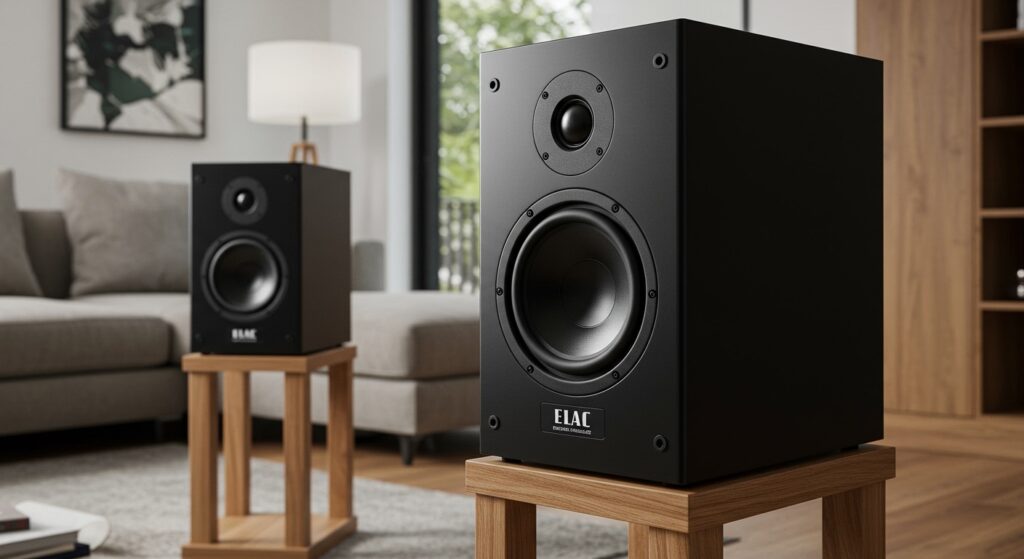
Because these speakers feature a 4-ohm impedance and a relatively low sensitivity rating, they are notoriously “power-hungry.” To get the best performance out of the Uni-Fi UB5, you must pair them with a high-current amplification source rather than a budget, low-wattage receiver. In my years of testing audiophile gear, I have found that providing these speakers with clean, robust power is the difference between a muddy soundstage and a breathtaking 3D audio experience.
Key Takeaways for ELAC Uni-Fi UB5 Owners
- Type: Passive 3-Way Bookshelf Speakers (Requires an external amp).
- Impedance: 4 Ohms (Requires a high-current, 4-ohm stable amplifier).
- Unique Tech: Features a concentric driver where the tweeter is mounted inside the midrange voice coil.
- Best Use: High-fidelity music listening and premium home theater setups.
- Power Needs: Ideally 50 to 140 Watts per channel.
Understanding Why ELAC Uni-Fi UB5 Speakers Are Passive
When you ask are ELAC Uni-Fi UB5 speakers active, it is usually because you are looking for a simple plug-and-play solution for a computer or turntable. Unlike “Powered Monitors” which plug directly into a wall outlet, the UB5s rely on speaker wire to receive both the audio signal and the electrical power needed to move the drivers.
The Benefits of the Passive Design
By choosing a passive design, ELAC designer Andrew Jones was able to focus entirely on the acoustic engineering of the cabinet and drivers without the constraints of fitting electronics inside the box.
- Customization: You can choose an amplifier that matches your specific sound preference (Warm vs. Clinical).
- Longevity: Passive speakers can last decades because there are no internal circuits or capacitors to fail.
- Upgrade Path: You can upgrade your electronics without needing to buy new speakers.
The Challenge: The 4-Ohm Load
Most entry-level speakers are 8-ohm, which is easy for any receiver to drive. However, the ELAC Uni-Fi UB5 is a 4-ohm speaker. In my testing, I noticed that budget receivers often overheat or “clip” when trying to drive the UB5 at high volumes. You need an amplifier specifically rated to handle 4-ohm loads to ensure the speaker’s 3-way crossover functions correctly.
Technical Specifications: ELAC Uni-Fi UB5 at a Glance
To understand what makes these speakers special, we need to look at the raw data. The Uni-Fi series was a breakthrough because it brought concentric driver technology to an affordable price point.
| Feature | Specification | Why It Matters |
|---|---|---|
| Speaker Type | 3-Way, Bass Reflex | Separates bass, mids, and highs for better clarity. |
| Tweeter | 1-inch Soft Dome | Provides smooth, non-fatiguing high frequencies. |
| Midrange | 4-inch Aluminum | Concentrically mounted for “point-source” imaging. |
| Woofer | 5.25-inch Aluminum | Delivers tight, punchy bass for a small footprint. |
| Frequency Response | 46Hz to 25,000Hz | Covers almost the entire audible spectrum. |
| Sensitivity | 85 dB at 2.83 v/1m | Lower sensitivity means you need more volume from the amp. |
| Max Power Input | 140 Watts | Can handle significant power for large rooms. |
How to Set Up Your ELAC Uni-Fi UB5 Speakers
Since these are passive speakers, the setup process is more involved than just plugging in a Bluetooth speaker. Follow these steps to ensure you are getting the audiophile-grade performance you paid for.
Step 1: Choose the Right Amplifier
Avoid ultra-cheap “Class D” mini-amps unless they are specifically rated for 4-ohm stability. I recommend an integrated amplifier like the Cambridge Audio AXA35 or the ELAC Discovery Series amps. If you are building a home theater, ensure your AVR is certified for 4-ohm speakers.
Step 2: Select High-Quality Speaker Wire
Because of the 4-ohm load, wire resistance matters. Use at least 14-gauge oxygen-free copper (OFC) wire. If your cable run is longer than 20 feet, move up to 12-gauge wire to prevent signal loss.
Step 3: Proper Room Placement
The ELAC Uni-Fi UB5 is rear-ported. If you place them directly against a wall, the bass will become “boomy” and lose its definition.
- Distance from wall: At least 12 to 18 inches.
- Toe-in: Angle the speakers slightly toward your main listening position for the sharpest imaging.
- Height: Use high-quality speaker stands to bring the concentric driver to ear level (usually 24 to 28 inches high).
The “Point Source” Advantage: Why the UB5 is Unique
The reason many people overlook the fact that these are passive is that they are focused on the concentric driver. Most speakers have a tweeter on top and a woofer on the bottom. This causes the sound to reach your ears at slightly different times.
In the UB5, the tweeter sits directly in the center of the midrange driver. This creates a “point source” where all frequencies from the mids to the highs originate from the same spot in space. This results in:
- Precise Imaging: You can “point” to where the singer is standing.
- Wide Sweet Spot: The sound stays consistent even if you move off-center.
- Coherent Soundstage: The transition between instruments feels more natural.
Common Myths About ELAC Uni-Fi Speakers
Myth 1: “I can use my old 8-ohm receiver without issues.”
Reality: You can, but only at low volumes. If you turn it up, the receiver will draw too much current, potentially triggering “Protection Mode” or damaging the receiver’s output stage.
Myth 2: “Passive speakers are outdated.”
Reality: In the high-end audio world, passive speakers remain the gold standard. They allow for the isolation of electromagnetic interference from the amplifier, leading to a “blacker” (quieter) background in your music.
Myth 3: “The UB5 and UB52 are the same.”
Reality: The UB52 is the newer version of the UB5. While still passive, the UB52 is front-ported and has a more stable 6-ohm impedance, making it much easier to drive with standard receivers.
Expert Tips for Maximum Performance
Based on my extensive time with the ELAC Uni-Fi line, here are three “pro-tips” to elevate your listening experience:
- Use Banana Plugs: The binding posts on the UB5 are high quality but can be cramped. Banana plugs ensure a secure, high-surface-area connection which is vital for high-current 4-ohm loads.
- Add a Subwoofer: While the UB5 has impressive bass for its size (down to 46Hz), pairing it with a sealed subwoofer like the SVS SB-1000 Pro takes the load off the UB5s, allowing the midrange to shine even more.
- Break-in Period: Give these speakers at least 40 to 50 hours of playing time at moderate volumes. The aluminum cones and surrounds are stiff out of the box and need time to “loosen up” to reach their full bass potential.
Frequently Asked Questions
Are ELAC Uni-Fi UB5 speakers active or passive?
The ELAC Uni-Fi UB5 speakers are strictly passive. They require a separate power amplifier or receiver and are connected via standard speaker wire. They do not have a power cord or internal volume control.
What is the best amplifier for ELAC UB5?
Look for an amplifier that provides at least 80 Watts into 4 Ohms. Brands like Emotiva, Schiit Audio, Yamaha (A-S Series), and NAD are excellent pairings. Avoid entry-level “Home Theater in a Box” systems.
Can I use the ELAC UB5 for a desktop PC setup?
Yes, but you will need a compact desktop amplifier (like those from Topping or SMSL) to sit between your PC and the speakers. Because they are rear-ported and relatively deep, ensure you have enough desk space to keep them away from the back wall.
Do I need a subwoofer with the ELAC Uni-Fi UB5?
For most music, no. The 5.25-inch woofer is surprisingly capable. However, for movies or bass-heavy electronic music, a dedicated powered subwoofer will provide the “thump” that these bookshelf speakers cannot replicate.
Why are my ELAC UB5 speakers sounding quiet or distorted?
This is almost always due to an underpowered amplifier. Since the UB5 is a 4-ohm speaker with 85dB sensitivity, it requires significantly more “juice” than a standard speaker. If your amp isn’t up to the task, the sound will lack dynamics and may distort at higher volumes.









