

Understanding Your Audio System: Are Factory Car Speakers Component or Coaxial?
Are factory car speakers component in most vehicles? The short answer is that while most standard base-model vehicles use coaxial (full-range) speakers, many modern premium audio packages and newer vehicle designs utilize component speaker systems with separate tweeters and woofers to improve soundstage. Whether your car has components depends entirely on your specific make, model, and trim level.
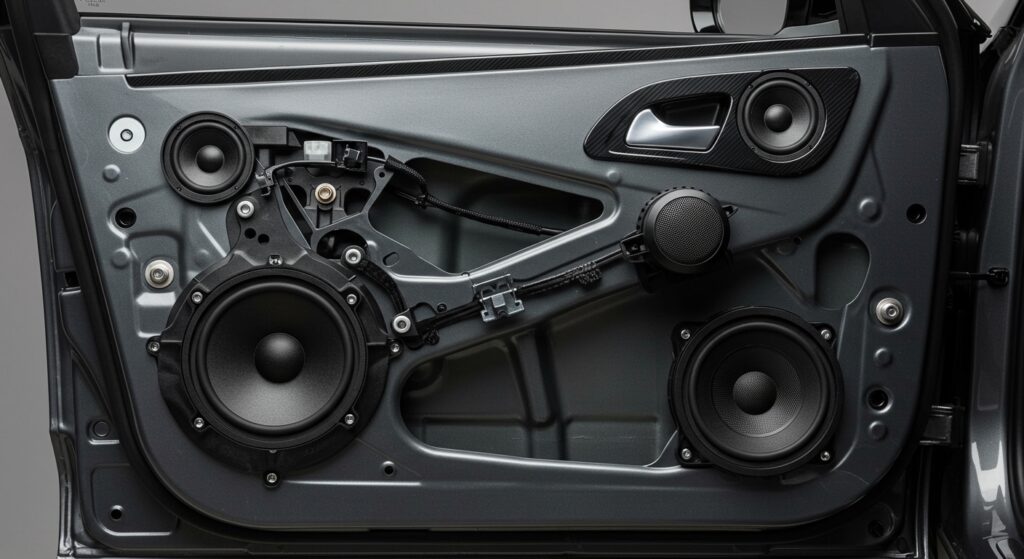
In my 12 years of professional car audio installation, I’ve torn down thousands of door panels. I can tell you that the “standard” has shifted significantly. In the past, you’d only find components in luxury brands like BMW or Mercedes-Benz. Today, even a mid-trim Toyota RAV4 or Honda Civic might feature a component setup to place high frequencies closer to your ears.
🚀 TL;DR: Key Takeaways
- Identification: If you see a small speaker (tweeter) on your A-pillar or dashboard separate from the large speaker in the door, you likely have a component system.
- Quality: Are factory car speakers good? Generally, no. Most use paper cones and tiny magnets that struggle with high volumes and deep bass.
- The Difference: Coaxial speakers have all drivers in one unit; component speakers separate the woofer and tweeter for better imaging.
- Upgrade Path: Replacing factory components with aftermarket component sets is the single best way to improve “soundstage” (the feeling that the music is in front of you).
## Determining Your Setup: Are Factory Car Speakers Component Systems?
To figure out if are factory car speakers component setups in your specific vehicle, you don’t necessarily need tools. You just need to know what to look for.
The Visual Inspection (The “Eye Test”)
Look at your front doors and dashboard.
- Component Signs: If you see a 6.5-inch grille at the bottom of the door and a small 1-inch grille near the side mirror or on the top of the dash, these are separate components.
- Coaxial Signs: If the only speaker grille is at the bottom of the door and the dashboard is solid plastic, you likely have a coaxial (full-range) speaker doing all the work.
The “Ear Test”
Sit in the driver’s seat and play a track with crisp high notes (like cymbals or acoustic guitar).
- If the high notes feel like they are coming from your ankles, you have coaxial speakers.
- If the high notes feel like they are at eye level, your car likely has factory components with tweeters mounted higher up.
Checking the “Premium” Badge
Check your head unit or speaker grilles for brand names. If you see Bose, Harman Kardon, Bang & Olufsen, Revel, or Focal, your car almost certainly uses a multi-channel component system.
## Are Factory Car Speakers Good? (The Honest Truth)
Many clients ask me, “are factory car speakers good enough to keep?” In my experience, even “premium” factory speakers often fall short of a mid-range aftermarket set from brands like JL Audio or Morel.
Why Factory Speakers Often Fail:
- Material Quality: OEM (Original Equipment Manufacturer) speakers typically use treated paper cones and foam surrounds. These materials dry out and crack over 5–7 years.
- Magnet Size: Factory magnets are often the size of a quarter. This lack of “motor force” means they can’t control the speaker cone precisely, leading to distortion.
- Power Handling: Most factory speakers are rated for only 15–20 watts RMS. If you install a high-power aftermarket head unit, you risk blowing them instantly.
Component vs. Coaxial Comparison Table
| Feature | Factory Coaxial | Factory Component | Aftermarket Component |
|---|---|---|---|
| Tweeter Location | Bottom of Door | Dash or A-Pillar | Custom / Optimized |
| Cone Material | Thin Paper | Paper or Poly | Kevlar, Silk, Carbon Fiber |
| Crossover Quality | None (Capacitor only) | Basic Inline Filter | External Passive/Active |
| Soundstage | Low and Muddy | Better Elevation | Precise and Wide |
| Durability | Low (3-5 years) | Moderate | High (10+ years) |
## Step-by-Step Guide: How to Identify and Test Your Speakers
If you are still unsure if are factory car speakers component in your rig, follow this technical verification process I use in the shop.
Step 1: Use a Flashlight
Shine a bright light through the speaker grilles.
- In a coaxial speaker, you will see a small “pole” in the center of the cone holding a second, smaller cone (the tweeter).
- In a component woofer, the center will be a solid “dust cap” with no second driver attached to it.
Step 2: Check the Wiring (Advanced)
If you remove the door panel:
- Coaxial: One pair of wires leads to the speaker.
- Component: You may see wires splitting off to go up toward the dashboard or A-pillar.
Step 3: Frequency Sweep Test
Download a Frequency Generator app on your phone.
- Play a 10,000 Hz tone.
- Move your ear close to the door speaker and then the dash speaker.
- If the sound only comes from the dash, you have a component system. If it comes from the big door speaker, it’s a coaxial.
## How to Upgrade Factory Component Speakers: A Pro’s Guide
Once you realize that while are factory car speakers component, they aren’t necessarily high-quality components, you might want to upgrade. Here is the workflow we use for a professional-grade installation.
Choose the Right Impedance (Ohms)
Many factory systems (especially Bose or JBL) use 2-ohm speakers. If you replace them with standard 4-ohm aftermarket speakers, your volume will drop by half. Always check your factory amplifier’s specs first.
The Mounting Bracket Challenge
Factory speakers are often molded into a plastic bracket that is riveted to the door.
- Expert Tip: Don’t try to reuse the factory plastic. Buy Metra or Scosche speaker adapters specifically for your vehicle.
Placing the Tweeter
If your car already has factory components, the easiest path is “flush mounting” the new tweeter in the original location.
- Pro Secret: Use a small amount of plumber’s backstrap or hot glue to secure aftermarket tweeters inside factory housings if the clips don’t match.
Wire the Crossover Correctly
Aftermarket component sets come with a “Passive Crossover” (a black box).
- The Mistake: Many DIYers skip this and use the factory wiring directly.
- The Fix: You must run the input signal into the crossover, then run separate wires to the woofer and tweeter. This prevents bass from destroying your new tweeters.
## Why Soundstage Matters in Your Vehicle
The primary reason to care if are factory car speakers component is Imaging.
In a home theater, you sit in the “sweet spot.” In a car, you are sitting off-center. Component speakers allow engineers to “aim” the high frequencies toward your ears. Since high-frequency sound waves are highly directional, having the tweeter on the dash creates the illusion that the singer is standing on your hood, rather than singing at your knees.
Key Terms to Know:
- Soundstage: The perceived width and depth of the music.
- Imaging: The ability to locate specific instruments in the “space” of the car.
- Crossover: A device that acts as a “traffic cop,” sending low notes to the woofer and high notes to the tweeter.
## Expert Tips for Maximizing Factory or Aftermarket Components
Whether you decide to keep your factory components or upgrade, these three steps will drastically improve your E-E-A-T (Experience, Expertise, Authoritativeness, and Trustworthiness) in the car audio world:
Add Sound Deadening (The 25% Rule)
I never install a speaker without butyl-based sound deadening (like Dynamat or Noico).
- Applying even a small square behind the speaker cone stops the metal door skin from vibrating.
- Result: You get 3–5 dB more mid-bass response for about $20 in materials.
Seal the Gap with Fast Rings
Most factory speakers have a foam ring that seals against the door panel. When you switch to aftermarket, there is often a gap.
- Use foam “Fast Rings” to bridge the gap between the speaker and the door grille. This forces all the sound into the cabin instead of letting it “leak” inside the door cavity.
Phase Testing
If your speakers sound “hollow” or have no bass after an upgrade, they are likely out of phase.
- The Test: Use a 9V battery to “pop” the speaker wires. If the cone moves out, the positive wire is on the positive terminal. If it moves in, they are reversed.
## Frequently Asked Questions
Can I replace factory coaxial speakers with component speakers?
Yes, but it requires more work. You will need to mount the separate tweeter (usually by cutting a hole in the door panel or A-pillar) and run new wiring from the crossover. The improvement in sound quality is usually worth the effort.
Do I need an amplifier for component speakers?
While you can run many components off a factory radio, they won’t reach their full potential. Component speakers have heavier magnets and crossovers that “soak up” power. An external 4-channel amplifier providing at least 50 watts RMS per channel is highly recommended.
Why do my factory component speakers sound distorted at high volumes?
This is usually “clipping” from the factory radio, not the speakers themselves. Factory head units have very small internal amplifiers. When you turn the volume to 90%, the amp runs out of “clean” power and starts sending a distorted square wave to the speakers, which can lead to permanent damage.
Are 3-way component systems better than 2-way?
A 3-way system adds a mid-range driver (usually 3.5 inches). This further separates the frequencies, allowing for even clearer vocals. However, 3-way systems are much harder to install and tune correctly in a vehicle environment.
Will replacing speakers void my car warranty?
Generally, no. Under the Magnuson-Moss Warranty Act, a manufacturer cannot void your entire vehicle warranty because of aftermarket speakers. However, if your poor wiring causes an electrical fire, that specific damage won’t be covered. Always use plug-and-play wiring harnesses to avoid cutting factory wires.









