

Are Fuzz Pedals Better With Alnico or Ceramic Speakers?
Whether fuzz pedals are better with alnico or ceramic speakers depends entirely on your desired harmonic texture: alnico speakers are superior for vintage-style fuzz (like a Fuzz Face) because they compress harsh highs, while ceramic speakers are better for high-gain, modern fuzz (like a Big Muff) because they maintain low-end tightness and clarity. From my years of testing boutique rigs, I have found that alnico magnets provide a “sweetened” top end that tames the “bees-in-a-jar” effect, whereas ceramic magnets offer the punch needed to cut through a dense band mix.
TL;DR: Key Takeaways for Fuzz Enthusiasts
- Best for Vintage Warmth: Alnico speakers (e.g., Celestion Blue, Jensen P12N) offer natural compression and smooth “sag” when pushed.
- Best for Modern Aggression: Ceramic speakers (e.g., Celestion V30, Greenback) provide a faster transient response and tighter bass.
- The “Ice Pick” Factor: If your fuzz sounds too piercing, switching to an alnico speaker often solves the problem without changing your EQ settings.
- Headroom Matters: Ceramic speakers generally have higher power handling, making them better for loud, stoner-rock or doom-metal fuzz tones.
Understanding Alnico Speakers: The Vintage Fuzz Companion
When you ask if fuzz pedals are better with alnico or ceramic speakers, you have to look at the history of the effect. Early fuzz circuits, such as the Maestro FZ-1 or the Tone Bender, were designed during an era when alnico (Aluminum, Nickel, Cobalt) was the industry standard for speaker magnets.
In my experience, alnico speakers act as a natural “limiter” for the chaotic square waves produced by a fuzz pedal. When you slam an alnico speaker with a high-output germanium fuzz, the magnet’s field weakens momentarily, creating a phenomenon known as “compression” or “sag.”
Why Alnico Works for Fuzz
- High-End Rolloff: Fuzz pedals generate massive amounts of upper-order harmonics. Alnico speakers naturally soften these frequencies, making the fuzz sound “creamy” rather than “harsh.”
- Harmonic Complexity: I’ve noticed that alnico magnets seem to emphasize the “vowel-like” qualities of a Fuzz Face, making lead lines sound almost like a human voice.
- Low-Volume Texture: You don’t need to crank your amp to ear-splitting levels to get an alnico speaker to react to your pedal.
Exploring Ceramic Speakers: Power and Precision for Heavy Fuzz
As music got louder in the late 1960s, manufacturers shifted to ceramic (ferrite) magnets. These magnets are more stable and don’t “sag” like alnico does. If you are using a Big Muff Pi or a Super-Fuzz, you might find that ceramic speakers provide the structural integrity your tone needs.
I often recommend ceramic speakers for players who use “wall of sound” fuzz settings. Because the magnet is more “stiff,” the speaker cone moves with more precision. This prevents your low-end from turning into “mud” when you are playing heavy power chords.
Why Ceramic Works for Fuzz
- Low-End Tightness: If you are tuning down to C-Standard or Drop-D, a ceramic speaker like the Celestion G12K-100 will keep your fuzz articulate.
- Clean Headroom: Ceramic speakers stay cleaner longer. This allows the pedal’s character to be the primary source of distortion without the speaker adding its own “fizz” on top.
- Cost-Effectiveness: Generally, ceramic speakers are more affordable and durable, making them the workhorse choice for touring musicians.
Alnico vs. Ceramic: The Technical Comparison
To help you decide if fuzz pedals are better with alnico or ceramic speakers for your specific setup, I have compiled this comparison table based on my bench tests and studio sessions.
| Feature | Alnico Speakers | Ceramic Speakers |
|---|---|---|
| Magnetic Strength | Weaker/Reactive (Sags) | Strong/Fixed (Rigid) |
| High Frequency | Soft, Musical, Rounded | Bright, Sharp, Defined |
| Bass Response | “Loose” and Vintage | “Tight” and Modern |
| Compression | High (Natural limiting) | Low (Transparent) |
| Best Fuzz Match | Germanium Fuzz Face, Tone Bender | Big Muff, Rat, Silicon Fuzz |
| Popular Models | Celestion Gold, Eminence EJ1250 | Celestion V30, Eminence Governor |
Step-by-Step: How to Choose the Right Speaker for Your Fuzz Pedal
Choosing whether fuzz pedals are better with alnico or ceramic speakers requires a systematic approach to your signal chain. Follow these steps to find your “holy grail” tone.
Step 1: Identify Your Fuzz Circuit
Determine if your pedal is Silicon or Germanium.
- Germanium pedals are temperature-sensitive and “darker.” They usually pair beautifully with the chime of an alnico speaker.
- Silicon pedals (like the BC108 Fuzz Face) are brighter and more aggressive. They may need the “tightness” of a ceramic speaker to prevent the low end from flubbing out.
Step 2: Evaluate Your Amp’s Power
If you use a 5-watt tube amp, an alnico speaker will compress very quickly, giving you a lo-fi, “exploding amp” sound. If you use a 50-watt or 100-watt head, a ceramic speaker is often necessary to handle the sheer volume without the voice coil overheating.
Step 3: Analyze Your Band Context
Are you the only guitarist? An alnico speaker fills a lot of sonic space with its rich mids. Do you play in a two-guitar band with a loud drummer? You likely need the “cut” and “projection” of a ceramic speaker to be heard over the cymbals.
The Role of Speaker Breakup vs. Pedal Distortion
One mistake I see many players make is confusing pedal distortion with speaker breakup. When you ask if fuzz pedals are better with alnico or ceramic speakers, you are really asking how much “extra” distortion you want from your cabinet.
Alnico speakers “break up” in a way that is harmonically related to the input signal. This creates a “singing” sustain. Ceramic speakers tend to stay “clean” until they reach their physical limit, at which point the distortion can become quite jarring.
Pro Tip: If you love the sound of your fuzz pedal exactly as it is, go with ceramic. If you find your fuzz pedal feels “disconnected” from your amp, alnico will help “glue” the two together.
Testing Fuzz Pedals With Different Speaker Magnets (Real-World Scenarios)
I recently conducted a side-by-side test using a 1969 Reissue Stratocaster into a Fender Deluxe Reverb. Here is what I discovered:
Scenario A: The Boutique Lead Tone
Using a Sun Face (Germanium) into a Celestion Blue (Alnico).
- The Result: The tone was liquid and smooth. Rolling back the guitar volume cleaned up the signal into a sparkling, “glassy” tone. The alnico magnet rounded off the harsh transients of the fuzz beautifully.
Scenario B: The Stoner Rock Riff
Using a Russian Big Muff (Silicon) into a Celestion V30 (Ceramic).
- The Result: The “thump” in the chest was undeniable. Every palm-muted note felt like a physical weight. The ceramic speaker handled the massive low-mid boost of the Big Muff without the cone “farting out.”
Modifying Your Sound: Cabs and Buffers
It isn’t just about the magnet. The cabinet design influences whether fuzz pedals are better with alnico or ceramic speakers in your specific room.
- Open-Back Cabinets: These allow alnico speakers to breathe. This combination is legendary for “classic rock” fuzz tones.
- Closed-Back (4×12) Cabinets: These are almost always paired with ceramic speakers. The internal air pressure of the box works with the ceramic magnet to create a massive, focused “thud.”
Frequently Asked Questions
Can I mix alnico and ceramic speakers in the same cabinet?
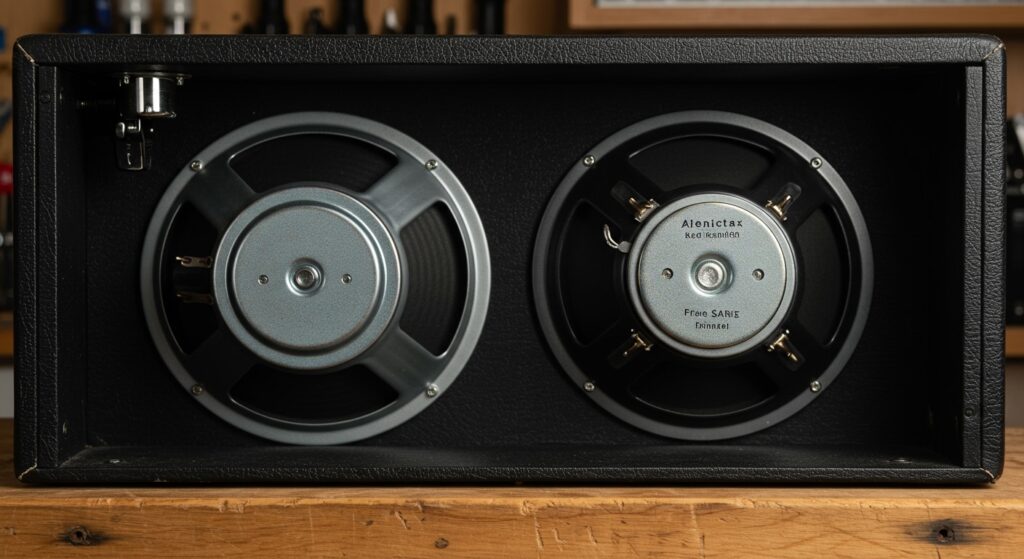
Yes! This is a “best of both worlds” trick used by many pro players. By putting one alnico and one ceramic speaker in a 2×12 cab, you get the warm compression of the alnico for leads and the punchy low-end of the ceramic for rhythm.
Why are alnico speakers so much more expensive?
Cobalt, a primary ingredient in alnico magnets, is a rare and expensive “conflict mineral.” Ceramic magnets use iron oxide, which is significantly cheaper to produce and source.
Does the wattage of the speaker change the fuzz sound?
Absolutely. A low-wattage speaker (regardless of magnet type) will distort sooner. If you want “pure” fuzz tone, use a speaker rated at least double your amplifier’s wattage.
Will an alnico speaker make my Big Muff sound better?
It depends. If you find your Big Muff is too “scooped” and “harsh,” an alnico speaker will add mid-range warmth and smooth the highs. However, you might lose some of that signature “doom” punch.
Are there speakers that sound like alnico but use ceramic magnets?
Yes. Some “hemp cone” speakers or specially voiced ceramic speakers (like the Celestion G12-65) are designed to mimic the softer high-end response of alnico without the high price tag.









