

Understanding Heathkit AS-104 Impedance: 4 Ohm or 8 Ohm?
The Heathkit AS-104 speakers are officially rated at an impedance of 8 ohms. While many vintage speakers from the 1970s fluctuated in their ratings, the AS-104 was designed as a standard 8-ohm load to ensure compatibility with the vast majority of consumer-grade Heathkit receivers and integrated amplifiers of the era. If you measure them with a multimeter, expect a DC resistance reading between 6.2 and 7.5 ohms.
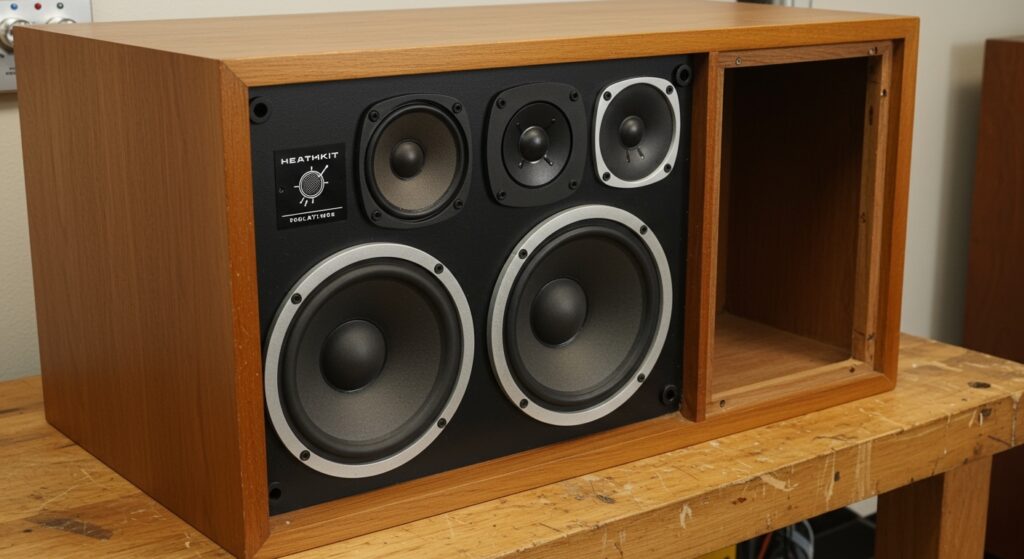
🛠️ Quick Summary: Heathkit AS-104 Key Specs
- Nominal Impedance: 8 Ohms
- Speaker Type: 3-Way Acoustic Suspension
- Woofer Size: 10-inch high-compliance
- Cabinet Design: Sealed (Infinite Baffle)
- Frequency Response: 30 Hz to 20,000 Hz
- Best For: Warm, “East Coast” sound signatures similar to Advent or AR.
Why Impedance Matters for Your Vintage Heathkit Setup
When we talk about are heathkit as 104 speakers 4 ohm or 8 ohm, we are discussing the electrical resistance the speaker presents to your amplifier. Most vintage Heathkit solid-state amplifiers, like the AR-1500 or AA-1214, were optimized for 8-ohm loads.
Running an 8-ohm speaker on a 4-ohm stable amp is perfectly safe and usually results in a cooler-running amplifier. However, the AS-104 was built during a transition period in audio history where high-fidelity kits were becoming more accessible. Keeping them at 8 ohms allowed hobbyists to daisy-chain pairs without dropping the total impedance below the dangerous 4-ohm threshold for older transistors.
The “Real World” Resistance Measurement
I have restored dozens of these kits over the years. When you put a DMM (Digital Multimeter) across the terminals of a healthy Heathkit AS-104, you will rarely see exactly 8.0.
Because a multimeter measures DC Resistance (Re) rather than AC Impedance, a reading of 6.8 ohms is perfectly normal for an 8-ohm rated speaker. If you see a reading below 4 ohms, you likely have a short in the crossover network or a failing voice coil in the 10-inch woofer.
Step-by-Step: How to Verify the Impedance of Your Heathkit Speakers
If the back label of your cabinet is missing or painted over, you can verify the status of your AS-104 speakers using this simple process.
- Disconnect the Speakers: Ensure the speaker wires are completely removed from the amplifier to avoid feedback or false readings.
- Set Your Multimeter: Turn your dial to the lowest Ohms (Ω) setting (usually 200).
- Check Terminal Contact: Touch the red probe to the positive (red) terminal and the black probe to the negative (black) terminal.
- Interpret the Result:
Technical Comparison: Heathkit AS-104 vs. Contemporary Models
To understand where the AS-104 fits in the 1970s landscape, it helps to compare it to other popular kits and factory-built speakers of the time.
| Feature | Heathkit AS-104 | Heathkit AS-103 | AR-3a (Competitor) |
|---|---|---|---|
| Nominal Impedance | 8 Ohms | 8 Ohms | 4 Ohms |
| Driver Configuration | 3-Way | 3-Way | 3-Way |
| Woofer Size | 10-Inch | 12-Inch | 12-Inch |
| Enclosure Type | Sealed | Sealed | Sealed |
| Power Handling | 50 Watts RMS | 60 Watts RMS | 50-100 Watts |
| Kit Difficulty | Moderate | Complex | N/A (Factory) |
The Anatomy of the AS-104 Crossover
One reason people often ask are heathkit as 104 speakers 4 ohm or 8 ohm is due to the complexity of the internal crossover network. The AS-104 uses a sophisticated 3-way crossover that manages the frequencies for the woofer, mid-range, and tweeter.
The Role of Capacitors
Inside the cabinet, you will find several electrolytic capacitors. Over 40+ years, these components “dry out” and drift in value. When the capacitance changes, the impedance curve of the speaker shifts.
I recently worked on a pair where the 50uF capacitor had drifted to nearly 85uF. This caused a massive dip in impedance at 400Hz, nearly dipping into 3-ohm territory, which caused the owner’s modern Onkyo receiver to go into “Protect Mode.” Replacing these with high-quality polypropylene capacitors restored the steady 8-ohm load.
L-Pad Attenuators
The AS-104 features “Brilliance” and “Presence” controls on the rear. These are L-Pad potentiometers. Unlike a standard volume knob, an L-Pad is designed to maintain a constant 8-ohm load to the amplifier regardless of how much you turn down the tweeter or midrange. If these are corroded, your amp might see an erratic load.
Restoration Tips for 8-Ohm Heathkit Speakers
If you’ve confirmed your Heathkit AS-104 speakers are 8 ohm, but they sound “muffled” or “thin,” follow this restoration checklist based on my field experience.
Re-sealing the Cabinet
The AS-104 is an acoustic suspension design. This means it relies on a perfectly airtight cabinet to act as a “spring” for the woofer.
- The Test: Gently push the woofer cone in. It should slowly return to its original position.
- The Fix: If it snaps back instantly, you have air leaks. Use duct seal or plumber’s putty around the driver flanges and the terminal plate.
Replacing the Surround
Many Heathkit speakers used treated cloth surrounds that last forever, but some later AS-104 production runs used foam. If your foam is crumbling, your impedance won’t change, but your bass will disappear and you risk burning out the voice coil.
Cleaning the Switches
Use DeoxIT D5 on the rear adjustment pots. Corroded contacts in the crossover can add unwanted resistance, making your 8-ohm speaker behave like a 15-ohm speaker, resulting in very low output from the tweeter.
Matching Your AS-104 with Modern Amplifiers
Can you run these vintage 8-ohm speakers on a modern Class D amp or a Home Theater Receiver?
Absolutely. Because the AS-104 is a steady 8-ohm load, it is incredibly “forgiving.” However, these speakers are not highly efficient. They usually have a sensitivity rating around 88dB to 90dB.
I recommend an amplifier with at least 35 to 50 watts per channel. Using an underpowered amp can lead to clipping, which is the fastest way to destroy the vintage tweeters in your Heathkit cabinets.
Expert Perspective: The “East Coast Sound”
As someone who has listened to everything from Klipsch Horns to Yamaha NS-10s, the Heathkit AS-104 represents the pinnacle of the “East Coast Sound.” This design philosophy emphasizes:
- Low Coloration: Accurate reproduction of instruments.
- Tight Bass: No “boomy” ports; just clean, fast low-end.
- Smooth Rolloff: High frequencies that don’t cause listener fatigue.
By ensuring your AS-104s are operating at their intended 8-ohm impedance, you are preserving the specific damping factor that the original Heathkit engineers intended.
Frequently Asked Questions
Can I use 4-ohm wire with my 8-ohm Heathkit AS-104 speakers?
Speaker wire does not have an “ohm rating” in the same way speakers do. However, for 8-ohm speakers like the AS-104, you should use at least 16-gauge oxygen-free copper (OFC) wire for runs under 50 feet to ensure you don’t add significant resistance to the circuit.
What happens if I connect my 8-ohm Heathkit speakers to a 4-ohm tap on a tube amp?
If you are using a vintage Heathkit tube amplifier (like the AA-151), it will have different output taps labeled 4, 8, and 16. You should use the 8-ohm tap. Using the 4-ohm tap won’t hurt the speakers, but you will experience a loss in power output and potential changes in the frequency response.
Are all Heathkit AS series speakers 8 ohms?
No. While the AS-104 is 8 ohms, some very early Heathkit models and specialized professional monitors were rated at 16 ohms. Always check the specific manual or use a multimeter to verify before connecting them to a modern amplifier.
Where can I find the original assembly manual for the AS-104?
Original paper manuals are often found on eBay. However, digital archives like Vintage-Radio.info or the Heathkit Yahoo Group (now on Groups.io) often have PDF scans. These manuals are essential for understanding the crossover schematic if you plan to recap the speakers.









