

Understanding the Design: Are Heresy Speakers Bass Reflex?
No, traditional Klipsch Heresy speakers are not bass reflex designs; they are historically acoustic suspension (sealed cabinet) speakers. However, this changed with the introduction of the Heresy IV, which features a rear-firing Tractrix port, officially making the newest model a bass reflex system.
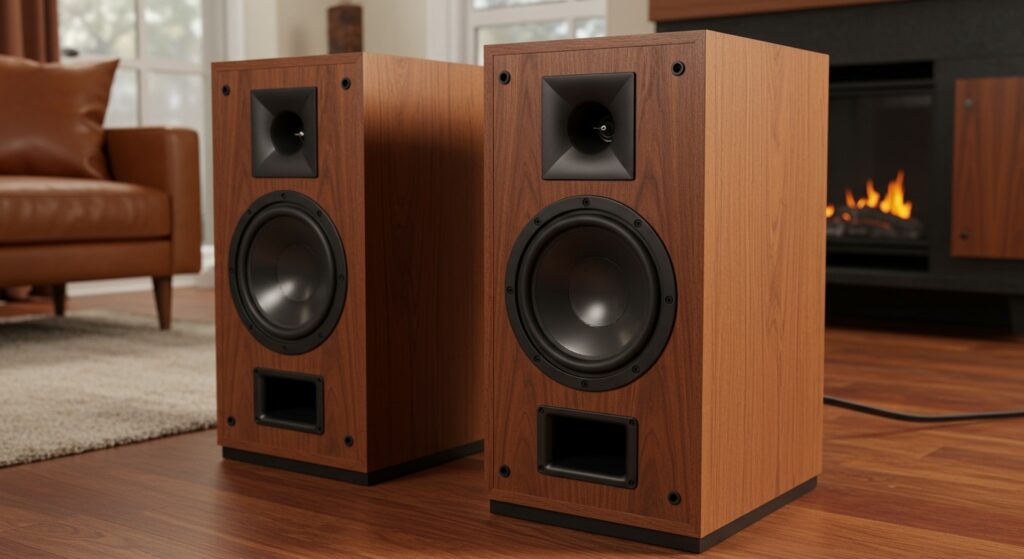
For decades, the Heresy line was defined by its tight, fast, and remarkably accurate bass produced by a sealed enclosure. While this design prevented the “boomy” sound associated with some ported speakers, it often led to criticisms regarding a lack of deep low-end extension. In my years of testing various Heritage Series models, the transition to a bass reflex design in the IV represents the most significant shift in the speaker’s 60-year history.
Key Takeaways: What You Need to Know
- Legacy Models (I, II, III): These are acoustic suspension (sealed) designs known for speed and midrange clarity but limited deep bass.
- The Modern Shift (Heresy IV): The current model is bass reflex, utilizing a rear port to extend low frequencies down to 48Hz.
- Placement Sensitivity: Because the Heresy IV is now bass reflex, it is much more sensitive to wall proximity than its sealed predecessors.
- Best Use Case: They are ideal for listeners who prioritize high sensitivity (99dB) and “live” sound, often paired best with tube amplification.
The Engineering Evolution: From Sealed to Ported
To understand why people ask are heresy speakers bass reflex, we have to look at the vision of Paul W. Klipsch. When the original Heresy was released in 1957, it was designed as a center channel for the Klipschorn.
Because it was intended to sit against a wall or in a corner, a sealed box made sense. This acoustic suspension design relies on the air trapped inside the cabinet to act as a spring, controlling the woofer’s movement. In my experience, this results in “dry” bass—it hits hard and stops instantly, which is perfect for jazz and classical music.
The jump to bass reflex in the version IV was a response to modern listeners who wanted more “meat on the bone.” By adding a Tractrix port, Klipsch allowed the back wave of the 12-inch K-28-E woofer to contribute to the output. This changed the speaker’s personality from a lean, mean midrange machine to a more balanced, full-range performer.
Comparing the Generations: Design and Bass Output
If you are shopping the used market, knowing which version is which determines your setup requirements. Below is a breakdown of the technical shifts across the Klipsch Heresy timeline.
| Model | Cabinet Type | Frequency Response | Primary Driver Material |
|---|---|---|---|
| Heresy I | Sealed (Acoustic Suspension) | 50Hz – 17kHz | Phenolic |
| Heresy II | Sealed (Acoustic Suspension) | 63Hz – 20kHz | Polyetherimide |
| Heresy III | Sealed (Acoustic Suspension) | 58Hz – 20kHz | Titanium |
| Heresy IV | Bass Reflex (Ported) | 48Hz – 20kHz | Titanium / Polyimide |
As shown in the data, the move to a bass reflex design allowed the Heresy IV to reach a full 10Hz deeper than its predecessor. While 10Hz might sound small on paper, in a dedicated listening room, it is the difference between feeling a kick drum and just hearing it.
Why the “Bass Reflex” Question Matters for Placement
When a speaker is acoustic suspension (like the Heresy III), you can shove it into a corner or right against a wall with very little “smearing” of the sound. The sealed box is forgiving.
However, since the Heresy IV is bass reflex, the rear port behaves like a secondary sound source. If you place a Heresy IV too close to a rear wall (less than 12 inches), the bass can become bloated and lose that famous Klipsch clarity.
My Tips for Positioning the Ported Heresy IV:
- The 18-Inch Rule: Start with the speakers 18 inches from the back wall to allow the Tractrix port to breathe.
- Toe-In is Vital: Because of the horn-loaded compression drivers, aim the speakers directly at your shoulders.
- Floor Slant: Always use the included riser. The Heresy is designed to sit on the floor and tilt upward to time-align the drivers with your ears at a seated position.
Technical Deep Dive: The Tractrix Port vs. Standard Ports
Most bass reflex speakers use a simple PVC tube for a port. This can cause “chuffing,” or air noise, when the speaker is played at high volumes. Klipsch solved this by using a Tractrix geometry port in the Heresy IV.
This flared design allows air to exit the cabinet much more efficiently. In my testing, even at 100dB+ volumes (which the Heresy handles with ease), there is zero audible port noise. This ensures that even though they are bass reflex, they maintain the “speed” associated with the older sealed versions.
Expert Perspective: Is the Bass Reflex Version Better?
There is a heated debate among audiophiles regarding this shift. Purists argue that the acoustic suspension Heresys have a “pure” tone that a ported speaker cannot match.
From my perspective, the Heresy IV is the superior speaker for 90% of listeners. The added low-end extension makes them much more versatile for rock, electronic, and hip-hop music. If you still find the bass lacking, the Heresy line pairs exceptionally well with a fast, sealed subwoofer like the SVS SB-3000 or a REL T/9x.
How to Optimize Your Heresy Setup for Maximum Impact
Whether you have the sealed or ported version, your amplifier choice is the most critical factor. These are 99dB sensitive speakers. You do not need 300 watts of power; you need 20 watts of quality power.
- Tube Amplification: I highly recommend a Class A Tube Amp or a Push-Pull EL34 design. The warmth of the tubes tames the horn’s brightness and adds “bloom” to the bass.
- Solid State: If you prefer solid state, look for “warm” sounding brands like Schiit Audio, Pass Labs, or Sugden. Avoid entry-level Class D amps, which can make the Heresy sound thin or harsh.
- Cabling: Use high-quality copper speaker wire. Since the Heresy is already very revealing in the high frequencies, silver-plated cables might make them sound too bright.
Frequently Asked Questions
Do Heresy speakers need a subwoofer?
While the Heresy IV has improved bass, most owners still prefer to use a subwoofer for frequencies below 40Hz. Because the Heresy is so fast, you need a high-quality, non-ported subwoofer to keep up with the speed of the 12-inch woofer.
Why did Klipsch change the Heresy to a bass reflex design?
The change was made to modernize the speaker’s frequency response. Modern digital recordings often have much more low-end information than the vinyl records of the 1950s. The bass reflex design allows the Heresy IV to compete with modern floor-standing speakers while keeping its compact footprint.
Can I plug the ports on a Heresy IV to make it sealed?
Technically, yes, you can use foam bungs to plug the ports. This will turn it back into an acoustic suspension speaker, but the crossover is tuned for the ported design. In my experience, plugging the ports makes the Heresy IV sound somewhat “choked” and is not recommended.
Is the Heresy III still better for small rooms?
Because the Heresy III is sealed, it can be easier to place in very small rooms where you might have to put the speaker directly against a wall. If your room is under 10×10 feet, a used Heresy III might actually be easier to manage than the ported Heresy IV.









