

Why Hybrid Speakers Deliver the “Best of Both Worlds”
Are hybrid speakers good? Yes, hybrid speakers are an excellent choice for listeners who want the surgical precision and “airiness” of electrostatic or ribbon drivers combined with the deep, physical bass punch of traditional dynamic woofers. They solve the biggest weakness of panel speakers—lack of low-end impact—by integrating a dedicated cone driver into a single cabinet.
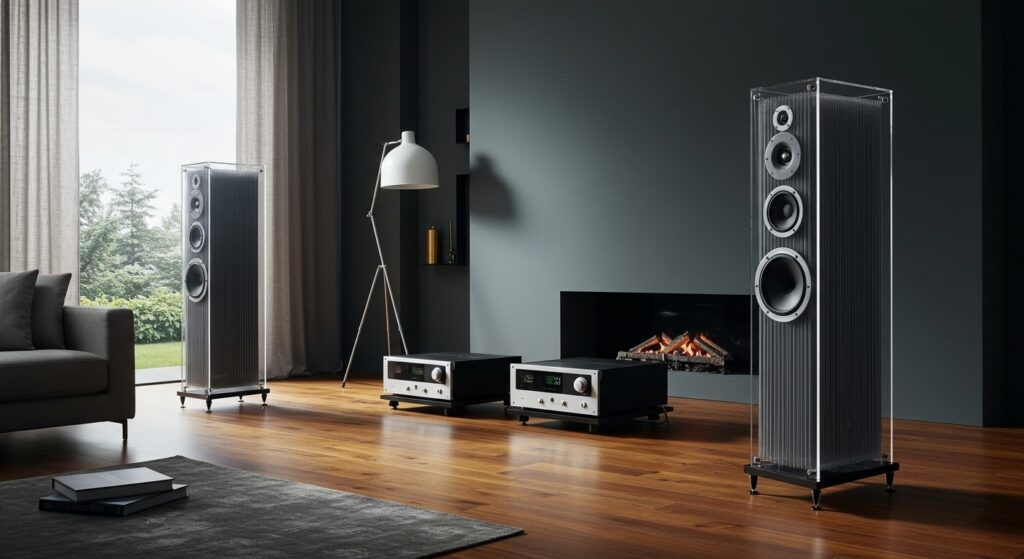
In my experience testing high-end audio setups, hybrid speakers represent the ultimate middle ground for home theater enthusiasts and audiophiles alike. While a pure electrostatic panel often sounds thin in the bass, and a standard bookshelf speaker might lack transparency in the vocals, a hybrid system bridges this gap. However, their quality depends heavily on the crossover integration—the “hand-off” between the two different technologies.
Key Takeaways: What You Need to Know
- Superior Clarity: You get unmatched detail in the mid-range and highs thanks to thin-film driver technology.
- Robust Bass: Unlike pure panels, hybrids use dynamic woofers to provide the “thump” needed for rock, hip-hop, and movies.
- Placement Matters: These speakers are often dipole (sound comes out the front and back), meaning they need space from the wall to sound their best.
- Power Hungry: Most hybrid models require high-quality amplification with high current to drive the varying impedance loads.
What Exactly Are Hybrid Speakers?
To understand if hybrid speakers are good for your specific room, we first need to define the “hybrid” nature. In the world of high-fidelity audio, a hybrid speaker combines two or more different driver technologies that operate on different physical principles.
The Most Common Hybrid Combinations
- Electrostatic + Dynamic Woofers: The most famous version, popularized by brands like MartinLogan. A large, curved transparent panel handles everything from the upper bass to the highs, while a traditional boxed woofer handles the deep bass.
- Ribbon/AMT + Dynamic Woofers: High-frequency Ribbon drivers or Air Motion Transformers (AMT) are paired with standard cone drivers. This is common in brands like PS Audio or GoldenEar.
- Planar Magnetic + Dynamic: Similar to electrostatic, but uses magnets rather than an electrical charge to move a thin film.
The Anatomy of a Hybrid Speaker
| Component | Driver Type | Function | Benefit |
|---|---|---|---|
| Top Section | Electrostatic / Ribbon | Mid-range & Treble | Ultra-fast response, zero distortion. |
| Bottom Section | Dynamic Cone | Bass / Sub-bass | Moves a lot of air for physical impact. |
| Crossover | Passive or Active | Frequency Routing | Ensures the two drivers sound like one. |
| Cabinet | Hybrid / Ported | Structural Support | Houses the woofer and electronics. |
Are Hybrid Speakers Good for Your Listening Style?
When people ask me are hybrid speakers good, I always start by asking what they listen to. The “best” speaker is subjective, but hybrids have a very specific performance profile.
For the Audiophile (Jazz, Classical, Vocals)
If you value “imaging”—the ability to close your eyes and point to exactly where the singer is standing—then hybrid speakers are phenomenal. Because the top-end driver is so lightweight (often lighter than the air it moves), it reacts to the musical signal instantly. This creates a “wraparound” soundstage that traditional speakers struggle to replicate.
For the Home Theater Enthusiast
For a long time, electrostatic panels were considered “too polite” for action movies. Hybrid designs changed that. By adding a high-excursion 10-inch or 12-inch woofer into the base, these speakers can now handle the explosions in Interstellar while still making the dialogue sound incredibly lifelike.
For the “Plug-and-Play” User
This is where hybrids can be tricky. They are not “set it and forget it” devices. To get the most out of them, you need to understand room acoustics. Because the panels are often open-back, the sound bouncing off the wall behind the speaker is just as important as the sound coming toward your ears.
The Technical Challenges: Why Some Hybrids Fail
We cannot talk about whether hybrid speakers are good without discussing the “integration” problem. This is the “Holy Grail” of speaker engineering.
The Speed Mismatch
Think of it like a race. The electrostatic panel is a Formula 1 car; it starts and stops instantly. The dynamic woofer is a heavy SUV; it takes a split second to get moving and a split second to stop.
If the manufacturer doesn’t tune the speaker correctly, you will hear a “disconnect.” The bass will sound “slow” or “muddy” compared to the lightning-fast highs. When shopping, look for brands that use DSP (Digital Signal Processing) or very high-order crossovers to sync these two drivers.
Impedance Curves
Hybrid speakers, especially electrostatic ones, can have “difficult” impedance. This means at certain frequencies, the speaker looks like a short circuit to a cheap receiver.
- Pro Tip: If you buy hybrid speakers, do not skimp on the amplifier. You want an amp that is “4-ohm stable” or better. I personally recommend Class AB or high-quality Class D amps with high damping factors.
Step-by-Step: How to Set Up Hybrid Speakers for Maximum Performance
If you’ve decided that hybrid speakers are good for your needs, follow this setup guide to ensure you aren’t wasting your investment.
Step 1: The “Rule of Thirds”
Place your speakers approximately one-third of the way into the room from the front wall. This prevents the rear-firing sound from the panels from reflecting too quickly and causing “phase cancellation,” which makes the music sound thin.
Step 2: Toeing-In for the Sweet Spot
Hybrid panels are often highly directional.
- Sit in your primary listening chair.
- Angle the speakers so they are pointed directly at your shoulders.
- Slowly adjust the angle (toe-in) until the center image (the singer’s voice) feels “locked” in the middle of the room.
Step 3: Managing Bass Reflections
Since the woofer is usually in a box at the bottom, it interacts with the floor. If the bass feels “boomy,” try moving the speakers a few inches further from the side walls. In my testing, using acoustic panels or even a thick rug can significantly tighten the bass response.
Top Brands Making the Best Hybrid Speakers Today
If you are looking for real-world examples, these three manufacturers are the gold standard for hybrid speaker technology.
MartinLogan (The Hybrid King)
MartinLogan is the most recognizable name in this space. Their Masterpiece Series uses massive electrostatic panels paired with dual powered woofers. They even include Anthem Room Correction (ARC) in some models to automatically fix bass issues in your room.
GoldenEar (The Ribbon Hybrid)
The GoldenEar Triton series uses a High-Velocity Folded Ribbon (HVFR) tweeter. It’s a hybrid design that puts everything into a sleek, tower cabinet. These are widely considered some of the best “bang for your buck” speakers in high-end audio.
PS Audio (The New Challenger)
The Aspen series from PS Audio uses planar magnetic drivers for the mids and highs with traditional woofers. We’ve found these to be much easier to place in a room than traditional electrostatic hybrids while still offering 95% of the clarity.
Data Comparison: Hybrid vs. Traditional vs. Pure Panel
| Feature | Hybrid Speakers | Traditional Box Speakers | Pure Electrostatic Panels |
|---|---|---|---|
| High-Freq Detail | Excellent | Good | Best |
| Bass Impact | Very High | High | Low |
| Room Sensitivity | High | Medium | Very High |
| Ease of Drive | Moderate (Needs good Amp) | Easy | Difficult |
| Visual Footprint | Large / Modern | Varies | Very Large / Flat |
Common Myths About Hybrid Speakers
Myth 1: They “Wear Out” Over Time
I often hear people worry that the electrostatic panels will lose their “charge” or attract too much dust. While early 1980s models had issues, modern hybrid speakers are built with coated diaphragms that can last 20-30 years without significant degradation. Just use a can of compressed air once a year to keep the dust off!
Myth 2: You Can’t Use Them for Rock Music
This is an old stereotype from the days before hybrids. Because are hybrid speakers good for bass is now a resounding “yes,” you can absolutely blast Led Zeppelin or Daft Punk. The dedicated woofer handles the heavy lifting, leaving the panel to capture the “shimmer” of the cymbals.
Expert Verdict: Should You Buy Them?
In my professional opinion, hybrid speakers are good for about 80% of high-end audio enthusiasts, but they aren’t for everyone.
Buy them if:
- You crave “transparency” and want to feel like the artist is in the room.
- You have a medium-to-large room where you can move the speakers away from the walls.
- You are willing to invest in a high-quality integrated amplifier or power amp.
Avoid them if:
- You live in a tiny apartment where the speakers must be pushed against the wall.
- You use a budget “All-in-One” receiver from a big-box store.
- You prefer a very warm, “thick” sound (hybrids tend to be very clinical and honest).
Frequently Asked Questions
Are hybrid speakers better than traditional speakers?
“Better” is subjective, but hybrid speakers offer superior transient response (speed) in the higher frequencies compared to most traditional dome tweeters. However, traditional speakers are often easier to set up and less sensitive to room acoustics.
Do I need a subwoofer with hybrid speakers?
Usually, no. Most hybrid speakers are designed to be full-range. For example, many MartinLogan models have built-in powered subwoofers that go down to 20Hz. You only need a separate sub if you have an enormous room or want extreme “theater-style” LFE (Low-Frequency Effects).
Why are hybrid speakers so expensive?
The manufacturing process for electrostatic and planar membranes is highly specialized. Unlike mass-produced paper cones, these films must be tensioned to exact specifications in clean-room environments. You are paying for that precision engineering and the high-grade crossover components needed to blend the drivers.
Can I use hybrid speakers for my TV and movies?
Yes, absolutely. They are excellent for movies because the “speed” of the drivers makes dialogue exceptionally clear. Just ensure your Center Channel speaker is also a hybrid or a high-quality match, so the sound remains consistent as it moves across the front stage.
**
**
**
**









