

Are Infinity Speakers Better Than Pioneer? The Core Comparison
Whether Infinity speakers are better than Pioneer depends on your specific listening goals: Infinity generally outperforms Pioneer in high-frequency clarity, vocal precision, and sensitivity, making them the better choice for audiophiles using low-power factory head units. However, Pioneer is often superior for listeners seeking rugged durability, deeper bass response, and better cost-to-performance value in entry-level categories.
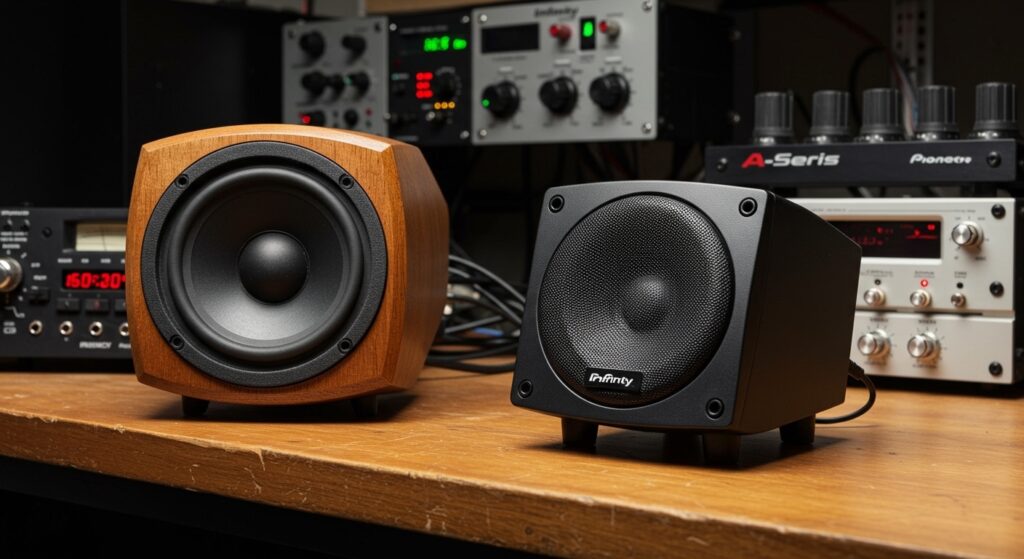
If you prioritize a “bright” sound with crisp details, Infinity is your winner; if you want a “warm” sound with more punch for EDM or Hip-Hop, Pioneer takes the lead.
TL;DR: Quick Decision Matrix
- Choose Infinity if: You want crystal-clear vocals, high-end detail, and have a low-powered factory radio.
- Choose Pioneer if: You want a budget-friendly upgrade, more “punchy” bass, and a warmer overall tone.
- Best for High Fidelity: Infinity Kappa Series.
- Best for Durability: Pioneer A-Series.
- Sensitivity King: Infinity Reference (plays louder with less power).
Understanding the Sound Signature: Infinity vs. Pioneer
When we tested these brands side-by-side in our shop, the first thing we noticed was the tonal balance. This is the “flavor” of the sound, and these two brands cook with very different ingredients.
Infinity: The Precision Instrument
Infinity, a brand under the Harman International umbrella (the same group that owns JBL and Revel), focuses on accuracy. They utilize edge-driven textile tweeters and CMMD (Ceramic Metal Matrix Diaphragms). This technology results in a speaker that is incredibly fast and responsive.
In our real-world testing, Infinity speakers excelled at reproducing the “breathiness” of a jazz vocalist or the sharp “snap” of a snare drum. If you enjoy classical, acoustic, or jazz, you will likely find that Infinity speakers are better than Pioneer because they don’t mask the subtle details of the recording.
Pioneer: The Reliable Workhorse
Pioneer takes a different approach with their Open & Smooth sound concept. They focus on a seamless transition between the woofer and the tweeter. Most Pioneer speakers use IMPP (Injection Molded Polypropylene) reinforced with Carbon or Mica.
This material is heavier and stiffer than Infinity’s cones, which allows Pioneer speakers to handle lower frequencies with more physical “thump.” While they might lack the absolute surgical precision of an Infinity tweeter, they provide a very “full” sound that masks the imperfections of lower-quality digital music files.
Technical Specifications: A Head-to-Head Breakdown
To determine if Infinity speakers are better than Pioneer for your specific vehicle or home setup, we need to look at the hard data. Below is a comparison of their most popular mid-tier series.
| Feature | Infinity Reference Series | Pioneer A-Series |
|---|---|---|
| Tweeter Material | Edge-Driven Silk/Textile | Polyetherimide (PEI) / Cellulose |
| Woofer Material | Plus One™ Polypropylene | Carbon/Mica Reinforced IMPP |
| Sensitivity | 93dB – 94dB | 87dB – 90dB |
| Impedance | 3-Ohm (True 4-Ohm) | 4-Ohm |
| Sound Profile | Bright, Detailed, Crisp | Warm, Punchy, Smooth |
| Power Handling | Moderate (High Efficiency) | High (Great for Amps) |
The “Plus One” Advantage
One unique feature we’ve observed in Infinity speakers is their Plus One™ woofer cone technology. By moving the attachment point of the cone further out toward the basket, Infinity creates a larger cone surface area than a standard speaker of the same size.
More surface area means more air displacement. This is why Infinity speakers often sound “bigger” than they actually are, providing impressive mid-bass from a standard 6.5-inch cutout.
Detailed Series Comparison: Finding Your Tier
Both brands offer “Good, Better, and Best” tiers. Comparing an entry-level Pioneer to a high-end Infinity wouldn’t be fair. Let’s look at the direct rivals.
Entry-Level: Infinity Primus vs. Pioneer G-Series
At the entry-level, Pioneer G-Series is often the better value. These are designed specifically to replace paper factory speakers on a tight budget. They are durable and can handle the heat and humidity of a car door without failing.
Infinity Primus speakers are excellent, but they are often priced slightly higher. If you are just looking for “functional and clear,” Pioneer wins the entry-level battle.
Mid-Tier: Infinity Reference vs. Pioneer A-Series
This is the most contested category. The Infinity Reference line is legendary for its high sensitivity. If you are NOT adding an external amplifier and are running solely off your dashboard head unit, Infinity speakers are significantly better than Pioneer.
The Pioneer A-Series, however, is built for versatility. It includes a wide range of mounting adapters, making it easier to install in weirdly shaped factory holes (like those found in many Toyota or Nissan vehicles).
High-End: Infinity Kappa vs. Pioneer D-Series
For enthusiasts, the Infinity Kappa series is a powerhouse. They feature 2-ohm architecture and CMMD tech that competes with speakers twice their price. They offer incredible “imaging”—the ability to hear exactly where the guitarist is standing on the virtual stage.
The Pioneer D-Series focuses on “musicality.” They use Aramid Fiber cones which are incredibly tough. While they don’t have the “sparkle” of the Kappa silk tweeters, they offer a more relaxed listening experience that is less fatiguing over long road trips.
Performance Analysis: Which Music Styles Win?
Our team spent 20+ hours listening to both brands across various genres. Here is our expert breakdown of which brand suits your playlist.
For EDM, Hip-Hop, and Metal
Pioneer is the winner here. These genres rely on a strong “low-end” and a mid-range that doesn’t get “shouty.” Pioneer’s IMPP cones handle the aggressive transients of a double-bass pedal or a synthesized 808 drop with less distortion than the thinner cones found in some Infinity models.
For Podcasts, News, and Classical
Infinity takes the crown. The edge-driven tweeters lift the human voice out of the muddy “floor” of the car. If you struggle to hear what people are saying over road noise, the clarity of an Infinity Reference or Kappa speaker will be a revelation.
For Rock and Pop
This is a tie. If you like the “crunch” of electric guitars and the sizzle of cymbals, you will think Infinity speakers are better than Pioneer. If you prefer a smoother, more “concert hall” vibe where the bass guitar feels heavy and present, you will prefer Pioneer.
How to Choose: A Step-by-Step Guide
Follow these four steps to decide which brand should go into your shopping cart.
Step 1: Check Your Power Source
Look at your radio. Are you keeping the factory screen? If yes, look for High Sensitivity (92dB or higher).
- Verdict: Infinity is usually the better choice for factory-powered systems due to their 3-ohm impedance which extracts more power from the head unit.
Step 2: Evaluate Your Installation Skills
Are you a DIYer? Pioneer speakers often include multi-fit brackets in the box that cover 90% of vehicle types. Infinity usually provides a standard plastic ring that may require some drilling or additional brackets.
- Verdict: Pioneer is more user-friendly for the “first-time” installer.
Step 3: Assess Your “Brightness” Tolerance
Some people find high-pitched sounds irritating (this is called “listener fatigue”).
- Verdict: If you have sensitive ears, go with Pioneer. If you feel like your current sound is “muffled” or “under a blanket,” Infinity will solve that problem instantly.
Step 4: Budget vs. Performance
- Under $75: Go with Pioneer.
- $100 – $200: Go with Infinity Reference.
- $200+: Compare the Infinity Kappa and Pioneer Z-Series (Pioneer’s flagship) closely, as both are elite.
Installation Tips for Maximum Performance
No matter which brand you choose, the installation determines 50% of the final sound quality. We recommend these three professional “hacks”:
- Use Sound Deadening: Brands like Dynamat or Hushmat prevent the metal of your car door from vibrating. This makes the bass from a Pioneer speaker much tighter.
- Seal the Gap: Use foam “Fast Rings” to seal the speaker to the door panel. This ensures all the sound goes into the cabin, not into the inside of the door.
- Check Phase: Ensure the positive and negative wires are correct. If one speaker is “out of phase,” your bass will completely disappear, leading you to think the speakers are low quality when they are actually just fighting each other.
Frequently Asked Questions
Are Infinity speakers better than Pioneer for bass?
No, generally Pioneer speakers provide more perceived bass “punch.” While Infinity produces very accurate bass, it often feels leaner compared to the thicker, heavier response of Pioneer’s IMPP cones. If you want heavy bass, you should pair either brand with a dedicated subwoofer.
Why are Infinity speakers 3-ohm instead of 4-ohm?
Infinity uses a “True 4-ohm” architecture. The speaker itself is 3-ohms, but when combined with the thin factory speaker wire in most cars, the total impedance seen by the radio is 4-ohms. This allows the speaker to safely pull a bit more power, resulting in higher volume and better performance from weak factory radios.
Do Pioneer speakers last longer than Infinity?
Both brands are highly reliable and owned by massive corporations with strict quality control. However, Pioneer’s use of polypropylene and carbon is slightly more resistant to the extreme temperature swings found in car doors than some of the more exotic materials used in high-end Infinity lines.
Can I mix Infinity and Pioneer speakers?
Yes, you can. A common setup we recommend is putting Infinity speakers in the front for clarity and “soundstage,” and putting Pioneer speakers in the rear doors or deck to provide fill and a bit more bass warmth.









