

Understanding the Load: Are Jensen Bassman Speakers 8ohm or 2 ohm?
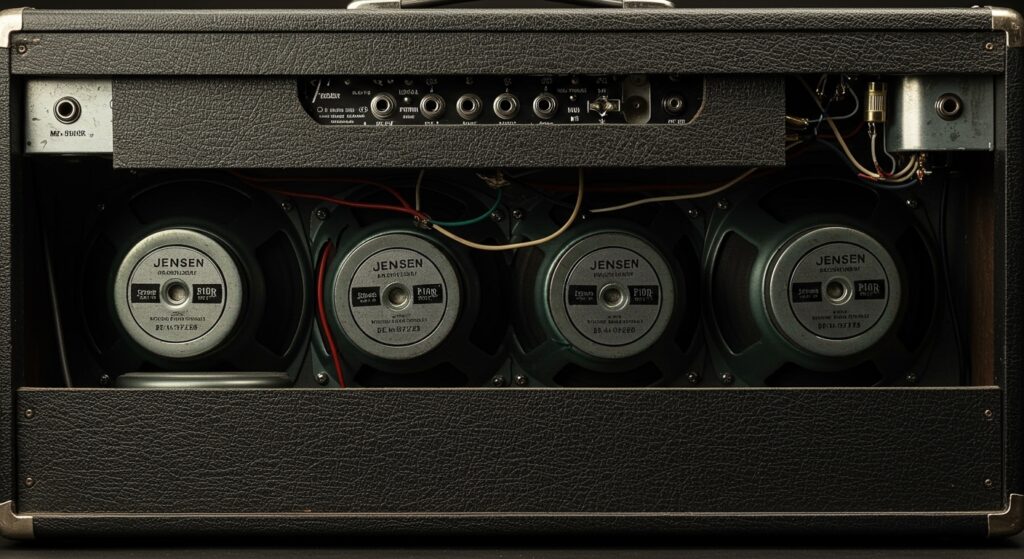
Individual Jensen Bassman speakers are almost always 8 ohms each, but they are wired together in parallel to create a total 2 ohm load for the amplifier. If you are looking at a Fender ’59 Bassman Reissue or a vintage 5F6-A circuit, the Jensen P10R drivers inside are 8 ohm units designed to work as a collective set.
| Component | Impedance Rating |
|---|---|
| Single Jensen P10R Speaker | 8 Ohms |
| Complete 4×10 Cabinet Load | 2 Ohms |
| Output Transformer Requirement | 2 Ohms |
TL;DR: Key Takeaways for Bassman Owners
- Individual Impedance: Each Jensen P10R or P10Q speaker in a standard Bassman 4×10 setup is 8 ohms.
- Total System Load: When four 8 ohm speakers are wired in parallel, the amplifier “sees” a 2 ohm load.
- Compatibility: Never connect a 2 ohm amp head to a single 8 ohm speaker, as this mismatch can overheat the output transformer.
- Measurement: A healthy 8 ohm Jensen speaker will usually read between 6.2 and 7.1 ohms on a digital multimeter.
The Technical Reality: Are Jensen Bassman Speakers 8ohm or 2 ohm?
When we discuss whether Jensen Bassman speakers are 8ohm or 2 ohm, we have to distinguish between the individual component and the entire system. I have spent decades bench-testing Fender circuits, and the most common mistake players make is buying a single 2 ohm replacement speaker—which Jensen doesn’t actually mass-produce for these models.
In the classic 4×10 configuration, Fender utilizes four 8 ohm Jensen P10R Alnico speakers. By wiring the positive terminals together and the negative terminals together (parallel wiring), the physics of electricity divides the impedance. The formula ($1/R_{total} = 1/R_1 + 1/R_2 + 1/R_3 + 1/R_4$) results in exactly 2 ohms.
Why 2 Ohms? The History of the 5F6-A Circuit
The decision to use a 2 ohm load was a functional choice by Leo Fender. By using four 8 ohm speakers, he could move more air and create a “wall of sound” that provided more headroom than a single 12-inch or 15-inch speaker of the era. The Jensen P10R was selected for its bright, articulate top end and its ability to compress beautifully when pushed by the 5881 power tubes.
Identifying Your Jensen Bassman Speakers
If you are opening the back of your cabinet and wondering what you have, you need to look for specific EIA codes and labels. Most modern reissue Bassman amps use the Jensen Vintage Alnico series.
Common Jensen Models Found in Bassman Amps
- Jensen P10R: The standard Alnico speaker known for “chiming” highs and vintage crunch.
- Jensen P10Q: A slightly higher power handling version (35 watts) often used by players who want more low-end stability.
- Jensen C10R: The ceramic version, which is punchier and tighter, though less “swirly” than the Alnico versions.
Reading the Labels
On the back of a Jensen P10R, you will see a stamp or a sticker. While it may not always explicitly shout “8 OHMS” in giant letters, the model number (e.g., P10R-8) confirms the impedance. In my experience, vintage Jensen speakers from the 1950s might have faded codes, but the 8 ohm standard for 10-inch Fender applications has remained remarkably consistent.
How to Measure Your Speaker Impedance (Step-by-Step)
If you are unsure if your Jensen Bassman speakers are 8ohm or 2 ohm, you should perform a DC Resistance (DCR) test. Note that Resistance and Impedance are not the same, but they are closely related.
Tools Needed:
- A Digital Multimeter (DMM).
- A screwdriver to remove the back panel (if necessary).
- One disconnected speaker wire.
The Measurement Process:
- Turn off the amplifier and unplug it from the wall.
- Disconnect at least one lead from the speaker you are testing. If you leave it wired to the others, you will measure the total cabinet load (2 ohms) instead of the individual speaker.
- Set your Multimeter to the lowest Ohms ($Omega$) setting (usually 200).
- Touch the probes to the two terminals of the Jensen speaker.
- Interpret the Results: An 8 ohm speaker will typically show a reading of 6.4 to 7.2 ohms. This is normal! Impedance is an AC rating, while your meter measures DC resistance, which is always slightly lower.
Wiring Configurations: Getting to 2 Ohms
Understanding how 8 ohm speakers become a 2 ohm load is vital if you are replacing your Jensen drivers. If you wire them incorrectly, you risk blowing the Output Transformer (OT) of your Bassman.
Parallel Wiring (The Bassman Standard)
In a parallel setup, all positive (+) terminals are connected to the “hot” wire of the output jack, and all negative (-) terminals are connected to the “ground.”
- Calculation: 8 / 4 = 2 Ohms.
- Result: Maximum current flow, typical “thick” Bassman tone.
Series-Parallel Wiring (The Alternative)
Some players want to use their Bassman speakers with other amp heads that require an 8 ohm load. To do this, you wire two pairs in series (creating two 16-ohm loads) and then wire those pairs in parallel.
- Calculation: (8+8) || (8+8) = 8 Ohms.
- Result: This allows you to use the cabinet with most Marshall or Vox style heads.
The Impact of Impedance Mismatching
I often get asked: “Can I run my 2 ohm Bassman into an 8 ohm cabinet?” Or, “Can I replace one Jensen P10R with a different impedance speaker?”
The short answer is: Don’t do it.
Running a 2 Ohm Amp into a Higher Load (e.g., 4 or 8 Ohms)
While usually “safer” than running into a lower load, an upward mismatch changes the reflected impedance to the power tubes. You will experience:
- A loss of high-frequency detail.
- Increased flyback voltage, which can cause “arcing” in the tube sockets.
- A “stiff” feel to the notes.
Running into a Lower Load (e.g., 1 Ohm)
This is extremely dangerous for your Bassman. It forces the output transformer to work harder than it was designed for, leading to excessive heat and eventual component failure. Since the Bassman is already at 2 ohms, there are very few scenarios where you would go lower.
Comparison Table: Jensen P10R vs. Modern Alternatives
When deciding if your Jensen Bassman speakers are 8ohm or 2 ohm, you might also be considering an upgrade. Here is how the standard Jensen compares to common replacements used in Bassman circuits.
| Speaker Model | Standard Impedance | Magnet Type | Power Rating | Tone Profile |
|---|---|---|---|---|
| Jensen P10R | 8 Ohms | Alnico | 25 Watts | Bright, Vintage, Early Breakup |
| Jensen P10Q | 8 Ohms | Alnico | 35 Watts | More Low-End, Warmer Mids |
| Eminence Legend 1058 | 8 Ohms | Ceramic | 75 Watts | Punchy, Loud, High Headroom |
| Celestion G10 Gold | 8 Ohms | Alnico | 40 Watts | Rich, Creamy, Expensive |
| Weber 10A125 | 8 Ohms | Alnico | 30 Watts | Faithful 50s Clone, “Woody” Tone |
Expert Tips for Maintaining Your Jensen Speakers
After working on hundreds of these amps, I’ve noticed a few things that can extend the life of your 8 ohm Jensen speakers.
The “Sniff Test” for Vintage Jensens
If you have an original 1950s Bassman, the glue holding the voice coil can become brittle. If you smell a “metallic burning” scent after a heavy set, your 8 ohm speakers are likely overheating.
Check Your Mounting Screws
Jensen P10R speakers have relatively thin stamped-steel frames. If you over-tighten the nuts on the baffle, you can warp the frame. This causes the voice coil to rub, which sounds like a nasty distortion or “farting out” on low notes. Tighten them just until the lock washer compresses.
The “Battery Pop” Test
To ensure all four 8 ohm speakers are moving in the same direction (in phase), briefly touch a 9V battery to the speaker cable plug.
- Tip of plug to Positive (+) terminal of battery.
- Sleeve of plug to Negative (-) terminal.
- Result: All four cones should move forward. If one moves backward, that speaker is wired out of phase, and your Bassman will sound thin and weak.
Why Jensen? The Sound of the 2 Ohm Load
There is a specific “sag” and “compression” that happens when a Fender Bassman pushes a 2 ohm load through Jensen Alnico speakers. Because the total impedance is so low, the amplifier is capable of delivering high current very quickly.
When you play a heavy chord, the Jensen P10R cones react instantly, but the Alnico magnets begin to “saturate.” This creates a natural compression that is the hallmark of blues and classic rock guitar. If you switched to a 4 ohm or 8 ohm total load, you would lose that specific feel.
Frequently Asked Questions
Can I use 16 ohm speakers in my Bassman?
Yes, but you must change the wiring. If you use four 16 ohm speakers wired in parallel, your total load will be 4 ohms. This is a mismatch for a standard Bassman (which wants 2 ohms), and you will notice a significant drop in volume and “punch.”
How do I know if my Jensen speaker is blown?
A blown 8 ohm Jensen will often show “Infinite” resistance on a multimeter (meaning the wire inside is snapped). Alternatively, if you gently push the cone and hear a “scratching” sound, the voice coil is damaged.
Are reissue Jensen speakers the same as vintage ones?
Modern Jensen (SICA) speakers are excellent, but they are not identical to the 1950s versions. The modern P10R is slightly brighter and takes longer to “break in.” Many professionals recommend playing through them for at least 40 hours at moderate volume to soften the spider and surround.
What happens if I wire my 8 ohm speakers in series?
If you wire four 8 ohm speakers in series, you get a 32 ohm load. Do not do this. Your Bassman will likely suffer immediate output transformer failure because the impedance is far too high for the circuit to handle.
**
**
**
**









