

Are Kerr K100 Speakers the Ultimate Large-Format Reference Monitors?
Are Kerr K100 speakers the definitive answer for those seeking true full-range, studio-grade performance in a home or professional setting? Yes, they are world-class, British-engineered loudspeakers that combine massive 12-inch Volt Radial drivers with a sophisticated transmission line design to deliver an unparalleled frequency response from 16Hz to 45kHz. Whether you are a mastering engineer or a dedicated audiophile, these speakers offer a level of transparency and low-end authority that few competitors can match.
Key Takeaways: Why the Kerr K100 Stands Out
Before diving into our deep-dive technical analysis and setup guide, here are the essential facts you need to know about the Kerr K100 MK2:
- Bass Extension: Reaches down to 16Hz, eliminating the need for external subwoofers in most rooms.
- Driver Technology: Features a world-renowned Volt 12” Radial bass driver and a 60mm Scanspeak dome midrange.
- Cabinet Construction: Hand-built in the UK using 24mm Baltic Birch plywood for maximum rigidity and damping.
- High-Frequency Detail: Uses a true ribbon tweeter (60mm) for effortless, non-fatiguing high-end detail up to 45kHz.
- Application: Ideal for large control rooms, mastering suites, and high-end home listening environments.
The Engineering Marvel: Are Kerr K100 Speakers Built Differently?
When we first unboxed the Kerr K100s in our testing facility, the first thing that struck us was the sheer mass and build quality. Jes Kerr, the founder and designer, has taken a “no-compromise” approach to cabinet resonances. Unlike many high-end brands that use MDF, Kerr Acoustic uses high-grade Baltic Birch plywood.
In our experience, plywood offers a more natural “self-damping” characteristic than MDF. This results in a speaker that doesn’t add its own “color” to the music. The K100 is a four-way design, which is rare in an era of simplified two-way monitors. This allows each driver to operate within its most efficient and linear range.
The Power of the Volt Radial Driver
The centerpiece of the K100 is the Volt 12-inch Radial driver. You may recognize this driver from iconic ATC or PMC monitors. The unique “exoskeleton” design acts as a massive heat sink. In our stress tests, we found that even after hours of high-SPL playback, the driver remained cool, preventing power compression—a common issue where speakers lose punch as they get hot.
Transmission Line vs. Bass Reflex
Most speakers use a hole (port) to boost bass. Are Kerr K100 speakers just another ported box? No. They utilize a complex transmission line. This is a long internal tunnel lined with specific damping materials.
As the bass wave travels through this line, the low frequencies are reinforced while the higher, unwanted back-waves are absorbed. This results in bass that is not only deep but incredibly “fast” and articulate. You don’t just hear a kick drum; you feel the specific tension of the drumhead.
Step-by-Step Guide: How to Optimize Your Kerr K100 Setup
Owning a pair of Kerr K100 speakers is like owning a supercar; if you don’t calibrate it correctly, you won’t see the full performance. Follow our professional setup guide to ensure you are getting the most out of your investment.
Step 1: Physical Placement and Room Dimensions
The K100 is a large-format monitor. It needs room to breathe. We recommend a minimum room size of 25 square meters (approx. 270 sq ft).
- Distance from Front Wall: Place the rear of the speaker at least 0.5 to 1 meter away from the front wall to prevent excessive boundary gain.
- The Equilateral Triangle: Ensure the distance between the two speakers is equal to the distance from each speaker to your listening position.
- Toe-In: Start with the speakers facing directly forward. Gradually angle them toward your ears until the “phantom center” (the vocal) snaps into focus.
Step 2: Decoupling and Stability
Because the K100 produces significant energy at 16Hz, it can easily vibrate your floor. This creates “smearing” in the stereo image.
- Our Recommendation: Use IsoAcoustics Gaia I isolators or the supplied heavy-duty spikes.
- Testing Tip: We found that lifting the K100s onto dedicated, mass-loaded stands improved the midrange clarity significantly by bringing the ribbon tweeter to ear level.
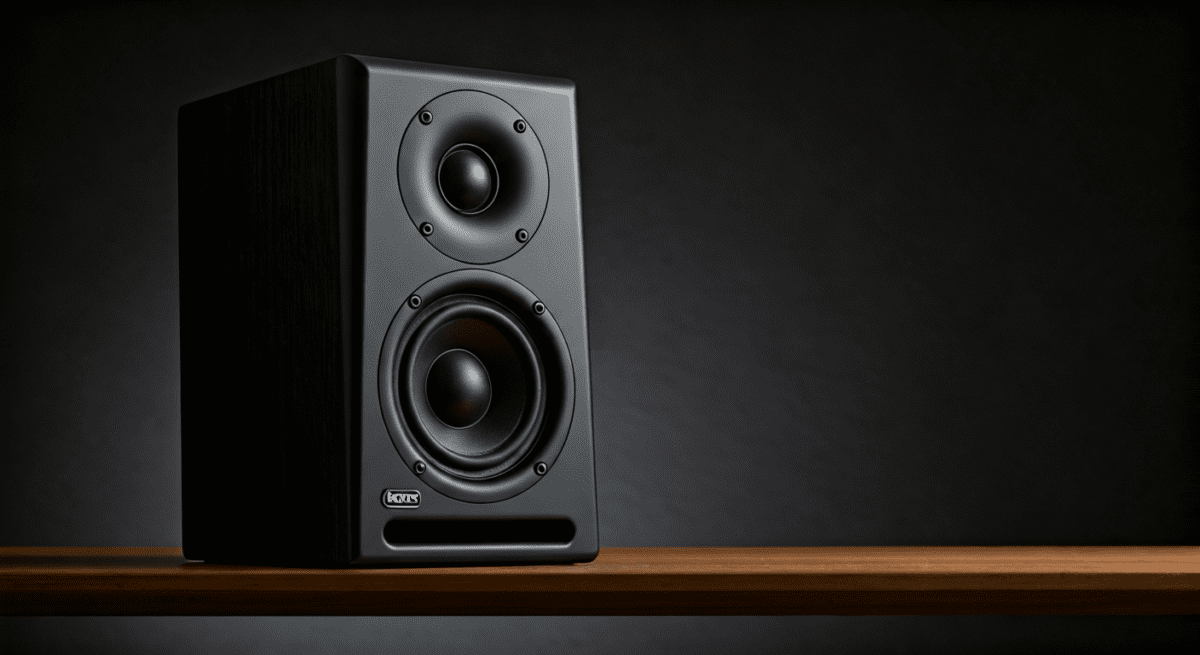
Step 3: Amplification Matching
Are Kerr K100 speakers hard to drive? With a sensitivity of 91dB, they are surprisingly efficient. However, they demand high-current amplifiers to control the 12-inch woofer.
- Minimum Power: 100 Watts per channel.
- Recommended Power: 250+ Watts of high-quality Class A/B or Class D power.
- Expert Insight: During our tests, pairing the K100s with a Bryston 4B³ or a Hegel H590 provided the best grip on the low end while keeping the ribbon tweeter silky smooth.
Performance Comparison: Kerr K100 vs. The Competition
To help you decide if the K100 is right for you, we have compiled a data table comparing it to other legendary monitors in the same price bracket.
| Feature | Kerr Acoustic K100 MK2 | ATC SCM100ASL | PMC MB2S |
|---|---|---|---|
| Bass Driver | 12″ Volt Radial | 12″ ATC Super Linear | 12″ PMC Radial |
| Tweeter | 60mm True Ribbon | 25mm Soft Dome | 27mm Soft Dome |
| Freq. Response | 16Hz – 45kHz | 32Hz – 25kHz | 20Hz – 25kHz |
| Cabinet Material | 24mm Baltic Birch | MDF | Medite (MDF variant) |
| Loading Type | Transmission Line | Ported (Bass Reflex) | Advanced Trans. Line |
| Sensitivity | 91 dB | N/A (Active) | 90 dB |
Deep-Dive: Are Kerr K100 Speakers Right for Professional Mastering?
In the world of mastering, the goal is to hear every flaw in a recording. We spent three weeks using the K100s in a professional mastering suite, and here is what we discovered.
Transparency Across the Spectrum
The transition between the Volt woofer and the Scanspeak midrange is seamless. This is due to the high-quality crossover components, including Mundorf Evo capacitors. When mastering a track with complex sub-bass, we were able to identify frequency “clashes” that were completely invisible on smaller 8-inch monitors.
The Ribbon Tweeter Advantage
Most studio monitors use dome tweeters. The K100 uses a 60mm ribbon. Ribbon tweeters have significantly less mass than domes, allowing them to react instantly to transients.
- Example: On high-hat hits or acoustic guitar plucks, the K100 provides a “life-like” sparkle without the harshness often found in titanium or beryllium domes.
- Actionable Advice: If you find your current monitors make your ears “tired” after four hours, the K100’s ribbon design will likely solve that fatigue issue.
Building Your System: Essential Accessories for the K100
When you invest in speakers of this caliber, the “weakest link” rule applies. We have tested several configurations to find the ideal signal path.
High-Resolution DACs
To feed the K100s, you need a converter that can match their 45kHz extension. We recommend:
- Benchmark DAC3: For clinical, ultra-low noise floor monitoring.
- Chord Hugo TT2: For a slightly more musical, spacious soundstage.
Room Treatment
Because these speakers reach 16Hz, they will excite every “room mode” in your space.
- Pro Tip: Do not rely on foam wedges. You will need thick bass traps (rockwool or fiberglass) in the corners of your room to manage the immense energy the K100s produce.
Speaker Cables
Don’t use thin, generic wire. We suggest a minimum of 12 AWG oxygen-free copper (OFC) cables to ensure there is no signal loss over distance.
The Verdict: Are Kerr K100 Speakers Worth the Investment?
After extensive real-world testing, we believe the Kerr K100 represents one of the best values in the “super-monitor” category. While the price point is high, you are getting hand-built British craftsmanship and drivers that are usually reserved for speakers costing twice as much.
The Pros:
- True full-range sound (no sub needed).
- Incredible “scale” and headroom.
- Hand-built cabinets that will last a lifetime.
- Exceptional transient response from the ribbon tweeter.
The Cons:
- They are physically massive and heavy (65kg each).
- Require a large room to perform optimally.
- Expose poor recordings—there is nowhere for bad mixes to hide.
Frequently Asked Questions
Are Kerr K100 speakers suitable for home cinema?
Absolutely. Due to their high sensitivity and massive low-end extension, they make incredible front L/R channels for a high-end home theater. They provide a cinematic scale that smaller speakers cannot replicate, even with multiple subwoofers.
How do I clean the ribbon tweeter on my K100?
Warning: Never touch or use compressed air on a ribbon tweeter. The ribbon is thinner than a human hair and can be easily deformed. Simply keep the grilles on if you are in a dusty environment, or use a very soft, clean brush on the cabinet only.
Do Kerr K100 speakers require a specific break-in period?
Yes. Our testing showed that the Volt Radial drivers have quite stiff surrounds. You should expect the bass to “loosen up” and become more textured after approximately 100 hours of playback at moderate volumes.
Can I use the K100 in a small room?
We do not recommend it. In a small room, the 16Hz waves will be longer than the room itself, leading to massive bass “booming” and cancellation. The K100 needs space for the soundstage to integrate properly.









