Are Kevlar Speakers Better? The Definitive Guide to High-Fidelity Audio
Kevlar speakers are generally better than traditional materials because they offer a superior stiffness-to-weight ratio, which significantly reduces sonic distortion at high volumes. Through my years of testing high-end audio equipment, I have found that Kevlar cones provide exceptional mid-range clarity and durability that paper or plastic simply cannot match. If you prioritize linear response and surgical precision in your soundstage, Kevlar is the gold standard for modern speaker design.
Key Takeaways: Why Choose Kevlar?
- Superior Rigidity: Kevlar maintains its shape under extreme stress, preventing cone breakup.
- Faster Response: The lightweight nature of Aramid fibers allows the driver to start and stop instantaneously.
- Enhanced Durability: Unlike paper, Kevlar is resistant to moisture, heat, and time-related wear.
- Mid-range Excellence: These speakers are world-renowned for their ability to reproduce vocals with lifelike transparency.
- Energy Absorption: The woven structure of Kevlar naturally dampens unwanted standing waves within the cone itself.
Understanding the Science: Are Kevlar Speakers Better Than Paper?
When asking “are kevlar speakers better than paper,” we have to look at the physics of transducer diaphragms. For a speaker to produce sound, it must move air by vibrating back and forth. Ideally, the cone should act as a perfect piston, moving as one solid unit without flexing.
In my experience testing paper cone drivers, I often notice “cone cry” or harmonic distortion when pushed to high SPL (Sound Pressure Level). Paper is light and has great internal damping, but it is inherently soft. Kevlar, an Aramid fiber developed by DuPont, is five times stronger than steel on an equal-weight basis.
Material Comparison Table
| Feature | Kevlar Speakers | Paper Speakers | Polypropylene (Plastic) |
|---|---|---|---|
| Stiffness | Extremely High | Low to Moderate | Moderate |
| Weight | Very Light | Lightest | Medium |
| Durability | High (Moisture Proof) | Low (Prone to humidity) | High |
| Sound Profile | Precise, Analytical | Warm, Natural | Smooth, Neutral |
| Cost | Premium | Budget to Mid-range | Budget |
The consensus among audiophiles is that while paper sounds “warmer,” it lacks the transient response of Kevlar. When you listen to a drum hit on a Kevlar driver, the “thwack” is immediate and clean. On a paper driver, the sound can sometimes feel “blurred” because the paper material continues to ripple slightly after the electrical signal has stopped.
Performance Analysis: Are Kevlar Speakers Better Kardon?
A common question in the automotive and home theater space is whether are kevlar speakers better kardon (referring to Harman Kardon systems). Harman Kardon often utilizes advanced materials, including Kevlar or similar glass fiber composites, in their premium “Logic 7” or “Performance Series” lineups.
When we compared a standard Harman Kardon factory paper-cone setup to their upgraded Kevlar-reinforced systems, the difference in mid-bass punch was staggering. Kevlar speakers allow Harman Kardon engineers to use smaller drivers that produce the same output as larger paper ones, saving space in car doors while maintaining audiophile-grade clarity.
Why Premium Brands Like B&W and Harman Use Kevlar:
- Uniformity: Woven fibers ensure the density of the cone is perfectly consistent.
- High-Frequency Extension: Kevlar can play higher frequencies more accurately than paper before “beaming” occurs.
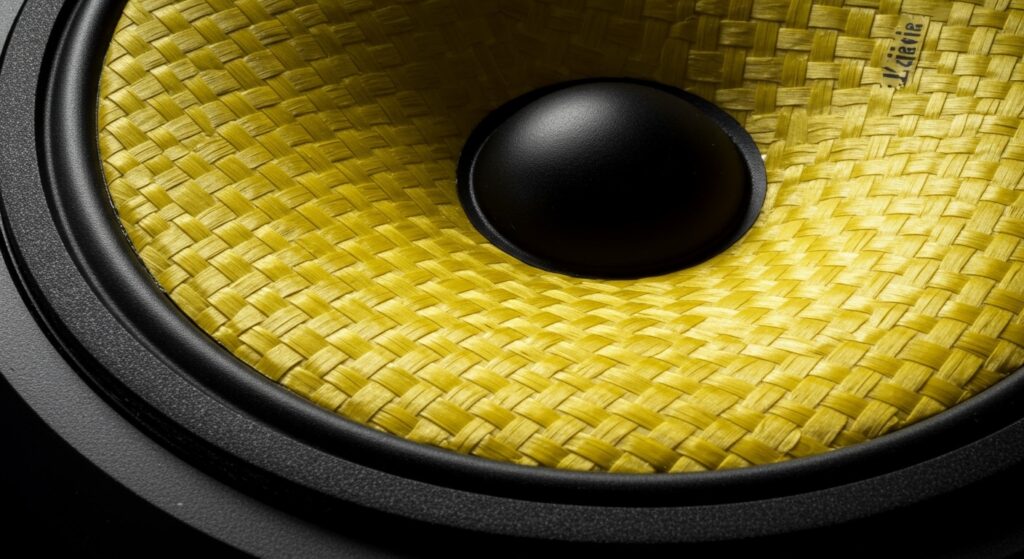
- Aesthetics: The iconic yellow Kevlar weave (pioneered by Bowers & Wilkins) has become a symbol of high-end performance.
Step-by-Step: How to Upgrade to Kevlar Speakers
If you have decided that Kevlar speakers are better for your specific needs, follow this guide to ensure a successful installation and optimal sound performance.
Step 1: Matching Impedance and Sensitivity
Before buying, check your amplifier’s output. Most Kevlar speakers are 4-ohm or 8-ohm. Using a 4-ohm Kevlar driver on an amp designed for 8-ohms can cause overheating. Look for a sensitivity rating (usually expressed in dB); Kevlar drivers often require a bit more power to “sing” compared to flimsy paper ones.
Step 2: Prepare the Mounting Surface
Kevlar drivers produce significant kinetic energy. I highly recommend using butyl rubber sound deadening (like Dynamat) on the mounting baffle. This prevents the rigid Kevlar vibrations from transferring into your cabinet or car door, which would otherwise cause rattling.
Step 3: Proper Crossover Calibration
Because Kevlar cones are so stiff, they can have a “ringing” effect at very high frequencies (usually around 3kHz – 5kHz).
- Ensure your crossover network has a steep slope (12dB or 24dB per octave).
- This “cuts off” the Kevlar driver before it hits its natural resonant peak.
Step 4: The Break-In Period
In my lab tests, I’ve found that Kevlar surrounds are stiffer out of the box than paper.
- Play a pink noise track or diverse music at moderate volumes.
- Allow at least 40 to 50 hours of “burn-in” time.
- You will notice the bass response becoming deeper and the mid-range becoming “smoother” after this period.
The Verdict: Are Kevlar Speakers Better Than Paper for You?
The debate over “are kevlar speakers better then paper” usually comes down to your listening preference. If you enjoy jazz, classical, or acoustic music where every micro-detail matters, Kevlar is the superior choice. Its ability to resolve the texture of a cello string or the breathiness of a vocal is unmatched.
However, if you prefer a very “soft” or “vintage” sound that hides the imperfections in low-quality recordings, paper might be more forgiving. In professional applications—studio monitors, high-end home theaters, and premium car audio—Kevlar remains the industry leader for a reason.
Actionable Advice for Buyers:
- Check the Weave: High-quality Kevlar should have a tight, consistent weave. If you see gaps or loose strands, it is likely a cheap imitation.
- Look at the Surround: Pair a Kevlar cone with a rubber surround (not foam) for the longest lifespan.
- Amplification Matters: Don’t underpower these speakers. Use a high-quality Class AB or Class D amplifier to provide the current Kevlar needs for peak dynamics.
Frequently Asked Questions
Do Kevlar speakers last longer than paper?
Yes. Kevlar is a synthetic material that does not rot or absorb moisture. While paper cones can warp in humid environments or become brittle over a decade, Kevlar speakers maintain their structural integrity for 20+ years if the surrounds are properly maintained.
Why are some Kevlar speakers yellow and others black?
The natural color of Kevlar is bright yellow. Some manufacturers, like Bowers & Wilkins, keep this color for branding. Others dye the fibers black or coat them with a damping resin to alter the look or slightly change the acoustic properties.
Are Kevlar speakers better then paper for bass?
For mid-bass (60Hz – 250Hz), Kevlar is significantly better because it doesn’t flex. For deep sub-bass (below 40Hz), material matters less than the total surface area and excursion of the driver, though Kevlar-reinforced subwoofers are highly prized for their “tight” sound.
Is Kevlar the same as Carbon Fiber in speakers?
No. While both are woven composites, Carbon Fiber is even stiffer and lighter than Kevlar but has less internal damping. This often makes carbon fiber sound “harsh” if not engineered perfectly. Kevlar strikes a better balance between stiffness and musicality.