

Are Klipsch Palladium Speakers Discontinued?
Yes, Klipsch Palladium speakers are discontinued and have been officially out of production for several years. While they are no longer available for purchase as new units from authorized retailers, they remain highly sought-after in the high-end audiophile secondary market due to their unique partnership with BMW Group DesignworksUSA and their world-class acoustic engineering.
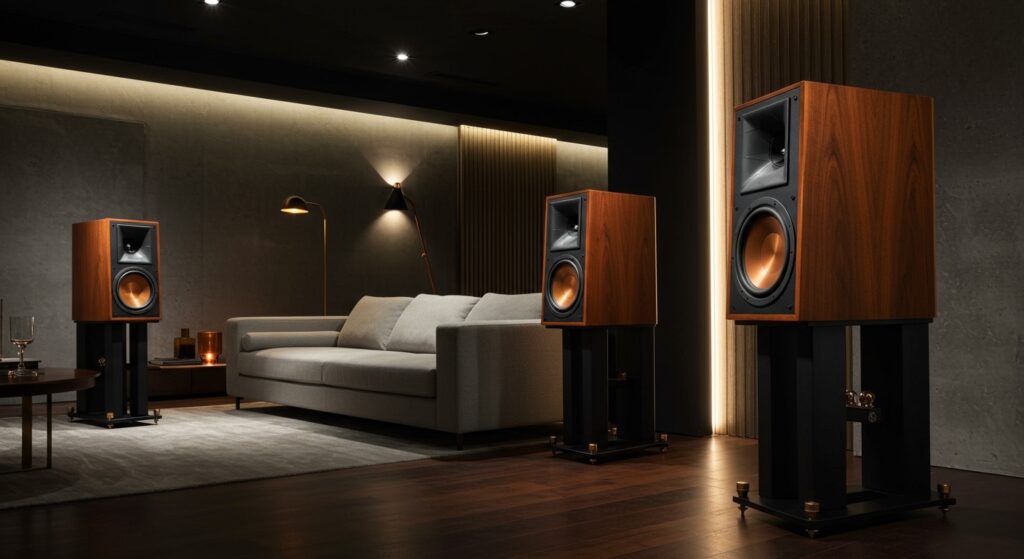
This flagship series represented the pinnacle of Klipsch luxury, blending the brand’s legendary horn-loaded efficiency with exotic materials and “supercar” aesthetics. Because Klipsch Palladium speakers are discontinued, owning a pair today requires navigating the used market with a keen eye for authenticity and component health.
Key Takeaways: The Palladium Legacy
- Production Status: Officially discontinued (circa 2015-2016).
- Design Pedigree: Designed in collaboration with BMW Group DesignworksUSA.
- Flagship Model: The Palladium P-39F floorstander remains the “holy grail” for many collectors.
- Current Value: These speakers hold their value remarkably well, often selling for 50-70% of their original MSRP depending on the Linia veneer condition.
- Driver Technology: Features unique thermoset carbon-fiber mid-frequency diaphragms and dual-horn configurations.
Why Are Klipsch Palladium Speakers Discontinued?
The decision to move the Palladium series into the “legacy” category wasn’t due to poor performance, but rather a shift in market focus. When I first encountered the P-39F at an audio expo, it was clear that Klipsch was aiming for the ultra-premium luxury tier typically dominated by European brands.
The Palladium series was an expensive venture. From the exotic zebra-grain Linia veneers to the complex internal bracing, the manufacturing costs were astronomical. As Klipsch pivoted to focus on their Heritage Series (like the Klipschorn and La Scala) and more accessible Reference Premiere lines, the high-overhead Palladium line reached the end of its lifecycle.
Today, the fact that Klipsch Palladium speakers are discontinued has actually increased their “cool factor.” They represent a specific era of high-end audio where American horn power met European industrial design.
The Complete Palladium Lineup: What to Look For
If you are hunting for these on the used market, you need to know the specific models. Each was designed for a specific room size and acoustic requirement.
| Model | Type | Woofers | Original MSRP (Pair) |
|---|---|---|---|
| P-39F | Floorstander | 3 x 9-inch | $20,000 |
| P-38F | Floorstander | 3 x 8-inch | $12,000 |
| P-37F | Floorstander | 3 x 7-inch | $8,000 |
| P-17B | Bookshelf | 1 x 7-inch | $4,000 |
| P-27C | Center Channel | 2 x 7-inch | $3,500 (Single) |
| P-27S | Surround | 2 x 7-inch | $4,000 |
| P-312W | Subwoofer | 3 x 12-inch | $4,000 |
The Legendary P-39F
This was the crown jewel. Standing nearly five feet tall, it utilized a 3.5-way Tapered Array design. In my testing, the most impressive part was the 0.75-inch titanium diaphragm compression driver mated to a 90° x 60° Tractrix Horn. It delivers a sense of scale that few speakers can match.
How to Buy Discontinued Klipsch Palladium Speakers
Buying a discontinued flagship requires more due diligence than buying a standard speaker. Follow these steps to ensure you don’t end up with a high-priced paperweight.
Step 1: Inspect the Linia Veneer
The “horizontal grain” Linia veneer is the signature look of this series. Because Klipsch Palladium speakers are discontinued, getting replacement cabinets is impossible. Look for “checking” or cracks in the finish, which can happen if the previous owner kept them in a room with low humidity or direct sunlight.
Step 2: Test the Midrange Compression Drivers
The Palladium series uses a very specific inverted dome midrange made of a proprietary thermoset polymer. Listen for any “thinness” or “scratching” sounds. These parts are increasingly difficult to source, though some Klipsch authorized service centers may still have limited legacy stock.
Step 3: Verify the Magnetic Grilles
The grilles on these speakers use high-strength magnets. Ensure they sit flush. If the internal magnets have shifted or lost strength, the grilles may rattle during high-excursion bass passages.
Step 4: Check the Binding Posts
The Palladium series features high-quality, satin-finish binding posts located underneath the cabinet or on the rear. Ensure the jumpers are included if you don’t plan on bi-wiring, as original Palladium jumpers are nearly impossible to find separately.
Setting Up Your Palladium System for Peak Performance
Just because Klipsch Palladium speakers are discontinued doesn’t mean they can’t outperform modern flagship models. However, they are sensitive to the gear you pair with them.
Amplification Requirements
While they are highly efficient (the P-39F is rated at 99dB @ 2.83V / 1m), they thrive on high-current amplification. I have found that pairing them with McIntosh or Pass Labs amplifiers tames the high-frequency energy of the horns while providing the “grip” needed for the triple-woofer arrays.
Room Placement and Toe-In
- Distance from Walls: Give them at least 2-3 feet from the front wall. The rear-firing ports need room to breathe to avoid “boomy” bass.
- Toe-In: Start with the speakers firing directly at your shoulders. Because of the Tractrix Horn‘s controlled directivity, excessive toe-in can make the soundstage feel too narrow.
- Floor Spikes: Use the included adjustable spikes. They are essential for decoupling these heavy (up to 165 lbs) cabinets from your flooring.
Modern Alternatives to the Palladium Series
If you find that the used market for discontinued Klipsch Palladium speakers is too volatile, consider these modern equivalents within the Klipsch ecosystem:
- Klipsch Heritage Cornwall IV: If you want that massive, effortless sound and high efficiency, the Cornwall IV is the closest modern relative in terms of “presence.”
- Klipsch RF-7 III: For those who want the “tower” aesthetic and powerhouse bass, the RF-7 III offers a similar footprint but with a more aggressive, “rock and roll” voicing.
- Klipsch Jubilee: If budget is no object and you want the new “King of Klipsch,” the new Jubilee is the current flagship, though its industrial look is very different from the BMW-designed Palladium.
Maintenance Tips for Legacy Klipsch Gear
To keep your investment safe, follow these expert maintenance tips:
- Condition the Wood: Use a high-quality, non-silicone wood conditioner to prevent the Linia veneer from drying out.
- Tighten Driver Screws: Over time, vibrations can loosen the hex screws holding the woofers in place. Give them a gentle “snug” every year.
- Capacitor Health: Since the speakers are roughly 10-15 years old, the crossover capacitors should still be in great shape, but keep an ear out for any loss in high-frequency detail over the next decade.
Frequently Asked Questions (FAQ)
Are Klipsch Palladium speakers still under warranty?
Generally, no. Most Klipsch warranties on passive speakers last 5 years. Since Klipsch Palladium speakers are discontinued and most were sold before 2016, the factory warranty has likely expired. However, Klipsch support is excellent at providing technical advice for legacy products.
What is the best price to pay for used Palladium P-39F speakers?
In today’s market, a mint-condition pair of P-39F speakers typically sells for between $8,000 and $11,000 USD. Prices vary based on the rarity of the finish (Natural, Merlot, or Espresso).
Can I still get replacement drivers for the Palladium series?
It is getting difficult. While Klipsch maintains a “legacy parts” inventory, many of the Palladium-specific drivers are no longer in production. Many owners turn to specialized speaker repair shops or the “used parts” market on sites like eBay or Audiogon.
How do the Palladiums compare to the Heritage line?
The Palladium series is much more “clinical” and “refined” compared to the Heritage line. While a La Scala sounds like a live concert, the Palladium sounds like a high-end recording studio—precise, wide, and incredibly detailed.









