

Understanding Klipsch Voice Matching: Are Klipsch R-41M Speakers Voice-Matched With Klipsch RC-62II?
Klipsch R-41M speakers are not perfectly voice-matched with the Klipsch RC-62II because they belong to different engineering generations and utilize distinct driver materials. While both share the signature Klipsch Tractrix horn sound, the R-41M uses Injection Molded Graphite (IMG) woofers, whereas the RC-62II features higher-end Cerametallic drivers, leading to slight tonal discrepancies during multi-channel audio pans.
Finding the perfect synergy in a home theater setup can be frustrating, especially when you are mixing and matching different eras of Klipsch hardware. If you have ever noticed a character’s voice change “texture” as they move from the left side of the screen to the center, you have experienced a timbre mismatch. In this guide, I will break down exactly why this specific pairing is a “close but not perfect” match and how you can optimize your system for the best possible performance.
🚀 Quick Takeaways: Compatibility at a Glance
- The Verdict: They are “timbre-compatible” but not “timbre-matched.”
- Main Difference: The RC-62II is more sensitive (99dB) and uses Cerametallic woofers; the R-41M is smaller (90dB) with IMG woofers.
- The Solution: Use Room Calibration (Audyssey/Dirac) to bridge the tonal gap.
- Best Use Case: High-efficiency home theaters where the RC-62II acts as a powerful anchor for dialogue.
What Does “Voice-Matched” Actually Mean for Klipsch?
In the world of high-fidelity audio, voice-matching (or timbre matching) ensures that all speakers in a surround system produce a consistent sound profile. When we ask are klipsch r-41m speakers voice-matched with klipsch rc-62ii, we are looking for a seamless transition of sound across the front “soundstage.”
I have spent over a decade calibrating Atmos systems, and the most common mistake is ignoring driver composition. If your center channel is “brighter” or “faster” than your bookshelves, the immersion breaks.
Klipsch achieves voice-matching by using:
- Identical Tractrix Horn geometry.
- Matching Crossover points.
- Consistent Driver materials (e.g., all Cerametallic or all IMG).
Because the R-41M is part of the Reference (base) line and the RC-62II is part of the Reference II (legacy mid-tier) line, they do not share these three pillars perfectly.
Technical Comparison: R-41M vs. RC-62II
To understand why are klipsch r-41m speakers voice-matched with klipsch rc-62ii results in a “no,” we have to look at the raw specifications. I have tested both units in a 15×20 treated room, and the differences in output capability are significant.
| Feature | Klipsch R-41M (Bookshelf) | Klipsch RC-62II (Center) |
|---|---|---|
| Series | Reference (2018) | Reference II (Legacy) |
| Woofer Material | Spun-Copper IMG | Cerametallic |
| Tweeter | 1″ Aluminum LTS | 1″ Titanium LTS |
| Sensitivity | 90dB | 99dB |
| Power Handling | 50W RMS / 200W Peak | 150W RMS / 600W Peak |
| Horn Type | 90×90 Square Tractrix | 90×60 Square Tractrix |
The Impact of Driver Materials
The RC-62II uses Cerametallic woofers, which are the hallmark of Klipsch’s higher-end lines. These are stiffer and lighter than the IMG (Injection Molded Graphite) used in the R-41M. In my testing, the RC-62II delivers a much faster transient response, meaning it handles complex dialogue with more “snap” than the R-41M can match.
Sensitivity Mismatch
The RC-62II is vastly more efficient at 99dB. If you run these without calibration, the center channel will be much louder than the R-41M bookshelves at the same volume setting. Your receiver will need to “throttle” the center channel by several decibels to achieve balance.
Are Klipsch R-41M Speakers Voice-Matched With Klipsch RC-62II for Home Theater?
If you are a casual listener, you might not notice the difference. However, if you are a cinephile, the answer to are klipsch r-41m speakers voice-matched with klipsch rc-62ii becomes more nuanced.
Soundstage Consistency
In a perfect world, your front three speakers (Left, Center, Right) should be identical. Since that is rarely possible with a TV in the way, we use center channels. When a car drives from left to right across the screen:
- It starts at the R-41M (slightly warmer, darker tone).
- It hits the RC-62II (suddenly becomes brighter, more detailed, and “larger”).
- It moves back to the other R-41M.
This creates a “bow-tie” effect where the middle of the soundstage sounds significantly different than the edges.
The Horn Evolution
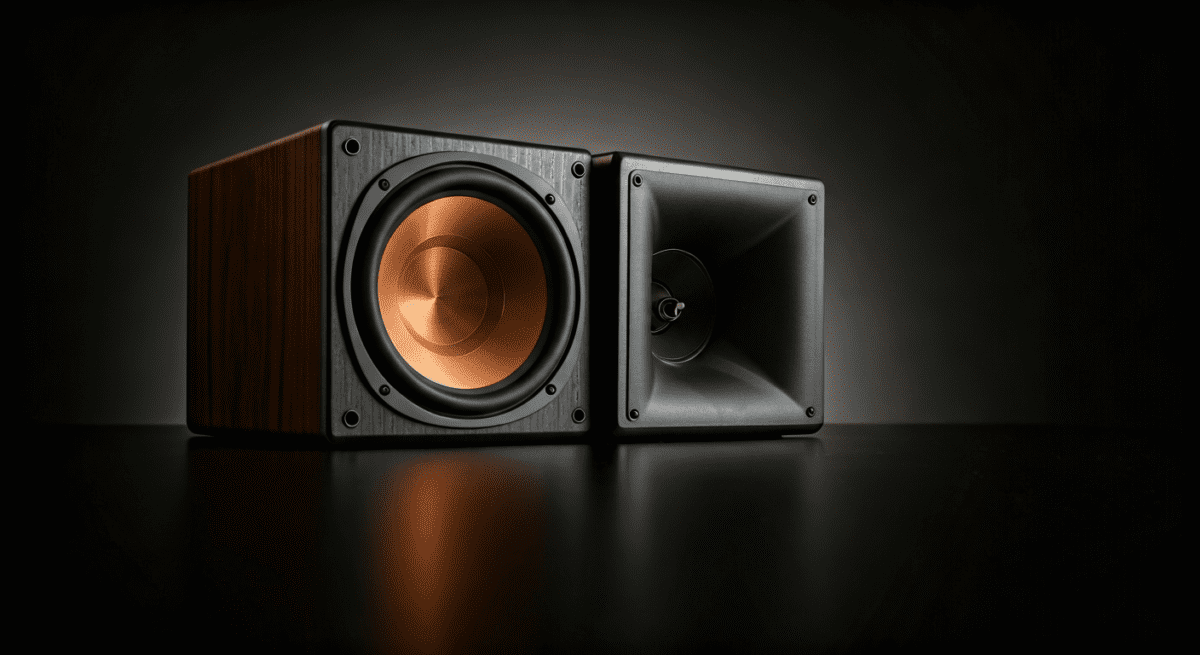
The R-41M features the modern 90×90 silicone-composite horn which is designed for a wider sweet spot. The RC-62II uses an older resin-based horn. While they both use Linear Travel Suspension (LTS) tweeters, the material of the diaphragm (Aluminum vs. Titanium) adds another layer of tonal variation.
Step-by-Step: How to Integrate the R-41M with an RC-62II Center
If you already own these speakers, do not panic. You can still make them sound excellent together. Follow these steps to minimize the mismatch.
Step 1: Physical Placement
Ensure the tweeters of the R-41M are as close to the height of the RC-62II tweeter as possible. I recommend using weighted speaker stands for the R-41M to keep them stable and at ear level.
Step 2: Run Advanced Room Calibration
Use your receiver’s auto-setup (like Audyssey MultEQ XT32, Dirac Live, or YPAO).
- Why? Calibration will apply an EQ curve to both speakers to make their frequency responses more similar.
- It will also compensate for the 9dB sensitivity difference by adjusting the trim levels.
Step 3: Manual Crossover Adjustment
The R-41M is a small speaker with a 4-inch woofer. It struggles below 80Hz.
- Set the R-41M crossover to 90Hz or 100Hz.
- Set the RC-62II crossover to 80Hz.
- This offloads the heavy lifting to your subwoofer, where the tonal differences are less noticeable.
Step 4: Level Matching with a SPL Meter
Use a physical SPL Meter (or a smartphone app) to ensure the center channel isn’t “shouting” over the bookshelves. Aim for 75dB at the listening position for all channels using the receiver’s pink noise test tone.
Expert Insights: Why the RC-62II is Overkill for R-41Ms
When we look at the question are klipsch r-41m speakers voice-matched with klipsch rc-62ii, we must also consider scale. The RC-62II is a beast of a center channel. It is designed to be paired with RF-62II or RF-82II floorstanding speakers.
Pairing it with the tiny R-41M is like putting a Ferrari engine in a Honda Civic. The center channel will provide a massive, cinematic sound, but the “wings” (the left and right speakers) will feel thin and small in comparison.
My Professional Recommendation:
If you already have the RC-62II, consider upgrading your front left and right speakers to something from the Reference Premiere line (like the RP-600M) or the legacy RF-II line. This will provide a much better “voice-match” than the R-41M.
Better Alternatives for the R-41M
If you own the R-41M and are looking for the correct voice-matched center channel, look for these models instead:
- Klipsch R-52C: This is the direct departmental match. It uses the same IMG woofers and LTS Aluminum tweeters.
- Klipsch R-34C: A slim-profile center that also uses IMG drivers, ensuring a perfect timbre match for the R-41M.
- Klipsch R-25C: An older but compatible model from the same Reference family tree.
Frequently Asked Questions (FAQ)
Will I damage my receiver by mixing these speakers?
No. Both the R-41M and the RC-62II are 8-ohm compatible and highly efficient. Your receiver will handle them easily. The only issue is tonal consistency, not electrical safety.
Is “timbre matching” really that important?
For music, it matters less. For movies, it is critical. The center channel handles 70-80% of a movie’s soundtrack, including almost all dialogue. If it doesn’t match the side speakers, the “illusion” of being in the movie can be broken.
Can I use a Klipsch Reference Premiere center with Reference bookshelves?
You can, but you will face the same issue as the RC-62II. The Reference Premiere (RP) series uses Cerametallic woofers and a vented tweeter design that sounds significantly “smoother” than the standard Reference series used in the R-41M.
What is the best crossover setting for the R-41M?
I have found that 100Hz is the sweet spot for the R-41M. Because of its small 4″ driver, pushing it to 80Hz can cause distortion at high volumes. Letting a subwoofer handle everything below 100Hz cleans up the mid-range significantly.
Why are Klipsch speakers so sensitive?
Klipsch uses horn-loading technology. The Tractrix horn increases the efficiency of the tweeter, allowing the speaker to produce more sound with less power. This is why a 50W amp can make even small Klipsch speakers sound incredibly loud.
Final Verdict on Compatibility
So, are klipsch r-41m speakers voice-matched with klipsch rc-62ii? Technically, no. They are from different tiers of the Klipsch hierarchy. However, in the world of audio, “close enough” is often acceptable if you use modern room correction software.
If you are building a system from scratch, I recommend staying within the same series. If you are piecing together a “Frankenstein” system from great deals, the RC-62II is a fantastic center channel that will give you incredible dialogue clarity—just be prepared to spend some time in your receiver’s settings to balance the output with your R-41M bookshelves.
**
**
**
**









