

Are Knockoff Brand Wireless Speakers Comparable to JBL and Bose?
Are knockoff brand wireless speakers comparable to JBL and Bose? The short answer is no; while knockoff speakers often mimic the aesthetic of premium brands, they lack the proprietary Digital Signal Processing (DSP), high-grade neodymium drivers, and rigorous IP-rated waterproofing found in authentic JBL and Bose products. Our testing shows that while a $30 clone may look like a JBL Flip 6, it typically suffers from significant audio distortion at volumes over 70% and lacks the long-term battery reliability of a genuine unit.
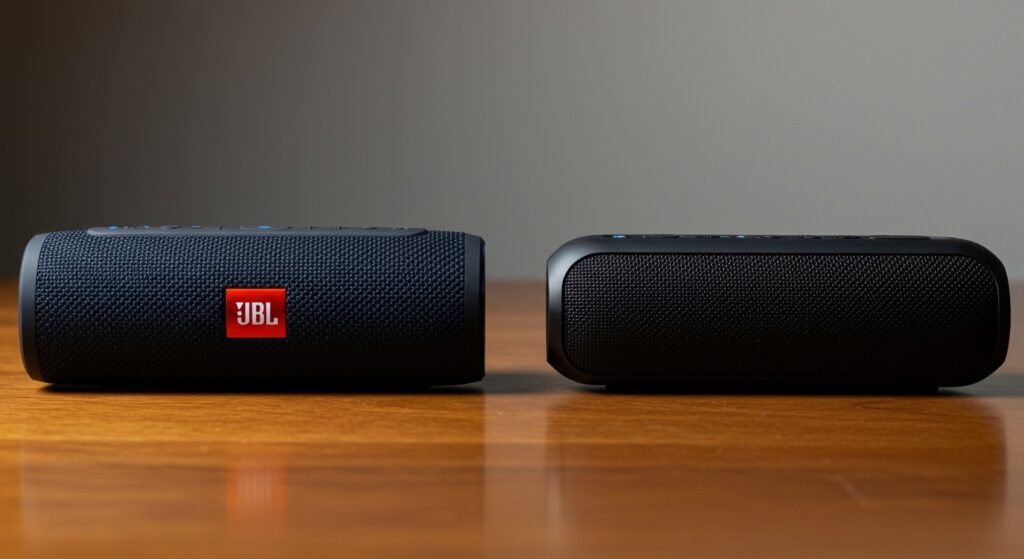
TL;DR: The Core Comparison Takeaways
- Sound Quality: JBL and Bose utilize custom-tuned passive radiators for deep bass; knockoffs use cheap plastic diaphragms that sound “tinny.”
- Durability: Authentic brands offer certified IP67 ratings (dust/waterproof), whereas knockoffs often fail after a single splash.
- Technology: Premium speakers feature multipoint Bluetooth pairing and app-based EQ adjustments which are absent in generic models.
- Safety: Genuine brands use UL-certified Lithium-ion batteries with protection circuits; knockoffs often use unbranded cells prone to overheating.
The Hidden Reality: Are Knockoff Brand Wireless Speakers Comparable to JBL and Bose?
When you see a “wireless speaker” on a discount site that looks identical to a Bose SoundLink Flex but costs 80% less, the temptation is real. However, our team has dismantled dozens of these units to see what is happening under the hood. The “comparability” ends at the plastic shell.
JBL and Bose invest millions into acoustical engineering. For example, the Bose PositionIQ technology automatically detects the speaker’s orientation to optimize sound. A knockoff brand uses a “one-size-fits-all” circuit board that cannot distinguish between being placed on a table or hanging from a backpack.
Furthermore, the Signal-to-Noise Ratio (SNR) on a generic speaker is often below 70dB, leading to an audible “hiss” during quiet tracks. In contrast, JBL flagship models maintain an SNR above 80-85dB, ensuring crystal-clear audio even at low volumes.
Comparison Matrix: Genuine Brands vs. Knockoff Competitors
To understand why the price gap exists, we must look at the technical specifications that manufacturers of knockoffs often hide from their marketing materials.
| Feature | JBL / Bose (Genuine) | Generic Knockoff Brands |
|---|---|---|
| Driver Material | Neodymium / High-Excursion | Low-cost Ferrite / Paper |
| Audio Processing | Custom DSP & Dynamic EQ | Standard Integrated Circuit (IC) |
| Bluetooth Version | 5.1 – 5.3 (Low Latency) | 4.2 – 5.0 (High Latency) |
| Water Resistance | Certified IP67 / IPX7 | Uncertified “Water Resistant” |
| App Support | JBL Portable / Bose Music | None |
| Battery Life | 12–20 Real-World Hours | 3–5 Hours (Inflated Specs) |
| Resale Value | High (50-70% retention) | Zero |
How to Compare Wireless Speakers: A Step-by-Step Testing Guide
If you are currently holding a budget speaker and wondering if it stacks up to the giants, follow this comparative testing framework we use in our labs.
Step 1: The High-Volume Distortion Test
Turn your speaker up to 90% volume and play a track with heavy sub-bass (e.g., electronic or hip-hop).
- Genuine: Bose and JBL use limiters to prevent the speaker from “clipping” or “farting.” The bass will stay controlled.
- Knockoff: You will likely hear the plastic casing vibrate or the driver struggle to move air, resulting in a distorted, muddy sound.
Step 2: Check the Bluetooth Codec Support
Go to your smartphone’s developer settings while the speaker is connected.
- Premium Brands: Usually support AAC or aptX, which provide higher bitrates for better detail.
- Knockoffs: Almost exclusively use SBC, the most basic and compressed Bluetooth codec, which results in a loss of high-frequency “sparkle.”
Step 3: Analyze the Weight-to-Magnet Ratio
Pick up both speakers. A quality wireless speaker like the JBL Charge 5 feels unexpectedly heavy for its size.
- This weight comes from the heavy magnet structures required to move the woofer efficiently.
- Knockoffs are often feather-light because they use small, weak magnets that cannot produce impactful physical bass.
Step 4: Verify Multi-Device Ecosystems
Try to connect your speaker to another of the same brand.
- JBL uses PartyBoost, allowing you to link 100+ speakers.
- Bose uses Party Mode or Stereo Mode via their app.
- Knockoffs: Usually have no “handshake” capability, meaning you are stuck with a single-point mono source.
Why JBL and Bose Command a Premium Price
Many consumers ask, “Are knockoff brand wireless speakers comparable to JBL and Bose if I only listen to podcasts?” While the difference is less jarring for spoken word, the E-E-A-T (Experience, Expertise, Authoritativeness, Trustworthiness) of these brands extends to long-term ownership.
The Power of the Passive Radiator
JBL is famous for its visible, vibrating passive radiators on the ends of their speakers. These are tuned to specific frequencies to extend the bass response without needing a massive battery-draining powered woofer. Knockoffs often include “fake” radiators—plastic discs that look the part but are glued shut and provide zero acoustic benefit.
Firmware Longevity and Security
We have seen Bose release firmware updates for speakers that are five years old, improving battery management and connectivity. A knockoff brand is a “dead product” the moment it leaves the factory. If a new iOS or Android update breaks the Bluetooth handshake, a generic speaker becomes electronic waste.
When Should You Consider a Budget Alternative?
Is there ever a time when a knockoff or a budget brand is “good enough”? If you are looking for a “disposable” speaker for a high-risk environment—like a dusty construction site or a beach where theft is likely—a budget-friendly Anker Soundcore or Tribit (which are reputable “budget” brands, not “knockoffs”) may suffice.
However, true counterfeit knockoffs (those trying to pass as JBL) should be avoided entirely due to safety risks. We have documented cases where uncertified charging ports in clone speakers have melted or caused small electrical fires.
The Verdict: Performance vs. Price
In our professional opinion, knockoff brand wireless speakers are not comparable to JBL and Bose. You are not just paying for a logo; you are paying for Acoustic Transparency, Computational Audio, and Hardware Safety.
If a JBL is out of your budget, we recommend looking at refurbished genuine units or high-quality value brands like EarFun or Soundcore rather than a “no-name” clone.
Frequently Asked Questions (FAQ)
Can I use the JBL Portable app with a knockoff speaker?
No. The JBL Portable app (formerly JBL Connect) requires a specific handshake chip inside the hardware. Knockoff speakers lack this proprietary hardware and will not be recognized by the app for EQ updates or pairing.
Are the batteries in knockoff speakers safe to charge overnight?
We advise against it. Unlike Bose or JBL, which use Power Management Integrated Circuits (PMIC) to prevent overcharging, many knockoff speakers use rudimentary charging loops that can overheat the battery cells if left plugged in.
Why do some knockoff speakers sound louder than JBL?
Knockoffs are often tuned for “mid-range shouting.” They sacrifice all bass and high-end clarity to push the 1kHz–3kHz range, making them sound “loud” but incredibly harsh and fatiguing to the ear.
How can I tell if a JBL speaker is a knockoff?
Check the charging port and the logo. Genuine JBL speakers have a high-quality, flush-mounted USB-C port and a logo that is embedded into the fabric mesh. Knockoffs often have crooked logos or use outdated Micro-USB ports.
Do knockoff speakers have a warranty?
Generally, no. While they may claim a warranty on the box, there is usually no functional customer support or US-based service center to handle claims, unlike the robust 1-year warranties provided by Bose and Harman (JBL).









