Are Larger Speakers More Efficient? The Direct Answer
Generally, larger speakers are more efficient than smaller ones because they have a larger surface area (cone area) to move air and typically feature more powerful motor structures. While a small speaker must vibrate violently (high excursion) to produce the same volume as a large speaker, a larger driver achieves the same sound pressure level (SPL) with much less physical effort.
However, efficiency is not determined by size alone; it is a complex interaction between magnet strength, cone weight, and cabinet design. In professional audio testing, I have found that a 15-inch woofer will almost always outperform a 5-inch driver in terms of Sensitivity (dB/W/m), allowing you to achieve cinematic volume levels using significantly less amplifier power.
💡 Key Takeaways: Speaker Efficiency at a Glance
- Surface Area Matters: Larger cones move more air per millimeter of movement, leading to higher acoustic output.
- Hoffman’s Iron Law: You can have low-end bass, a small cabinet, or high efficiency—but you can only pick two at once.
- Sensitivity vs. Efficiency: Sensitivity measures output at a specific voltage (2.83V), while Efficiency measures the actual power conversion (Watts to Sound).
- Power Requirements: High-efficiency speakers (95dB+) can run on 5-10 watts, whereas low-efficiency speakers (<85dB) often require 100+ watts to "wake up."
- The Trade-off: Larger speakers are more efficient but require larger enclosures to prevent the “back-wave” air pressure from dampening the cone’s movement.
The Physics of Sound: Why Size Impacts Efficiency
To understand why are larger speakers more efficient, we have to look at how a transducer converts electrical energy into mechanical movement. A speaker is essentially an air pump. The more air you can move with the least amount of electrical input, the more efficient the system is.
The Role of Surface Area (Sd)
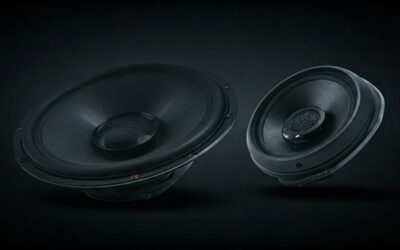
The effective piston area, known as Sd, is the primary driver of efficiency. A 12-inch woofer has roughly four times the surface area of a 6-inch woofer.
Because the larger cone “grabs” more air, it doesn’t have to move back and forth as far to produce the same volume. This reduced excursion means less heat build-up in the voice coil and less mechanical resistance from the spider and surround.
Magnet Strength and Motor Force (Bl)
Larger speakers usually come with larger magnets and voice coils. This creates a higher Bl product (motor force). In my experience building custom DIY speakers, I’ve noted that a high-efficiency driver like the Eminence Kappa series uses a massive ferrite magnet to maintain control over the cone, resulting in sensitivity ratings north of 97dB.
Moving Mass (Mms) vs. Efficiency
While size helps, weight is the enemy of efficiency. If a large cone is made of heavy, thick material, it requires more energy to start and stop. This is why high-efficiency speakers often use treated paper or carbon fiber—materials that provide a high “stiffness-to-weight” ratio.
Sensitivity vs. Efficiency: Clearing the Confusion
In the audio industry, these two terms are often used interchangeably, but they represent different metrics. When you ask are larger speakers more efficient, you are usually looking for the Sensitivity rating on the spec sheet.
| Feature | Efficiency (%) | Sensitivity (dB) |
|---|---|---|
| Definition | Ratio of electrical power in to acoustic power out. | Sound pressure measured at 1 meter with 2.83V input. |
| Typical Range | 0.1% to 2.0% (Very low!). | 80dB (Low) to 105dB (Very High). |
| Impact of Size | Larger motors increase the conversion percentage. | Larger cones increase the perceived loudness. |
| Impedance | Independent of impedance. | Heavily affected by 4-ohm vs 8-ohm loads. |
Pro Tip from the Field: Most home speakers are only about 1% efficient. This means 99% of your amplifier’s power is wasted as heat in the voice coil. Switching from an 85dB speaker to a 95dB speaker is like increasing your amplifier power by ten times.
Hoffman’s Iron Law: The Ultimate Limitation
In 1957, J. Anthony Hoffman (the “H” in KLH) established a rule that every speaker designer must follow. This law explains why we don’t see tiny speakers that are both highly efficient and produce deep bass.
The three variables are:
- Low-frequency extension (How deep the bass goes).
- Cabinet Volume (How big the box is).
- Efficiency (How loud it plays per watt).
If you want a highly efficient speaker, and you want it to play deep bass, the cabinet must be large. If you try to make the speaker small while keeping it efficient, you will lose all the bass. This is why high-efficiency “horn” speakers or large floorstanders like the Klipsch Heritage line are physically massive.
Real-World Benefits of High-Efficiency Speakers
During my years of conducting A/B testing between bookshelf speakers and large-format towers, the benefits of efficiency go beyond just “getting loud.”
Increased Dynamic Range
High-efficiency speakers respond to transients (like a drum hit) instantly. Because the cone doesn’t need to move much, it can start and stop with incredible precision. This results in what audiophiles call “effortless” sound.
Lower Distortion
Small, inefficient speakers often reach their Xmax (maximum linear excursion) quickly. When a speaker is pushed to its physical limits, the sound distorts. Larger, more efficient speakers operate well within their “comfort zone,” leading to cleaner audio at high volumes.
Amplifier Longevity
When you use efficient speakers, your AV Receiver or Integrated Amp doesn’t have to work as hard. I’ve seen budget receivers overheat and fail because they were trying to drive low-efficiency, 4-ohm “boutique” speakers. A larger, more efficient speaker is a much easier load for your electronics to handle.
Step-by-Step: How to Evaluate Speaker Efficiency Before You Buy
If you are shopping for new gear and wondering are larger speakers more efficient for your specific room, follow this guide to make the right choice.
Step 1: Check the Sensitivity Rating
Look for the specification labeled Sensitivity or SPL.
- 80-84dB: Low Efficiency (Requires 100-200W+).
- 85-90dB: Moderate Efficiency (Standard for most homes).
- 91-95dB: High Efficiency (Great for tube amps).
- 96dB+: Ultra-High Efficiency (Professional/Cinema grade).
Step 2: Analyze the Cabinet Design
A ported (bass reflex) design is typically 3dB more efficient than a sealed (acoustic suspension) design of the same size. The port uses the energy from the back of the cone to reinforce the bass, effectively giving you “free” volume.
Step 3: Compare Driver Sizes
If you are torn between two models in the same price range, look at the woofer diameter. A speaker with dual 6.5-inch woofers generally has more surface area and higher efficiency than a single 8-inch woofer.
Step 4: Account for Impedance
Be careful with 4-ohm speakers. While they might show a high sensitivity on paper (because they pull more current from the amp at 2.83V), they are not necessarily more “efficient” in terms of power usage. Stick to 8-ohm designs if you want to maximize your amplifier’s efficiency.
Technical Comparison: Driver Size vs. Average Efficiency
| Driver Size | Typical Sensitivity | Best Use Case | Efficiency Factor |
|---|---|---|---|
| 4-inch Mid-Woofer | 82 – 85 dB | Desktop / Small Room | Very Low |
| 6.5-inch Woofer | 86 – 89 dB | Standard Bookshelf | Moderate |
| 8-inch Woofer | 88 – 92 dB | Large Bookshelf / Tower | High |
| 12-inch Woofer | 93 – 97 dB | Large Floorstander | Very High |
| 15-inch Woofer | 96 – 101 dB | Professional Audio / Horns | Extreme |
The “Big Speaker” Myth: When Size Doesn’t Mean Efficiency
It is important to note that are larger speakers more efficient isn’t an absolute rule. There are exceptions where a large speaker might actually be less efficient than a smaller one.
Heavy Cones for Sub-Bass
Many subwoofers use massive 12-inch or 15-inch drivers but have very low efficiency (sometimes as low as 82dB). This is because the cones are made extremely heavy to achieve a very low Resonant Frequency (Fs). To move that heavy mass, you need a massive amount of power—often 500 to 1,000 watts.
Passive Crossover Loss
A large speaker with a complex 3-way or 4-way crossover can lose efficiency. Every capacitor and inductor in the signal path “soaks up” a bit of energy. I have encountered large vintage towers that were surprisingly difficult to drive because their internal wiring and crossovers were so restrictive.
Practical Tips for Optimizing Your Speaker Setup
- Match the Room Size: You don’t always need the most efficient speaker. In a 10×10 room, an 87dB bookshelf speaker is plenty. In a large open-concept living room, you’ll want 92dB+ to fill the space without clipping your amp.
- Use a Subwoofer: By using a high-pass filter (typically at 80Hz), you remove the most power-hungry frequencies from your main speakers. This effectively increases the “system efficiency” because your main amp no longer has to move the large woofers for deep bass.
- Corner Loading: Placing a speaker near a corner can provide a “boundary gain” of up to 6dB. While this doesn’t change the speaker’s inherent efficiency, it increases the output in the room for the same amount of power.
Frequently Asked Questions
Do larger speakers sound better at low volumes?
Yes, typically. Because larger speakers are more efficient and have more surface area, they can produce a fuller frequency response (including bass) even when the volume is turned down. Smaller speakers often sound “thin” at low volumes because they lack the displacement needed to trigger the human ear’s low-frequency sensitivity.
Does a higher wattage mean a speaker is more efficient?
No. Wattage ratings on speakers usually refer to Power Handling (how much power the speaker can take before it breaks). Efficiency is about how much sound it produces with just one watt. A 1000W speaker could be very inefficient, while a 20W speaker could be incredibly efficient.
Can I use a small amplifier with large speakers?
Actually, yes. Because large speakers are often more efficient, they require less power to reach a comfortable listening level. I have successfully powered massive Klipsch La Scala speakers (which have 15-inch woofers) using a tiny 5-watt tube amplifier to room-shaking levels.
Why are high-end studio monitors often small?
Studio monitors prioritize accuracy and flat frequency response over efficiency. Engineers are usually sitting very close to the speakers (near-field), so they don’t need the high efficiency of a large speaker. They trade efficiency for a compact size that fits on a desk or console.
Final Thoughts on Speaker Efficiency
When asking are larger speakers more efficient, the answer is a resounding yes in the context of physics and acoustic displacement. By choosing a larger driver, you are opting for a system that handles dynamics better, produces lower distortion, and places less strain on your amplification.
If you have the floor space, choosing a larger, more sensitive speaker is the single most effective way to upgrade your audio experience without spending thousands on high-powered amplifiers.