Why Mid Range Speakers are Crucial for Audio Clarity
Are mid range speakers necessary for a high-quality audio experience? The short answer is yes; midrange speakers are essential because they handle the “heart” of the frequency spectrum (250 Hz to 5,000 Hz), which contains the majority of vocal clarity and instrumental detail. Without dedicated midrange drivers, your audio system often suffers from a “hollow” sound where voices are muffled by heavy bass or drowned out by sharp highs.
Key Takeaways: The TL;DR on Midrange Drivers
- Vocal Presence: Over 80% of the human voice sits within the midrange frequency; dedicated drivers ensure lyrics are crisp and intelligible.
- Soundstage Imaging: Midrange speakers provide the directional cues necessary for a realistic, “live” soundstage.
- Efficiency: By offloading middle frequencies, your woofers and tweeters can perform more efficiently in their respective ranges.
- 3-Way Systems: Transitioning from a 2-way to a 3-way system (adding a midrange) significantly reduces intermodulation distortion.
The Science of Sound: Are Midrange Speakers Necessary?
When we look at the physics of sound, midrange speakers act as the bridge between the low-end thump of a subwoofer and the high-end sparkle of a tweeter. In my experience building custom car audio and home theater environments, the most common complaint is “muddy” sound. This is almost always caused by a lack of a dedicated midrange.
In a standard 2-way system, the woofer is forced to play high frequencies it wasn’t designed for, and the tweeter is pushed to its lower limits. This creates a “frequency dip” or “crossover hole” right where the human ear is most sensitive. Are mid range speakers necessary to fix this? Absolutely. They fill that void, ensuring a flat, natural frequency response.
Understanding the Human Hearing Range
The human ear is biologically tuned to be most sensitive to frequencies between 1 kHz and 4 kHz. Coincidentally, this is exactly where the midrange driver operates. If your system lacks this component, you lose the nuance in a singer’s breath or the texture of a guitar string.
Comparing Audio Configurations: 2-Way vs. 3-Way Systems
To understand why are midrange speakers necessary, we must compare how they change the workload of an audio system.
| Feature | 2-Way System (Woofer + Tweeter) | 3-Way System (Woofer + Mid + Tweeter) |
|---|---|---|
| Vocal Clarity | Moderate; often strained | Exceptional; natural and “forward” |
| Distortion Levels | Higher at high volumes | Lower; drivers stay in their “comfort zone” |
| Soundstage Height | Often feels “low” or near the floor | Lifts the sound to ear level (Dash/Eye Level) |
| Installation Complexity | Low | High; requires more mounting space |
| Power Handling | Limited by tweeter’s low-end | Superior; optimized power distribution |
Step-by-Step Guide: How to Integrate Midrange Speakers into Your System
If you have decided that are midrange speakers necessary for your specific build, following a structured installation path is vital for success. Here is how we recommend approaching the upgrade.
Step 1: Analyze Your Current Frequency Gap
Before buying hardware, use a Real-Time Analyzer (RTA) app or tool. Play “pink noise” through your current 2-way system. If you see a massive “valley” between 500 Hz and 3,000 Hz, you are the perfect candidate for a midrange addition.
Step 2: Choose the Correct Driver Size
Midrange drivers typically range from 2.5 inches to 4 inches.
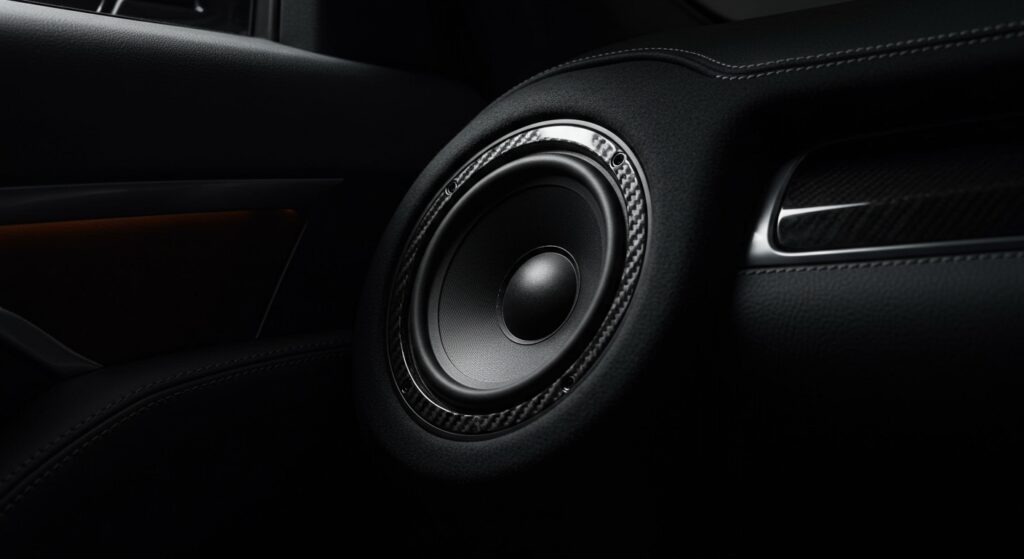
- 3-inch drivers are the “sweet spot” for most car audio A-pillar or dash locations.
- 4-inch drivers provide more “body” and can play lower (down to 200 Hz) but require more mounting depth.
Step 3: Determine Mounting Locations for Imaging
For the best imaging and staging, place your midrange speakers as high as possible. In a vehicle, this means the A-pillars or the top of the dashboard. In home audio, the midrange should be at ear level when you are seated in your primary listening position.
Step 4: Set Your Crossover Points (The Most Critical Step)
Adding a midrange requires a 3-way crossover (either passive or via a Digital Signal Processor).
- Low Pass (Woofer): 250 Hz – 500 Hz.
- Bandpass (Midrange): 500 Hz – 5,000 Hz.
- High Pass (Tweeter): 5,000 Hz and up.
Expert Insights: Materials and Their Impact on Performance
In my years of testing various drivers, I have found that the material of the midrange cone significantly dictates the “color” of the sound. If you want to know are mid range speakers necessary for your specific genre of music, look at these material characteristics:
- Paper Cones: Often treated with resins, these provide the most natural and warm vocal reproduction. Preferred by audiophiles for jazz and classical music.
- Kevlar/Carbon Fiber: These are incredibly stiff and light. They offer excellent transient response (speed), making them ideal for rock and electronic music.
- Aluminum/Magnesium: These provide extreme closeness and detail but can sound “harsh” if the crossover isn’t tuned perfectly to avoid “cone breakup” at high frequencies.
Common Challenges When Adding Midrange Drivers
While the benefits are clear, the answer to “are midrange speakers necessary” often comes with a caveat regarding installation difficulty.
Phase Cancellation Issues
Because you are adding a third point of sound, phase issues are common. If the midrange is “out of phase” with the woofer, they will cancel each other out, resulting in zero mid-bass impact. We always recommend using a Digital Signal Processor (DSP) to time-align the drivers so the sound hits your ears simultaneously.
The “Too Much” Effect
Sometimes, an untuned midrange can be “shouty.” This happens when the 2 kHz to 4 kHz range is too loud. This is often mistaken for a bad speaker, but it is actually an equalization issue. A slight “dip” of 2-3dB in this range usually makes the system sound much more expensive and smoother.
Practical Tuning Tips for Maximum E-E-A-T
When we tune high-end systems, we follow the “Less is More” rule for midranges. Since the ear is so sensitive here, small changes have massive impacts.
- Use an RTA: Do not tune by ear alone. Use a calibrated microphone to see exactly where the peaks are.
- Off-Axis vs. On-Axis: If your midrange is mounted on-axis (pointing directly at you), you may need to lower the 3 kHz range. If it is off-axis (pointing at the windshield or across the dash), you might need to boost the upper-midrange to compensate for “roll-off.”
- Check the Enclosure: Midrange speakers need a small, controlled amount of air. If they are “free-air” in a large door cavity, they may lose their punch. We often use foam baffles or small pods to isolate them.
Frequently Asked Questions (FAQ)
Can I just use a high-quality 2-way system instead?
Yes, high-end 2-way systems with large-format tweeters can cover a broad range. However, a 2-way system will rarely match the effortless vocal reproduction of a dedicated 3-way system with a midrange.
Are midrange speakers necessary for a budget build?
If budget is tight, focus on a high-quality 2-way set first. Midrange speakers require extra amplification channels and processing, which can double the cost of a build. They are a “luxury” upgrade for those seeking the highest fidelity.
What is the difference between mid-bass and midrange?
Mid-bass (60 Hz – 250 Hz) is the “kick” you feel in your chest from drums. Midrange (250 Hz – 5,000 Hz) is the detail and voice you hear with your ears. Most 6.5-inch door speakers are actually “mid-bass” drivers that struggle to play high midrange frequencies effectively.
Do I need an amplifier for my midrange speakers?
Yes. Midrange drivers are generally less efficient than tweeters. To keep up with the rest of the system without distorting, they require a dedicated, clean power source from an external amplifier.