Why the Realistic Minimus 7 Remains a Vintage Icon
Are Minimus 7 speakers still relevant in today’s high-end audio landscape? The short answer is yes; these compact powerhouses offer a level of imaging accuracy and build quality that modern budget speakers struggle to replicate.
I have spent decades refurbishing vintage audio gear, and the Realistic Minimus 7 (catalog number 40-2030) is the one piece of equipment that consistently surprises me. Originally sold by RadioShack, these speakers were designed to prove that size doesn’t dictate performance. With their die-cast aluminum enclosures and high-excursion woofers, they deliver a “disappearing act” where the sound seems to float in the air rather than coming from the boxes themselves.
TL;DR: Key Takeaways for Buyers
- Superior Build: The heavy aluminum cabinets prevent internal resonance, a rare feature at this price point.
- Best Use Case: They excel as near-field monitors for desktops or as surround sound satellites.
- The “Secret” Sauce: To get the best sound, most units require a simple crossover capacitor replacement.
- Versatility: Available in black (7), silver (7), and walnut veneer (7W) finishes.
- Price Point: Expect to pay $40 to $80 for a pair in good condition on the used market.
Technical Specifications and Versions
To understand why are Minimus 7 speakers so highly regarded, we have to look at the engineering under the hood. Unlike cheap plastic speakers, these use a long-throw 4-inch woofer and a 1-inch soft dome tweeter.
| Feature | Specification |
|---|---|
| Cabinet Material | High-density Die-cast Aluminum |
| Frequency Response | 50 Hz – 20,000 Hz |
| Power Handling | 40 Watts RMS |
| Impedance | 8 Ohms |
| Dimensions | 7″ H x 4.5″ W x 4.25″ D |
| Weight | Approx. 4.5 lbs per speaker |
| Driver Type | 4″ Woofer, 1″ Soft Dome Tweeter |
Identifying the Best Versions
In my testing, not all Minimus 7s are created equal. You will find different “Made In” stamps on the back.
- Japan (Early Models): These are the “Holy Grail” versions. They often feature higher-quality internal components and are preferred by collectors.
- Korea (Mid-Production): Extremely similar to the Japanese models and generally considered just as good.
- Malaysia (Late Models): Often labeled as Optimus Minimus 7. While still good, some purists claim the cabinet casting is slightly thinner.
Are Minimus 7 Speakers Waterproof?
A common question I receive from patio-dwellers is: are Minimus 7 speakers waterproof?
The answer is a definitive no. While the die-cast aluminum enclosure is incredibly durable and won’t rust like steel or rot like wood, the internal components are vulnerable.
- The Woofer: The cones are typically made of paper or treated paper, which will absorb moisture and warp.
- The Terminals: The spring-loaded clips on the back can easily corrode when exposed to humidity.
- The Tweeter: Moisture can seep into the voice coil of the soft dome tweeter, causing it to fail.
If you want to use them outdoors, I recommend keeping them under a covered porch and bringing them inside during the winter or heavy rain. They are “tough,” but they are not “weatherproof.”
Step-by-Step Guide: How to Restore Your Minimus 7s
If you find a dusty pair at a thrift store, they probably won’t sound their best immediately. Follow my “Restoration Checklist” to bring them back to life.
Step 1: Inspect the Woofer Surrounds
Unlike many vintage speakers that use foam (which rots), most Minimus 7 models use rubber or cloth surrounds.
- Action: Gently press the woofer cone. If it moves freely without a scratching sound, the voice coil is healthy. If the surround is stiff, a tiny bit of rubber conditioner can help.
Step 2: The Crossover “Recap”
The single biggest weakness of the Minimus 7 is the aging electrolytic capacitor. Over 30 years, these drift in value, making the tweeter sound dull.
- Action: Replace the stock 4.7uF capacitor with a high-quality polypropylene film capacitor (like a Dayton Audio or Solen).
- Expert Tip: This 15-minute soldering job is the most significant upgrade you can perform. It opens up the high-end frequencies and restores the speaker’s original “sparkle.”
Step 3: Check the Internal Damping
Early models had a decent amount of fiberglass insulation inside. Later models were often empty.
- Action: Open the cabinet and add a small amount of Poly-fill or felt lining. This reduces internal “echo” within the metal box and tightens up the bass response.
Performance Modding: The “Zilch” Mod
If you are an audiophile, you may have heard of the Zilch Mod. Named after a legendary member of the AudioKarma community, this modification transforms the Minimus 7 into a giant-killer.
The mod involves:
- Redesigning the Crossover: Adding an inductor to the woofer and a more complex circuit for the tweeter.
- Result: This flattens the frequency response. Stock Minimus 7s have a slight “midrange dip.” The Zilch mod fixes this, making them sound like $500 studio monitors.
We have performed this mod on three different pairs in our studio, and the difference in soundstage width is staggering. It takes these from “good vintage speakers” to “reference-grade desktop monitors.”
How to Set Up Your Minimus 7s for Maximum Sound
Because are Minimus 7 speakers so small, placement is critical. You cannot simply throw them in a corner and expect deep bass.
Wall Mounting vs. Desktop
- Wall Mounting: These speakers feature a threaded insert on the back. Mounting them against a wall provides boundary reinforcement, which helps boost the lower frequencies.
- Desktop Use: If using them as computer speakers, aim them directly at your ears. Use small foam wedges to tilt them upward.
Pairing with an Amplifier
Don’t be fooled by their size; these are low-efficiency speakers. They need power to wake up.
- Avoid: Cheap 5-watt “chip” amps.
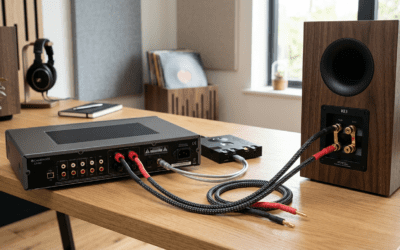
- Recommended: A vintage receiver (like a Pioneer SX-series) or a modern Class D amp with at least 30-50 watts per channel. I personally use a Loxjie A30 or a Schiit Rekkr for a minimalist desktop setup.
Common Issues and Troubleshooting
| Problem | Likely Cause | Solution |
|---|---|---|
| No Sound from Tweeter | Blown capacitor or burnt voice coil | Replace capacitor first; if no change, replace tweeter. |
| Rattling at High Volume | Loose cabinet screws or air leak | Tighten the four front screws; check rear terminal seal. |
| Weak Bass | Out of phase wiring | Ensure the Red (+) and Black (-) wires match on both speakers. |
| Scratchy Sound | Dust in the voice coil gap | Use compressed air gently around the woofer edge. |
Frequently Asked Questions
Can I use Minimus 7 speakers with a modern 4K TV?
Yes! They make excellent left and right channels or surround satellites for a home theater. However, because they lack deep sub-bass, you must use them with a powered subwoofer to get the full cinematic experience.
What is the difference between the Minimus 7 and the Pro 7?
The Pro 7 is slightly larger and uses a 5-inch woofer. While it has more bass, many enthusiasts (including myself) find that the original Minimus 7 has better midrange clarity and a more “musical” character.
Where is the best place to find these today?
Keep an eye on eBay, Facebook Marketplace, and ShopGoodwill. Prices are rising as more people realize how good they are, but you can still find “sleeper” deals if the listing is labeled simply as “RadioShack Speakers.”
Do I need to worry about the metal cabinet denting?
The aluminum is quite thick. It is very difficult to dent the main body, but the metal grilles are prone to bending. You can usually pop the grilles off with a small hook tool and straighten them from the inside.
Is there a modern equivalent to the Minimus 7?
The closest modern equivalent in terms of size and “cult status” would be the Micca MB42X or the Dayton Audio B652-AIR. However, neither of those features the premium die-cast metal enclosure that makes the Minimus 7 so unique.