Understanding If Most Car Stereo Amps Are Compatible With 2 Ohm Speakers
Most modern aftermarket car stereo amplifiers are compatible with 2-ohm speakers, especially when looking at mono-block or high-quality multi-channel units. However, many factory-installed head units and entry-level 4-channel amps are only stable down to 4 ohms and may overheat or enter “protect mode” if pushed with a lower impedance.
I have spent over a decade installing audio systems in everything from vintage muscle cars to modern EVs. In my experience, the leap from 4-ohm to 2-ohm is the most common way enthusiasts try to squeeze more “juice” out of their system, but doing it wrong can fry your voice coils or your MOSFET transistors.
TL;DR: Key Takeaways for Amp Compatibility
- Check the Label: Look for the “2-ohm stable” rating on your amp’s spec sheet before connecting.
- Power Increase: Running at 2 ohms usually doubles the wattage output compared to 4 ohms, but increases heat.
- Wiring Matters: You can turn two 4-ohm speakers into a 2-ohm load using parallel wiring.
- Heat Management: 2-ohm loads draw more current; ensure your ground wire and power wire are the correct gauge (e.g., 4-gauge OFC).
- Mono vs. Multi-Channel: Most Mono (Class D) amps thrive at 2 ohms, while some 4-channel amps only support 2 ohms per channel, not when bridged.
Why Impedance Matters: The 2-Ohm vs. 4-Ohm Debate
To understand if are most car stereo amps compatible with 2 ohm speakers, we first need to define impedance. Think of impedance (measured in Ohms) as electrical resistance. Lower resistance (2 ohms) allows more electrical current to flow from the amp to the speaker.
When you reduce resistance, the amplifier works harder. If an amp is designed for this, you get louder, more dynamic sound. If it isn’t, the amp will draw too much current, get dangerously hot, and eventually fail. In my shop, the number one cause of “smoke in the trunk” is a DIYer forcing a 4-ohm stable amp to run a 2-ohm subwoofer.
Comparing 2-Ohm and 4-Ohm Performance
| Feature | 4-Ohm Setup | 2-Ohm Setup |
|---|---|---|
| Current Flow | Lower (Restricted) | Higher (Free-flowing) |
| Power Output | Standard | Significantly Higher (Often 50-100% more) |
| Heat Generation | Low to Moderate | High |
| Sound Clarity | Excellent (Higher Damping Factor) | Good (Slightly more distortion) |
| Common Use | Door Speakers / Tweeters | Subwoofers / High-Output Mids |
How to Determine If Your Amp Is 2-Ohm Stable
You should never guess whether are most car stereo amps compatible with 2 ohm speakers in your specific setup. You must verify the technical specifications provided by the manufacturer like Rockford Fosgate, JL Audio, or Alpine.
Check the Physical Chassis
Many high-end Class D amplifiers will have “2-Ohm Stable” printed directly on the heat sink. If you see this, you are clear to proceed with a 2-ohm load.
Read the RMS Power Ratings
Look at the manual or the manufacturer’s website. You will typically see a rating like this:
- 300 Watts RMS x 1 @ 4 Ohms
- 500 Watts RMS x 1 @ 2 Ohms
If the 2-ohm rating is listed, the amp is designed to handle that load safely. If it only lists a 4-ohm rating, do not attempt to run 2-ohm speakers.
Identify the Amp Class
Class D amplifiers are the most common in modern car audio because they are highly efficient. Most Class D mono amps are stable down to 2 ohms or even 1 ohm. Older Class A/B amps are often less efficient and may struggle with 2-ohm loads unless they are high-end models.
Step-by-Step Guide: How to Connect 2-Ohm Speakers Safely
If you’ve confirmed your car stereo amp is compatible, follow these steps to ensure a long-lasting installation.
Step 1: Verify Speaker Impedance
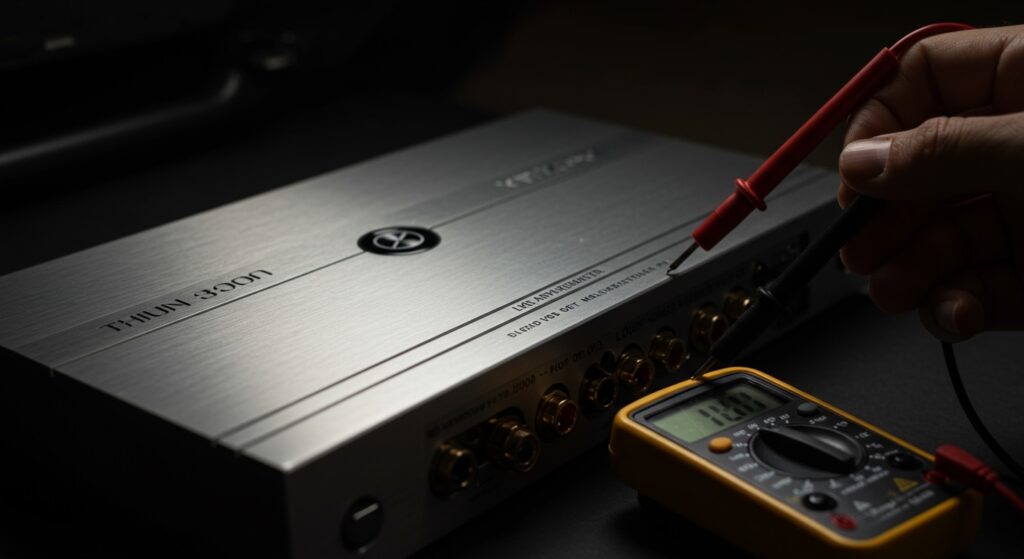
Use a Digital Multimeter set to the Ohms (Ω) setting. Touch the probes to the speaker terminals. A 2-ohm speaker will usually read between 1.6 and 1.9 ohms.
Step 2: Choose Your Wiring Pattern
If you have multiple speakers, how you wire them changes the final load seen by the amp.
- Parallel Wiring: Connecting two 4-ohm speakers together (positive to positive, negative to negative) creates a 2-ohm load.
- Series Wiring: Connecting two 2-ohm speakers in a chain (positive of one to negative of the other) creates a 4-ohm load.
Step 3: Upgrade Your Power Foundation
Because a 2-ohm load draws more current, your car’s electrical system needs to be ready.
- Power Cable: Use Oxygen-Free Copper (OFC) rather than Copper Clad Aluminum (CCA).
- Grounding: Ensure your ground is bolted to a clean, unpainted metal surface on the vehicle’s chassis.
- Big 3 Upgrade: For high-power setups, consider upgrading the alternator-to-battery and battery-to-chassis wires.
Step 4: Set the Gain Correctly
A common mistake is treating the Gain control like a volume knob. When running at 2 ohms, the amp is already pushed. Use an oscilloscope or a multimeter to set the gain to avoid clipping, which destroys speakers faster than “too much power” ever will.
The Risks of Running Incompatible Loads
If you find that your car stereo amps are not compatible with 2 ohm speakers, but you connect them anyway, several things will happen:
- Thermal Shutdown: Most modern amps have a thermal protection circuit. The amp will play for 10-15 minutes, get scorching hot, and turn off until it cools down.
- Blown Fuses: You will likely blow the on-board fuses or the main power fuse near the battery as the amp tries to pull more current than the circuit can handle.
- Internal Component Failure: Over time, the capacitors and output transistors will degrade due to excessive heat, leading to a permanent “Protect Mode” light.
Expert Insights: When Should You Use 2-Ohm Speakers?
In my professional opinion, 2-ohm speakers are best reserved for specific scenarios.
Use 2-Ohm Speakers When:
- Subwoofer Applications: You want maximum “thump” from a single or dual-sub setup.
- Compact Amps: You are using a small, hidden micro-amp and need to maximize its limited voltage.
- Factory Replacements: Some premium factory systems (like Bose or JBL OEM systems) actually use 2-ohm speakers. If you are replacing a speaker in one of these systems, you must use a 2-ohm replacement to maintain the volume levels.
Avoid 2-Ohm Speakers When:
- Audiophile Sound Quality: 4-ohm loads generally have a higher damping factor, meaning the amp has better control over the speaker cone’s movement, resulting in “tighter” bass and cleaner mids.
- Bridged 4-Channel Amps: Most 4-channel amps are 2-ohm stable per channel, but when you bridge two channels to run a sub, the minimum stable load usually jumps to 4 ohms.
Troubleshooting Common 2-Ohm Issues
My Amp Gets Extremely Hot
Check your impedance first. If you have wired two 2-ohm subwoofers in parallel, you are presenting a 1-ohm load. Most multi-channel car stereo amps cannot handle this. You may need to rewire them in series for a 4-ohm load.
The Sound is Distorted at High Volumes
This is often a sign of voltage drop. When the amp tries to pull current for that 2-ohm load, the car’s battery voltage drops. I recommend adding a stiffening capacitor or an AGM secondary battery if your lights are dimming during bass hits.
The Amp Won’t Turn On
Check the impedance with a multimeter. If a speaker has a “short” (reading 0 ohms), the amp’s short-circuit protection will prevent it from powering up to save the internal circuitry.
Frequently Asked Questions
Can I run 4-ohm speakers on a 2-ohm stable amp?
Yes, absolutely. A 2-ohm stable amp can easily handle a 4-ohm or even 8-ohm load. It will simply produce less power than it would at 2 ohms. It is much safer to run a higher impedance than a lower one.
Is 2-ohm louder than 4-ohm?
Technically, yes. Because a 2-ohm load allows more wattage to be delivered by the amplifier, the speaker will produce a higher Sound Pressure Level (SPL). However, volume also depends on the speaker’s sensitivity rating.
How do I know if my factory radio is 2-ohm compatible?
Most factory radios (non-premium) are designed for 4-ohm speakers. Connecting 2-ohm speakers directly to a factory head unit is risky and often leads to the internal chip-amp overheating or distorting heavily.
Does 2-ohm wiring affect sound quality?
To the average listener, the difference is negligible. However, for SQ (Sound Quality) competitors, 4-ohm loads are preferred because they offer better amplifier control (damping factor) and a lower signal-to-noise ratio.
What happens if I bridge a 2-ohm stable 2-channel amp?
When you bridge an amp, each channel “sees” half the load. Therefore, if you bridge a 2-ohm stable amp, it typically requires a 4-ohm minimum load in bridged mode. Attempting to run a 2-ohm load on a bridged amp is the most common way to cause a hardware failure.