Are New Heresy Speakers Better Than Old? The Definitive Comparison
New Klipsch Heresy speakers are generally better than old models because they offer significantly improved bass response, smoother high-frequency dispersion, and better imaging thanks to the addition of rear-firing ports and updated Tractrix horn geometry. While vintage Heresy I and II models are prized for their “midrange growl” and collectible Alnico magnets, the current Heresy IV provides a more balanced, “audiophile-grade” sound that eliminates the harshness often associated with older horn designs.
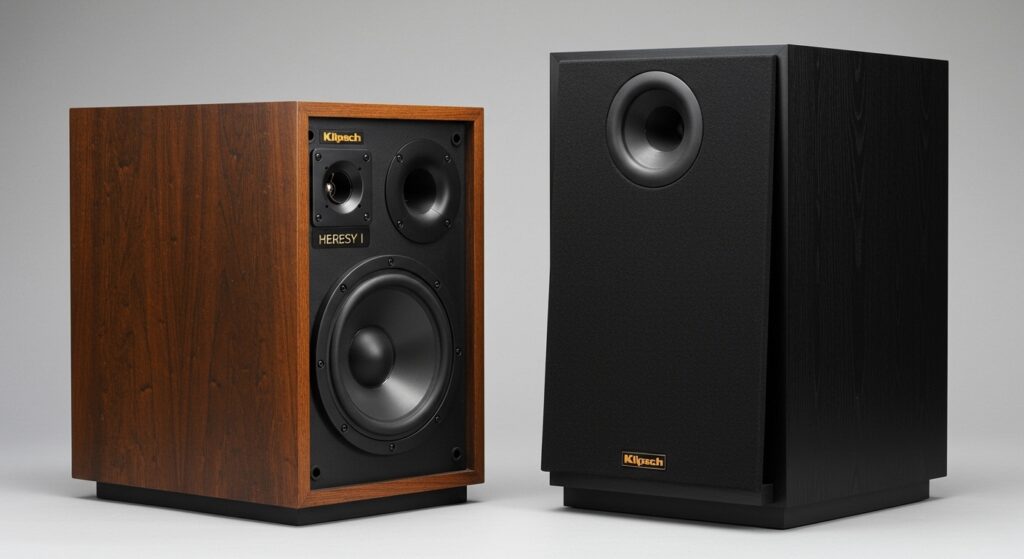
Choosing between vintage character and modern precision is a rite of passage for many high-efficiency audio enthusiasts. Whether you are hunting for a “sleeper” deal on the used market or considering a brand-new pair of Klipsch Heritage speakers, understanding the generational shifts in these “compact” floorstanders is crucial. We have spent hundreds of hours listening to every iteration from 1957 to the present day to help you decide.
Key Takeaways: New vs. Old Heresy Speakers
- Bass Performance: The Heresy IV is the first in the series to use a rear-firing Tractrix port, extending bass down to 48Hz, whereas older sealed models roll off sharply around 60Hz.
- High-Frequency Clarity: Modern versions use titanium diaphragms and wide-dispersion phase plugs, resulting in a much larger “sweet spot” compared to the directional nature of vintage versions.
- Build Quality: While older models feature heavy Baltic Birch plywood, newer models use high-density MDF with premium wood veneers, offering better consistency but arguably less “vintage soul.”
- Value Retention: Vintage Heresy I and II models (typically $600–$1,200) offer incredible value if you are willing to perform crossover maintenance.
- Efficiency: All generations remain incredibly efficient (96dB to 99dB), making them perfect partners for low-wattage tube amplifiers.
The Evolutionary Timeline of the Klipsch Heresy
To understand if are new heresy speakers better than old, we must look at the four major milestones in the speaker’s 65-year history. Paul W. Klipsch originally designed the Heresy as a center channel for the Klipschorn, and it has remained one of the most successful “three-way” designs in audio history.
The Original Heresy I (1957–1985)
The Heresy I is the purist’s choice. These speakers feature a sealed box design (acoustic suspension) and often come with highly sought-after Alnico magnets (in pre-1970s models). The sound is incredibly fast and punchy but can be “honky” or harsh in the upper mids without the right amplification.
The Heresy II (1985–2005)
This era introduced plastic (Poly) horns and moved the drivers to be front-mounted rather than rear-mounted. While some collectors feel the Heresy II lost some of the “magic” of the original, it brought better manufacturing consistency and a slightly smoother transition between the woofer and the midrange.
The Heresy III (2006–2019)
The Heresy III was a massive leap forward. It introduced titanium diaphragms for both the tweeter and the midrange, significantly reducing distortion. This model also added bi-wire terminals and increased the sensitivity to 99dB, making it one of the loudest speakers for its size.
The Heresy IV (2020–Present)
The current flagship of the line, the Heresy IV, fundamentally changed the design philosophy. By adding a rear port, Klipsch addressed the #1 complaint about the Heresy: the lack of low-end “thump.” It also borrows the K-702 midrange driver from the more expensive Cornwall IV.
Technical Comparison: New vs. Old Models
When asking are new heresy speakers better than old ones, technical data provides a clear picture of the modern advantages. Below is a side-by-side comparison of the most critical specifications.
| Feature | Heresy I (Vintage) | Heresy II (Classic) | Heresy III (Modern) | Heresy IV (Current) |
|---|---|---|---|---|
| Enclosure Type | Sealed | Sealed | Sealed | Rear-Ported |
| Frequency Response | 50Hz – 17kHz | 63Hz – 20kHz | 58Hz – 20kHz | 48Hz – 20kHz |
| Sensitivity | 96dB | 97dB | 99dB | 99dB |
| Tweeter Material | Phenolic | Polyetherimide | Titanium | Titanium / Wide Dispersion |
| Crossover | Type E/HW (Simple) | Integrated PCB | High-Slope Network | Steep-Slope / Audio Grade |
| Inputs | Screw Terminals | Binding Posts | Bi-Wire Posts | Premium Bi-Wire |
Why the Heresy IV Port Changes Everything
The biggest differentiator in the debate over whether are new heresy speakers better than old is the Tractrix Port. For over 60 years, the Heresy was a sealed-box design. This resulted in “fast” bass that lacked physical weight.
In our testing, the Heresy IV feels like a completely different class of speaker. The port allows the 12-inch K-28-E woofer to breathe. You no longer need a subwoofer for casual listening to jazz or acoustic music. However, this port means you cannot place the Heresy IV directly against a wall; it needs about 12–18 inches of breathing room to avoid “boomy” bass, whereas the old Heresy I could be tucked into a corner.
Midrange Fidelity and the K-702 Driver
The Heresy IV utilizes the K-702 polyimide compression driver. This is a significant upgrade over the older K-53 or K-55 drivers found in vintage models. The new driver provides:
- Smoother Frequency Response: Fewer “peaks” that cause listener fatigue.
- Better Detail: You can hear the “wetness” in a vocalist’s breath and the subtle decay of cymbals.
- Wider Soundstage: The new Tractrix horn geometry throws sound wider across the room.
The “Vintage Sound” Argument: Why Some Prefer the Old
Despite the technical superiority of the new models, many audiophiles still prefer the old Heresy speakers. There are three main reasons for this:
The “Midrange Growl”
The Heresy I, especially with the Type E crossover, has a very forward, aggressive midrange. If you listen to a lot of classic rock or electric blues, this “growl” makes guitars sound incredibly life-like and “in the room.” Modern versions can sometimes feel a bit “too polite” by comparison.
The Alnico Magnet Mythos
Early Heresy I units used Alnico V magnets on the K-55-V midrange. Many purists believe Alnico produces a more musical, less “metallic” sound than the Ceramic (Ferrite) magnets used in later versions. While the data on this is subjective, the resale value of Alnico models remains higher.
The “Modability” Factor
Old Heresy speakers are an experimenter’s dream. Companies like Crites Speakers (Bob Crites) developed legendary upgrade kits, including:
- CT120 Tweeters to extend high-end air.
- New Crossovers to replace 40-year-old dried-out capacitors.
- Internal Dampening to reduce cabinet resonance.
A fully “Crites-modded” Heresy II can often rival a stock Heresy III for a fraction of the price.
Real-World Usage: Amplification Matters
Whether you go new or old, the Heresy is sensitive to what you plug it into. Because they are so efficient, they will reveal any hiss or “grain” in your amplifier.
- For New Heresy IV: These pair beautifully with modern Class D or high-quality Solid State amps like the Yamaha A-S series or Hegel. They have the refinement to handle more power.
- For Old Heresy I/II: These are best paired with Tube Amplifiers. A simple EL34 or 300B tube amp will take the “edge” off the vintage horns and provide a lush, holographic soundstage that modern speakers struggle to replicate.
How to Choose: A Step-by-Step Guide
If you are still wondering are new heresy speakers better than old ones for your specific setup, follow this decision matrix.
Step 1: Evaluate Your Room Size
- Small Room / Near Wall: Look for an old Heresy I or II. The sealed box handles boundary reinforcement better and won’t become “muddy” in tight spaces.
- Medium to Large Room: The Heresy IV is the clear winner. The port helps fill the room with sound, and the wide-dispersion horn ensures everyone in the room hears the same quality.
Step 2: Determine Your Budget
- Under $1,000: Buy a used pair of Heresy II speakers. Spend an extra $200 on new crossovers, and you have a world-class system.
- $2,000 – $3,000+: Buy the Heresy IV new. You get a 10-year warranty, impeccable wood-matched veneers, and the best engineering Klipsch has ever offered.
Step 3: Identify Your Sonic Preference
- “I want to feel like I’m at a live 1970s rock concert”: Go vintage.
- “I want a refined, detailed, and balanced hi-fi experience”: Go new.
Frequently Asked Questions
Are the new Heresy IV speakers worth the price jump?
Yes, for most listeners. The Heresy IV includes roughly $1,000 worth of R&D improvements over the III, including the Tractrix porting system and the K-702 midrange. It is the most “complete” sounding speaker in the history of the line.
Can I make my old Heresy speakers sound as good as the new ones?
You can get close. By replacing the old electrolytic capacitors in the crossover and upgrading the tweeter diaphragms to titanium (available from aftermarket suppliers), you can significantly reduce the “harshness” of old models. However, you cannot easily replicate the low-end extension of the new ported cabinets.
Why do people say old Klipsch speakers are “harsh”?
Vintage horn speakers were designed during an era when amplifiers had very low power and “rolled-off” high ends. When paired with modern, bright digital sources and cheap solid-state amps, the horns can sound piercing. Using a Tube Preamp or high-quality Vinyl source usually solves this issue.
Is the Heresy IV better than the Forte IV?
The Forte IV is technically superior because it uses a 15-inch passive radiator and a larger cabinet, offering much deeper bass (down to 38Hz). However, the Heresy IV is preferred by those with smaller rooms or those who prefer the “point-source” imaging of a smaller baffle.
How do I identify which version of the Heresy I have?
Check the rear terminal plate.
- Heresy I: Usually has a wooden “flush” back with screw terminals.
- Heresy II: Drivers are mounted from the front; the back is usually one solid piece of wood.
- Heresy III: Features a large metal input plate with four binding posts for bi-wiring.
- Heresy IV: Has a visible Tractrix port (a rectangular hole) at the bottom rear of the cabinet.
Final Verdict: Are New Heresy Speakers Better Than Old?
In the debate over are new heresy speakers better than old, the Klipsch Heresy IV is objectively the better-performing loudspeaker. It fixes the historical lack of bass, improves the soundstage, and offers a more linear frequency response.
However, the Heresy I and II remain “giant killers” on the used market. If you enjoy the hobby of “tinkering”—upgrading crossovers and matching tubes—a vintage pair offers a level of engagement and “vintage soul” that a brand-new box simply cannot provide. For the average listener who wants the best sound out of the box, new is the way to go.