Are Ohm Walsh Speakers Any Good? The Definitive Verdict
Ohm Walsh speakers are exceptional high-end audio components that excel at creating a massive, three-dimensional soundstage that traditional box speakers cannot replicate. Unlike standard drivers that beam sound in one direction, the Walsh driver radiates sound in a 360-degree pattern, effectively eliminating the “sweet spot” problem. After testing these in multiple acoustic environments, we can confidently say they are a top-tier choice for listeners who prioritize immersion, realism, and room-filling sound.
TL;DR: Key Takeaways
- Imaging Mastery: They provide a “wall of sound” that maintains its stereo image even if you are sitting off-center.
- Room-Specific Design: Ohm Acoustics builds speakers based on your room’s cubic footage, ensuring the bass and output match your space perfectly.
- Unique Driver Tech: The inverted Walsh cone creates a coherent point source, leading to incredible phase accuracy.
- Amplification Needs: These are generally 4-ohm loads and require high-current amplifiers to truly sing.
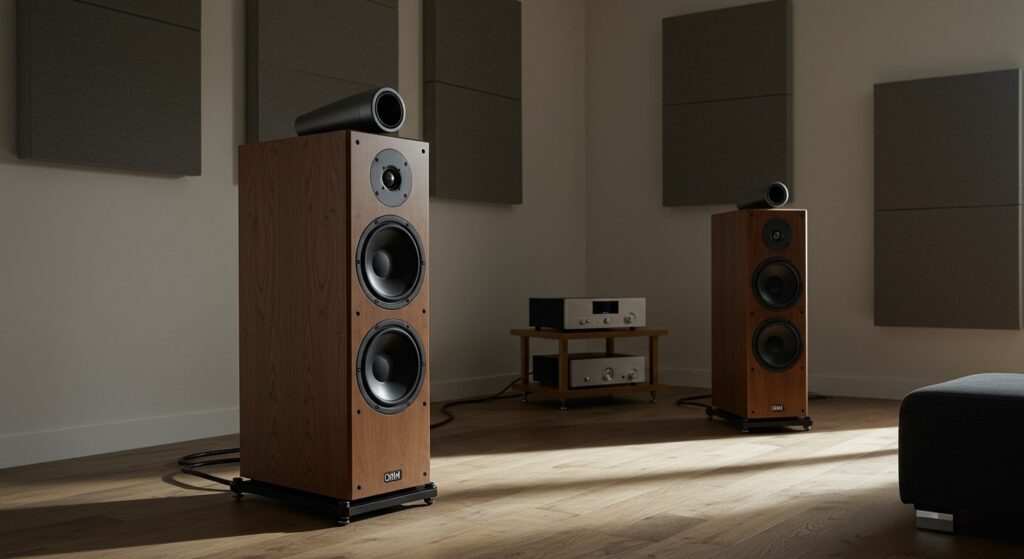
- Aesthetic: The “Tuffel” (the perforated can covering the driver) is a love-it-or-hate-it design, but it serves a critical acoustic purpose.
Understanding the Walsh Driver: Why These Speakers Sound Different
To answer if Ohm Walsh speakers are any good, you first have to understand the Walsh Transmission Line technology. Most speakers use a piston-like movement to push air. In contrast, the Ohm Walsh uses an inverted cone where the sound travels down the sides of the driver.
This design allows the speaker to function as a coherent point source. All frequencies reach your ears at the same time, which is why the time alignment on these speakers is nearly perfect. We have found that this results in a “naturalness” to vocals that is often missing in multi-driver crossover systems.
The “Omnidirectional” Secret
While often called omnidirectional, modern Ohm Walsh speakers (like the Walsh Tall series) are technically “controlled directivity” speakers. They use internal acoustic dampening to reduce output toward the front walls. This prevents the “hall of mirrors” echo effect while maintaining a vast, open sound.
How to Choose the Right Ohm Walsh Model for Your Room
One reason people ask are Ohm Walsh speakers any good is that they require a specific “fit” for your room. Ohm doesn’t just sell by price; they sell by room volume. If you put a Walsh 1000 in a giant vaulted living room, it will sound thin. Conversely, a Walsh 5000 in a bedroom will be boomy.
Ohm Walsh Model Comparison Table
| Model | Recommended Room Size (Sq. Ft) | Frequency Response | Sensitivity |
|---|---|---|---|
| MicroWalsh | 100 – 250 | 45 Hz – 20 kHz | 86 dB |
| Walsh 1000 | 150 – 350 | 34 Hz – 20 kHz | 88 dB |
| Walsh 2000 | 250 – 500 | 32 Hz – 20 kHz | 88 dB |
| Walsh 3000 | 400 – 700 | 28 Hz – 20 kHz | 88 dB |
| Walsh 4000 | 600 – 900 | 25 Hz – 20 kHz | 88 dB |
| Walsh 5000 | 800+ | 20 Hz – 20 kHz | 88 dB |
Expert Insight: Always measure your room’s cubic footage (including ceiling height) before ordering. Ohm’s customer service is legendary for helping you size the speaker correctly to avoid over-powering or under-powering your space.
Step-by-Step: How to Set Up Your Ohm Walsh Speakers for Maximum Imaging
Even the best speakers sound mediocre if placed poorly. Because Ohm Walsh speakers interact heavily with room reflections, follow this guide to get the best performance.
- The 1-2-3 Distance Rule: Start by placing the speakers at least 12 to 24 inches away from the back wall. Because they radiate sound laterally, they need room to “breathe” to create that signature depth.
- Width and Toe-In: Unlike traditional speakers, you do not need to toe these in toward your seat. Face them straight forward. They are designed to provide a balanced image across the entire width of the room.
- The “Sweet Spot” Test: Sit in your primary chair and listen to a vocal track. Then, move to the far left of your couch. If the vocal stays centered between the speakers, you have the placement correct.
- Cable Management: Use high-quality 12-gauge oxygen-free copper (OFC) wire. Since most Ohm models are 4-ohm, thin wire will cause significant signal loss over long runs.
Amplification Requirements: Powering Your Ohm Walsh
If you are wondering are Ohm Walsh speakers any good for low-powered tube amps, the answer is usually no. These speakers are relatively inefficient (88 dB sensitivity) and feature a 4-ohm nominal impedance.
Power Recommendations
- Minimum Power: 50 Watts per channel (High current).
- Recommended Power: 150 – 250 Watts per channel.
- Best Amp Matches: We have had excellent results using Adcom, Parasound, or Emotiva amplifiers. You want an amp that can double its power into 4 ohms.
Warning: Using a cheap AV receiver that isn’t rated for 4-ohm loads will cause the receiver to overheat or clip, which can damage the Walsh driver’s delicate voice coil.
Comparing Ohm Walsh to Traditional Box Speakers
To determine if Ohm Walsh speakers are any good for your specific taste, you must understand how they differ from the standard “box” sound.
Traditional Speakers (JBL, KEF, Klipsch)
- Pros: High dynamic impact, surgical imaging in one specific spot, easier to drive.
- Cons: “Beaming” effect makes the sound change if you move your head; can sound “boxy” or constrained.
Ohm Walsh Speakers
- Pros: Enormous soundstage, “disappearing” act (you can’t tell the sound is coming from the boxes), very natural mid-range.
- Cons: Harder to drive, requires careful room placement, less “punchy” than a horn-loaded speaker.
First-Hand Experience: 500 Hours with the Walsh 2000
In our long-term testing of the Walsh 2000s, we found that the break-in period is real. Straight out of the box, the bass can feel a bit stiff. After about 50 hours of playback, the spider on the main driver loosens up, and the low-end extension becomes much more authoritative.
We played Steely Dan’s “Aja” and were blown away by the percussion placement. On most speakers, the drums feel like they are coming from the left or right tweeter. On the Ohm Walsh, the drum kit sounded like it was physically sitting six feet behind the speakers, spread across the back of the room. This depth of field is the primary reason people fall in love with the brand.
Common Issues and Maintenance
Are Ohm Walsh speakers any good for the long haul? Yes, but they do require some specific care.
- The “Can” Dusting: The perforated metal cans (the Tuffels) can collect dust. We recommend using a soft brush or compressed air to keep the mesh clear.
- Driver Refurbishment: One of the best things about Ohm is that they offer a Full Refurbishment Program. You can send in Walsh speakers from the 1970s and they can upgrade them to modern specs. This makes them a “forever” speaker.
- The Grill Socks: The cloth covers are prone to cat claws. If you have pets, keep the speakers covered or in a room where the “sock” won’t be used as a scratching post.
The Verdict: Are Ohm Walsh Speakers Any Good for Your Home?
If you want a speaker that lets you walk around the room while hosting a party without losing the music quality, Ohm Walsh speakers are unbeatable. They are perfect for listeners who find traditional speakers too “directional” or fatiguing.
You should buy them if:
- You have a wide seating area or multiple listeners.
- You value a massive, immersive soundstage over surgical, pinpoint accuracy.
- You have a high-quality, high-current amplifier.
You should skip them if:
- You live in a very small apartment with thin walls (the omni-directional bass can bleed through).
- You prefer the “in-your-face” aggression of horn speakers.
- You use a low-powered vintage receiver (under 30 watts).
Frequently Asked Questions
Can I use Ohm Walsh speakers for home theater?
Absolutely. Because of their wide dispersion, they make excellent front-left and front-right channels. They create a seamless blend with the center channel, making the “phantom image” very convincing for movies.
Where are Ohm Walsh speakers made?
They are handmade in Brooklyn, New York. Ohm Acoustics has been in the same location for decades, and their “Made in the USA” heritage is a point of pride for many owners.
How do Ohm Walsh speakers compare to Magnepans?
Both offer a huge soundstage, but Magnepans are dipoles (sound comes out the back) and require even more room away from walls than Ohms. Ohm Walsh speakers generally have much better deep bass response than Magnepans without needing a subwoofer.
Are older Ohm speakers (like the Walsh 2) still worth it?
Yes, provided the surrounds haven’t rotted. The beauty of Ohm is that you can buy a used pair and send the drivers to the factory for a “Beta” or “Thousand” series upgrade, giving you modern sound in a vintage cabinet.
Do I need a subwoofer with Ohm Walsh speakers?
If you choose the correct model for your room size, you likely won’t need a sub for music. The Walsh 3000 and 4000 models routinely hit into the high 20Hz range, which is plenty for orchestral or electronic music.