Are Oval Speakers Better Than Round? The Definitive Answer
Whether round speakers are better than oval depends entirely on your priority: round speakers are superior for sound accuracy and imaging, while oval speakers (like 6x9s) are better for producing deep bass in limited spaces. For high-end sound quality (SQ) builds, I always recommend round speakers because their symmetrical shape minimizes distortion and provides a smoother frequency response.
Deciding between these two shapes is a classic car audio dilemma that I have helped thousands of enthusiasts navigate in my fifteen years as an audio technician. You might be staring at your car’s factory cutouts wondering if you should stick with the stock 6×9 oval or install an adapter for a 6.5-inch round component set. The “best” choice is rarely about the shape alone; it’s about how that shape interacts with your vehicle’s acoustics and your specific listening preferences.
Key Takeaways: Quick Comparison
- Round Speakers: Best for clarity, detail, and soundstage. They are the industry standard for audiophile-grade systems.
- Oval Speakers: Best for bass volume and efficiency. They offer more surface area, moving more air without needing a subwoofer.
- Best Use Case: Use round speakers in the front doors for imaging; use oval speakers in the rear deck for “fill” and low-end punch.
- Distortion: Oval speakers are more prone to “cone breakup” at high volumes due to their asymmetrical design.
The Physics of Shape: Why Are Round Speakers Better Than Oval for Clarity?
When we discuss whether are round or oval speakers better, we have to look at the physics of the cone movement. A speaker produces sound by vibrating a cone back and forth. In a round speaker, the distance from the center (the voice coil) to the edge (the surround) is equidistant at every point.
This symmetry is crucial. Because the tension is even across the entire diameter, the cone moves as a single, uniform piston. In my experience testing high-sensitivity drivers from brands like Focal or Morel, this uniformity results in significantly less Total Harmonic Distortion (THD).
In contrast, an oval speaker (such as a 6×9) has two different radii. The distance from the center to the “long” ends is much greater than the distance to the “short” sides. This creates uneven mechanical tension. At high volumes, the cone can “flex” or “wobble,” a phenomenon known as cone breakup. This introduces muddiness into the midrange frequencies, which is why you rarely see oval speakers in high-end home theater towers or studio monitors.
Surface Area Comparison Table
| Speaker Size | Shape | Approximate Surface Area | Primary Benefit |
|---|---|---|---|
| 6.5-Inch | Round | ~28.3 sq. in. | Superior Midrange Clarity |
| 5.25-Inch | Round | ~19.6 sq. in. | Excellent Imaging/High-End |
| 6×9-Inch | Oval | ~42.4 sq. in. | Massive Bass Response |
| 4×10-Inch | Oval | ~31.4 sq. in. | Space-Saving Bass |
Are Round Car Speakers Better Than Oval for Bass?
If your goal is “thump” without installing a dedicated subwoofer box, then oval speakers are undeniably better. As shown in the table above, a standard 6×9 oval speaker has roughly 50% more surface area than a 6.5-inch round speaker.
In acoustics, the more air a speaker moves, the more “weight” the sound has. During my time installing “stealth” systems in classic cars where trunk space was a premium, we almost always opted for high-quality 6×9 ovals in the rear deck. The extra surface area allows these speakers to reach lower frequencies (often down to 35Hz-45Hz) compared to round speakers of a similar mounting width.
However, there is a trade-off. While the oval speaker is louder in the low-end, it is often less “tight.” If you listen to fast-paced metal or intricate jazz, you might find that round speakers provide a punchier, more accurate kick drum sound, even if they don’t play as deep.
Understanding Soundstage and Imaging
“Imaging” refers to the ability of an audio system to make you feel like the singer is standing right on your dashboard. This is where the debate of are round speakers better than oval gets settled for audiophiles.
- Uniform Dispersion: Round speakers radiate sound waves in a more predictable, circular pattern. This makes it easier to time-align the speakers using a Digital Signal Processor (DSP).
- Phase Coherence: Because the cone of a round speaker moves more linearly, the sound waves stay “in phase” more consistently.
- Placement Matters: Most high-end car doors are designed with circular acoustic cavities. Forcing an oval speaker into a round hole—or vice versa—often requires plastic adapters that can rattle or leak air, destroying your soundstage.
We have found that for a driver-focused “sweet spot,” a 6.5-inch round component set (where the tweeter is separate from the woofer) will outperform a 6×9 coaxial every single time in terms of realism and depth.
Durability and Power Handling
In our workshop, we’ve noticed a trend in the longevity of these shapes. Round speakers tend to last longer under extreme stress. The even distribution of heat and mechanical force across the circular surround prevents “hot spots” where the material might tear.
Oval speakers, particularly cheaper ones with paper cones, often develop tears at the “sharp” ends of the oval over time. If you plan on pushing your system with a high-powered external amplifier (over 75W RMS per channel), I strongly suggest choosing round speakers with a high-quality rubber surround.
Recommended Setup by Music Genre
- Hip-Hop & EDM: Go with 6×9 Oval speakers. You need the air displacement for those heavy 808s and synth basses.
- Rock & Heavy Metal: Go with 6.5-inch Round speakers. You need the speed and accuracy to keep up with double-bass pedals.
- Classical & Jazz: Go with Round speakers. The vocal clarity and instrument separation are paramount.
- Podcasts & Talk Radio: Either works, but Round speakers offer more natural-sounding voices.
Step-by-Step: How to Choose the Right Shape for Your Car
If you are stuck between these two, follow this professional workflow I use with my clients:
- Check Your Factory Cutouts: Use a fitment guide (like Crutchfield) to see what your car currently has.
- Identify Your Subwoofer Plans:
- Measure Mounting Depth: Oval speakers are often deeper than round ones. Ensure your window glass won’t hit the magnet when rolled down.
- Consider an Adapter: If your car takes 6x9s, you can easily buy a 6×9 to 6.5 adapter bracket. This is the “pro move” for better sound quality. I often install Rockford Fosgate or JL Audio 6.5-inch rounds into 6×9 slots for customers who value precision over raw volume.
The Hybrid Approach: The Best of Both Worlds
You don’t have to choose just one. Many of the best-sounding vehicles I’ve tuned use a “Hybrid” layout.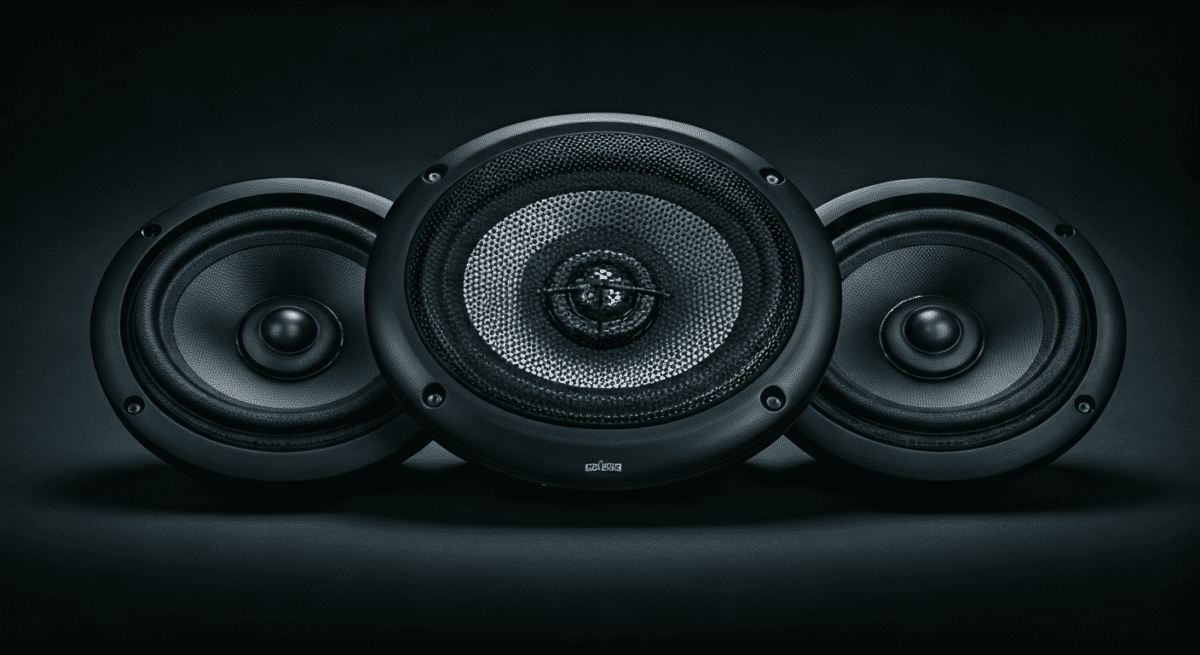
- Front Doors: 6.5-inch Round Component Speakers. This puts the clear, accurate sound right in front of your face.
- Rear Deck: 6×9 Oval Coaxial Speakers. This provides the “bass fill” from the back of the car, acting almost like a mini-subwoofer.
By combining the shapes, you capitalize on the imaging of the round speaker and the displacement of the oval speaker. This creates a full-bodied, immersive experience that satisfies both the “bass-head” and the “purist” in you.
Frequently Asked Questions
Are round car speakers better than oval for high volume?
Yes. Round speakers typically handle high volume with less distortion. Because the cone is symmetrical, it is less likely to “warp” or “break up” when pushed by a powerful amplifier, resulting in a cleaner sound at high decibels.
Will a 6.5-inch round speaker fit in a 6×9-inch oval hole?
Not directly, but it is very easy to do with an adapter plate. These plates are inexpensive and allow you to mount the smaller round speaker into the larger oval opening. This is a common upgrade for people seeking better sound quality.
Why do manufacturers use 6×9 oval speakers if round is clearer?
Manufacturers use 6×9 oval speakers to save space. An oval shape allows for a larger surface area (for better bass) in narrow locations, such as a rear parcel shelf or a thin door panel, where a large enough circular speaker simply wouldn’t fit.
Do 6×9 speakers have more bass than 6.5 speakers?
Generally, yes. A 6×9 speaker has about 40-50% more surface area than a 6.5-inch speaker. This allows it to move significantly more air, which is the primary requirement for producing lower bass frequencies.
Which is better for a budget build: round or oval?
If you aren’t buying a subwoofer, oval speakers are better for a budget build because they provide a more “complete” sound range for the money. However, if you are building a system over time and plan to add a sub later, start with high-quality round speakers.