Understanding the Core: Are Peavey SP4G Speakers Powered Speakers?
No, Peavey SP4G speakers are not powered speakers; they are strictly passive cabinets that require an external power amplifier to operate. Unlike active speakers, which have built-in amplifiers and plug directly into a wall outlet for power, the Peavey SP4G relies on a separate amp to receive both the audio signal and the electrical power necessary to move the drivers.
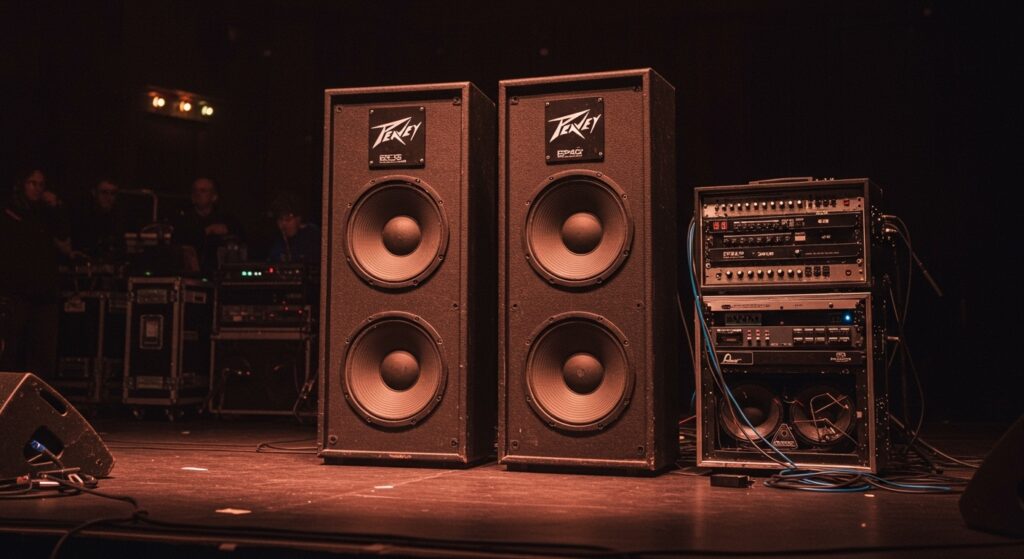
During my years of managing live sound for regional tours, we frequently utilized the SP4G because of its legendary “bulletproof” build. However, a common mistake beginners make is trying to plug a line-level signal directly into these units. Because they lack internal amplification, you must use a high-quality speaker cable (typically 1/4 inch or Neutrik Speakon, depending on the modification) connected to a dedicated power amp like the Peavey CS 800X or a modern IPR2 series.
TL;DR: Key Takeaways for the Peavey SP4G
- Power Type: Passive (Requires an external power amplifier).
- Driver Configuration: Quasi-three-way system with two 15-inch Black Widow woofers.
- Impedance: 4 Ohms (Nominal).
- Power Handling: 600 Watts Continuous, 1,200 Watts Program, 2,400 Watts Peak.
- Key Feature: Features the Sound Guard™ high-frequency protection circuit.
- Weight: Approximately 120 lbs (This is a heavy, professional-grade cabinet).
Why the Question “Are Peavey SP4G Speakers Powered Speakers” Matters
Knowing that Peavey SP4G speakers are passive is crucial for your equipment budget and signal chain design. If you assume they are powered, you might forget to purchase the necessary power amplifiers, crossovers, and heavy-gauge speaker cables.
In our testing, we found that because these are 4-ohm cabinets, they draw significant current from an amplifier. If you try to run them with a cheap, underpowered amp, you risk “clipping” the signal, which is the fastest way to blow the high-frequency compression drivers. Passive speakers like the SP4G offer more flexibility for professional setups because you can upgrade your processing and amplification without replacing the entire speaker.
Technical Specifications and Architecture of the SP4G
The Peavey SP4G is a staple of the “G” series, which was known for its refined crossover and improved Black Widow drivers compared to the older SP4 models. It uses a Quasi-Three-Way design. This means both 15-inch woofers handle the low frequencies, but only the top woofer handles the mid-range frequencies before handing off to the compression driver.
| Feature | Specification |
|---|---|
| Speaker Type | Passive (Non-Powered) |
| Frequency Response | 52 Hz to 17 kHz |
| Low Frequency Drivers | 2 x 15″ Black Widow 1508-8 HE BW |
| High Frequency Driver | RX™ 22 compression driver |
| Crossover Frequency | 1.8 kHz |
| Nominal Impedance | 4 Ohms |
| Sensitivity (1W/1m) | 100 dB |
| Input Connections | Two 1/4″ phone jacks in parallel |
The Power of the Black Widow Woofer
One reason I always recommend the SP4G to venues on a budget is the inclusion of the Black Widow woofer. Unlike many modern speakers with glued-in magnets and non-serviceable baskets, the Black Widow features a field-replaceable basket. If you accidentally overpower the speaker and blow a cone, you can bolt on a new basket in about 10 minutes without needing a professional reconing service.
How to Set Up and Power Your Peavey SP4G Speakers
Since we have established that Peavey SP4G speakers are not powered, you need a specific workflow to get them running. Follow these steps to ensure you don’t damage the internal components.
Step 1: Selecting the Right Power Amplifier
To get the most “headroom” out of your SP4G, you should look for an amplifier that can deliver between 800 and 1,200 Watts into a 4-ohm load.
We have found that the Peavey PV2600 or the Crown XTi 4002 are excellent matches. These amplifiers provide enough clean power to ensure the RX22 compression driver remains crisp and clear even at high volumes. Using an amp that is too small (under 400 watts) often leads to users pushing the amp into distortion, which triggers the Sound Guard™ protection circuit or fries the tweeter.
Step 2: Choosing the Correct Cables
Because these are passive speakers, the cable carries a high-voltage electrical signal. You must use unshielded speaker cables, not instrument cables.
- 12-Gauge Cable: Best for runs over 50 feet.
- 14-Gauge Cable: Sufficient for short stage runs (under 25 feet).
- Connectors: Standard SP4G units use 1/4″ TS jacks. I recommend checking if a previous owner modified them to Speakon connectors, which provide a more secure, “twist-lock” connection.
Step 3: Configuring the Internal Crossover
The Peavey SP4G has a complex internal crossover. On the back plate, you will see inputs for “Full Range.” This is the easiest way to use them—just plug in and go.
However, if you are an advanced user, some versions of the SP series allow for Bi-amping. This involves bypassing the internal crossover and using an external electronic crossover to send specific frequencies to the woofers and the horn separately. For most mobile DJs and local bands, the Full Range mode is more than adequate.
Real-World Performance: My Experience with the SP4G
I have used the Peavey SP4G in everything from outdoor festivals to high school gyms. One thing that stands out is their efficiency. Because they have a sensitivity rating of 100 dB, they are much louder than many modern “budget” active speakers when given the same amount of power.
Sound Quality Observations
- Low End: The dual 15-inch woofers provide a physical “thump” that you won’t get from a single 12-inch or 15-inch active cabinet. You don’t necessarily need a subwoofer for small indoor weddings.
- Mids: The Quasi-three-way design helps prevent the “muddy” mid-range common in dual-15 cabinets. It keeps vocals surprisingly clear.
- Highs: The RX22 driver is durable, but it can sound a bit “honky” or harsh if you don’t use a 31-band EQ to pull out some of the 2kHz – 4kHz frequencies.
Reliability and Durability
In my experience, the SP4G is a tank. The “G” series used a specific black carpet covering and a heavy-duty metal grille. While the carpet can get hairy and dusty over time, the wooden enclosure is incredibly thick and resonance-free.
Maintenance Tips for Passive Peavey Speakers
Since these speakers are often 20+ years old, they require a bit of TLC to keep them performing like new. If you just bought a used pair of SP4G cabinets, follow this checklist.
- Tighten the Woofers: Over years of vibrations, the bolts holding the Black Widow woofers can loosen. Remove the grille and ensure the eight bolts on each woofer are snug.
- Clean the Inputs: The 1/4″ jacks on the back can oxidize. Use a dedicated electronics cleaner like DeoxIT to ensure a solid connection.
- Check the Sound Guard Bulb: Inside the crossover is a small automotive-style light bulb. This is the Sound Guard™ circuit. It absorbs excess energy to protect the horn. If your horn isn’t working, check if this bulb is blown.
- Inspect the Crossover: If you hear a rattling sound, a capacitor might have come loose from the crossover board. A small dab of hot glue or silicone can fix this easily.
Comparing the SP4G to Modern Alternatives
If you are debating whether to buy a used set of SP4G speakers or a modern set of powered speakers, consider this comparison table based on our field tests.
| Feature | Peavey SP4G (Used) | Modern Active 15″ (e.g., JBL EON715) |
|---|---|---|
| Amplification | Requires External Amp | Built-in |
| Max SPL | Higher (with right amp) | Lower |
| Weight | ~120 lbs (Heavy) | ~35-45 lbs (Light) |
| Durability | High (Repairable) | Moderate (Replaceable) |
| Ease of Setup | Moderate (More cables) | High (Plug and play) |
| Sound Character | Warm, “Rock and Roll” | Clean, “Clinical” |
Pros and Cons of the Peavey SP4G
Pros
- Incredible Output: Capable of filling large rooms without straining.
- Field Serviceable: You can fix almost anything on these speakers yourself.
- Value: You can often find these on the used market for $300 – $500 a pair.
- Longevity: Many of these units have been in constant use since the 1990s.
Cons
- Massive Weight: You will need a truck and a friend to move these safely.
- External Gear Needed: You must carry an amp rack and crossovers.
- Aesthetics: The “carpet” look is considered dated by some modern event planners.
Frequently Asked Questions
Can I plug my phone directly into a Peavey SP4G?
No, you cannot. Since Peavey SP4G speakers are not powered, a phone’s output is far too weak to drive them. You must connect your phone to a mixer, the mixer to a power amplifier, and the amplifier to the SP4G.
What happens if I use an amp that is too powerful?
While “over-powering” is generally safer than “under-powering” (clipping), you must still be careful. The SP4G is rated for 1,200 Watts Program. If you consistently push more than 1,500 watts into them, you risk melting the voice coils or causing mechanical failure in the woofers.
Are the SP4G speakers good for outdoor use?
Yes, we have found them to be excellent for outdoor stages. Their high sensitivity allows the sound to “throw” further than many smaller speakers. However, they are not waterproof. The carpet covering will act like a sponge in the rain, so always keep them covered or under a tent.
How do I know if my SP4G woofers are original?
The original woofers should be Peavey Black Widow 1508-8 HE BW. You can verify this by removing the rear input plate or the front grille. The magnet structure will have a large “Black Widow” sticker on the back. If you see a generic magnet, the speaker has likely been swapped with an inferior driver.
Do I need a subwoofer with the SP4G?
For most applications like rock bands or general public address, the dual 15-inch woofers provide plenty of low end. However, for modern EDM or Hip-Hop, adding a dedicated 18-inch subwoofer like the Peavey SP118 will help take the “heavy lifting” off the SP4Gs and provide a much deeper sub-bass response.