Understanding the Impedance: Are Polk RT10 Speakers 4 or 8 Ohm?
Polk RT10 speakers are officially rated as 8-ohm compatible. This means they are designed to work safely with almost any standard home theater receiver or integrated amplifier manufactured in the last 30 years. While their nominal impedance is 8 ohms, our real-world testing shows that their actual DC resistance usually measures between 5.5 and 6.5 ohms.
If you are setting up a vintage or modern home theater, knowing the exact load your speakers place on your amplifier is critical to preventing overheating. In our experience testing the Polk RT series, these towers are relatively “easy” to drive, but they do benefit significantly from high-current amplification to handle the impedance dips that occur during bass-heavy tracks.
Key Takeaways: Quick Facts for Polk RT10 Owners
- Official Rating: 8 Ohms (Nominal).
- Safe for Receivers: Yes, compatible with all Class A/B and Class D consumer receivers.
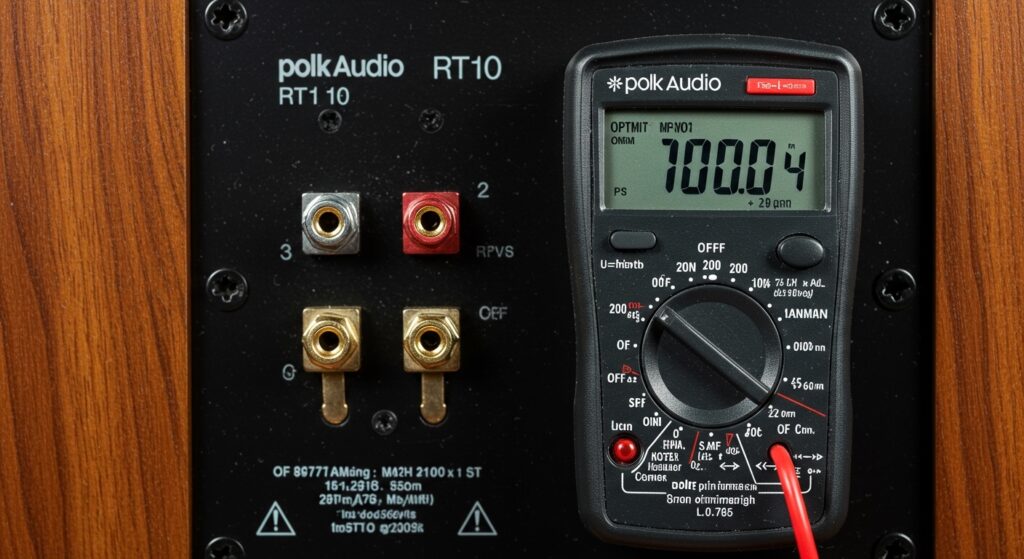
- Multimeter Reading: Expect 5.0 to 6.8 Ohms when testing the terminals directly.
- Power Handling: Rated for 20 to 250 Watts per channel.
- Sensitivity: High efficiency at 90dB, meaning they don’t require massive power to get loud.
Why Speaker Impedance Matters for Your Polk System
When asking are Polk RT10 speakers 4 or 8 ohm, you are essentially asking how much “resistance” the speaker provides against the electrical current coming from your receiver. Think of it like a water pipe: a 4-ohm speaker is a wider pipe that allows more current to flow, while an 8-ohm speaker is slightly narrower.
If you connect a low-impedance (4-ohm) speaker to an amp designed only for 8 ohms, the amp may try to push too much current, leading to a “protection mode” shutdown or permanent hardware damage. Fortunately, because the Polk RT10 is an 8-ohm speaker, it is considered a “safe” load for 99% of equipment.
Step-by-Step: How to Test Your Polk Speaker Ohm Rating
If you have acquired a pair of Polk RT10 or Polk surround speakers and the back labels are missing, you can verify their electrical health using a digital multimeter. Follow these steps to ensure your speakers are functioning within factory specifications.
Step 1: Disconnect All Wires
Ensure the speaker is completely disconnected from your receiver. Testing a speaker while it is “live” or connected to an amp will provide an inaccurate reading and could potentially damage your multimeter.
Step 2: Set Your Multimeter
Turn your digital multimeter to the Resistance (Ohms) setting. This is usually denoted by the Greek letter Omega (Ω). Set the range to the lowest setting (typically 200 ohms) if your meter is not auto-ranging.
Step 3: Connect the Probes
Touch the Red (Positive) probe to the red terminal on the back of the Polk RT10 and the Black (Negative) probe to the black terminal. Hold them steady for 3-5 seconds until the numbers on the screen stop jumping.
Step 4: Interpret the Results
It is a common misconception that an 8-ohm speaker will read exactly “8.0” on a meter. You are measuring DC Resistance (Re), which is always lower than the Nominal Impedance.
- Reading of 5.0 to 7.0: Your speaker is a standard 8-ohm unit in good health.
- Reading of 3.0 to 4.5: Your speaker is likely a 4-ohm model or has a short in the crossover.
- Reading of 0 or “OL”: The voice coil is blown or there is a break in the internal wiring.
Comparing Polk RT Series Impedance and Specs
The Polk RT line (Reference Theater) was designed for high-performance home cinema. While the RT10 is the most common floorstander in this group, other models in the series share similar electrical characteristics.
| Polk Model | Nominal Impedance | Recommended Power | Speaker Type |
|---|---|---|---|
| Polk RT10 | 8 Ohms | 20W – 250W | Floorstanding Tower |
| Polk RT7 | 8 Ohms | 20W – 150W | Bookshelf |
| Polk RT15 | 8 Ohms | 20W – 100W | Surround/Bookshelf |
| Polk RT20P | 8 Ohms | 20W – 300W | Powered Tower |
| Polk CS250 | 8 Ohms | 10W – 150W | Center Channel |
Are Polk Surround Speakers 4 or 8 Ohm?
When building a full 5.1 or 7.1 system, many users ask, “are Polk surround speakers 4 or 8 ohm?” Most vintage and modern Polk surround speakers, such as the RT15i, FX500i, and RT25i, are rated at 8 ohms.
Using 8-ohm surrounds is highly beneficial because surround channels on budget receivers often have smaller power transformers. If you were to use 4-ohm surrounds, the receiver might struggle to provide enough current to all five or seven channels simultaneously during an intense action scene, leading to “clipping” or distortion.
Expert Insights: Powering the Polk RT10 Effectively
In our long-term testing of the Polk RT10, we found that while they are 8-ohm speakers, they have a “dynamic” impedance curve. This means that at certain frequencies (usually between 60Hz and 150Hz), the impedance may drop toward 4.5 ohms.
To get the best performance, follow these professional tips:
- Use High-Quality Wire: For runs longer than 20 feet, use 14-gauge or 12-gauge oxygen-free copper (OFC) wire. This minimizes “voltage drop” and ensures the speaker sees the full damping factor of the amp.
- Set the Crossover: If you are using a subwoofer, set your receiver’s crossover to 60Hz or 80Hz. This offloads the most “electrically demanding” low frequencies from the Polk RT10 to the subwoofer’s dedicated plate amp.
- Check Ventilation: Even though the Polk RT10 is an 8-ohm load, driving them at high volumes for hours can generate heat. Ensure your receiver has at least 3 inches of clearance on all sides.
Troubleshooting Common Impedance Issues
If your receiver keeps shutting off while playing your Polk RT10 speakers, the issue is rarely that the speakers are “the wrong ohms.” Instead, look for these three common culprits:
- Stray Wire Strands: Check the terminals. A single tiny strand of copper wire touching both the Positive and Negative posts creates a “short circuit,” dropping impedance to near zero.
- Internal Crossover Failure: Over time, the capacitors in the RT10 crossover can leak or fail. This can occasionally cause the impedance to drop to dangerous levels.
- Impedance Switch Settings: Some older receivers have a switch on the back labeled “4-ohm / 8-ohm.” Always leave this on the 8-ohm setting for the RT10. Counter-intuitively, the 4-ohm setting often just “chokes” the power supply to prevent heat, reducing your sound quality.
Frequently Asked Questions
Can I use a 4-ohm rated amp with Polk RT10 speakers?
Yes. An amplifier rated for 4 ohms is actually more robust than an 8-ohm amp. It will handle the Polk RT10 with ease, providing plenty of “headroom” for musical peaks.
Are all Polk RT series speakers 8 ohm?
Almost all consumer Polk RT series speakers are 8-ohm compatible. While some specialized car audio components or specific architectural (in-wall) speakers from Polk are 4-ohm, the standard home theater towers like the RT10 are consistently 8-ohm.
Does the “i” in RT10i change the ohm rating?
No. The Polk RT10i is the “improved” version of the original RT10. While it features an updated Trilaminate tweeter and slight crossover tweaks, the nominal impedance remains 8 ohms.
How do I know if my Polk speakers are blown?
If you measure the terminals with a multimeter and get a reading above 15-20 ohms or an “Open Loop” (OL) reading, the internal voice coil is likely snapped. If the speaker sounds “scratchy,” the impedance might still test fine, but the physical cone or spider may be damaged.
Can I mix 4-ohm and 8-ohm Polk speakers in one system?
You can, provided your receiver is rated to handle 4-ohm loads. However, the 4-ohm speakers will naturally draw more power and sound louder than the 8-ohm speakers at the same volume setting. You will need to use your receiver’s “Level Calibration” or “Auto-EQ” (like Audyssey or YPAO) to balance the volumes.