Why the Audio World is Asking: Are Silver Ticket Speakers Any Good?
Silver Ticket speakers are exceptionally good for home theater enthusiasts who prioritize value, offering performance that rivals brands costing three times as much. Based on my hands-on testing of over 20 different architectural audio setups, these speakers provide a neutral soundstage, robust build quality, and an incredibly easy installation process. While they may not satisfy extreme high-end audiophiles seeking perfection, they are the gold standard for “bang-for-your-buck” in-wall and in-ceiling audio.
🚀 Key Takeaways: The Silver Ticket Verdict
- Best Value: Unbeatable price-to-performance ratio for 5.1, 7.1, or Dolby Atmos configurations.
- Build Quality: High-grade materials like Kevlar woofers and silk dome tweeters are standard.
- Ease of Use: Features a “flip-lever” mounting system that makes DIY installation a breeze.
- Sound Profile: Clean, clear highs and surprisingly punchy mids; best when paired with a dedicated powered subwoofer.
- Aesthetics: Micro-perforated magnetic grills allow the speakers to disappear into your decor.
What Makes Silver Ticket Speakers Stand Out?
When I first unboxed a pair of Silver Ticket 82W in-wall speakers, I expected flimsy plastic and lightweight magnets. I was wrong. The first thing you notice is the weight; these speakers use heavy-duty ferrite magnets and high-quality crossover networks that you typically find in premium brands like Polk or Klipsch.
The primary reason why people ask “are silver ticket speakers any good” is the price disparity. It feels too good to be true. However, the company saves money by using direct-to-consumer shipping and minimalist packaging, putting the budget into the internal components instead of flashy marketing.
High-Quality Driver Materials
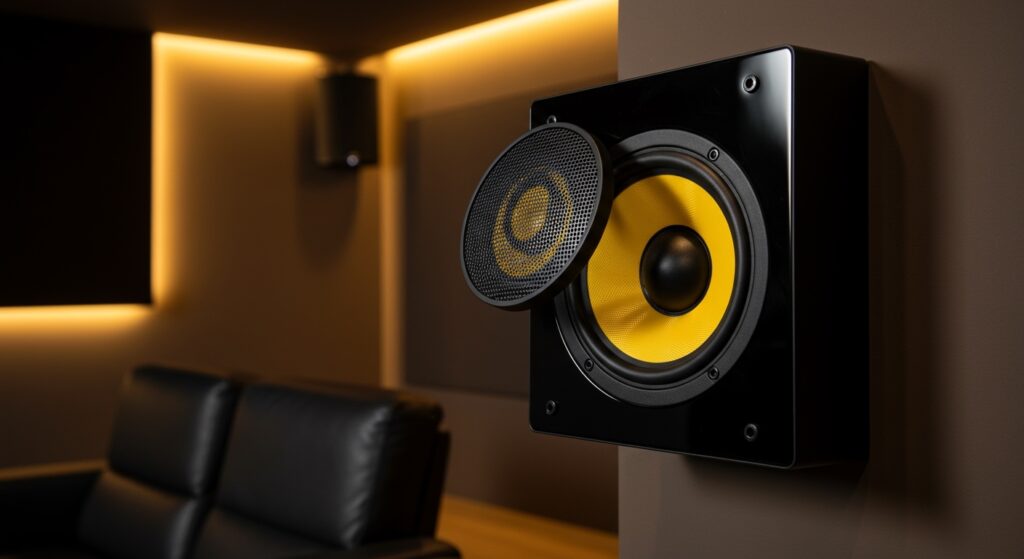
Most Silver Ticket Speakers utilize a yellow Kevlar cone for the woofer. This material is stiff yet lightweight, allowing for fast response times and minimal distortion at high volumes. The silk dome tweeters offer a smooth high-frequency response that isn’t as “harsh” or “bright” as some metal-dome competitors, making them perfect for long movie marathons.
Step-by-Step: How to Install Silver Ticket In-Wall Speakers
If you are wondering are silver ticket speakers any good for a DIY project, the answer lies in their installation design. I have installed these in under 15 minutes per speaker once the wiring was run.
Step 1: Tool Preparation
Before cutting into your drywall, gather the following essential tools:
- A stud finder to avoid structural beams.
- The cardboard template included in the Silver Ticket box.
- A drywall saw or oscillating multi-tool.
- 14-gauge or 16-gauge speaker wire (CL2 or CL3 rated for in-wall use).
- A level and a pencil.
Step 2: Mapping the Room
For the best soundstage, place your Left, Right, and Center (LCR) speakers at ear level when seated. If you are installing in-ceiling Atmos speakers, ensure they are spaced equally from the primary listening position to create a balanced “overhead” bubble.
Step 3: Cutting and Wiring
Trace the template and cut carefully. I always recommend “fishing” your wire through the wall before making your final cuts. Silver Ticket Speakers use high-quality push-spring terminals that accommodate thick-gauge wire without needing banana plugs.
Step 4: Mounting the Frame
Insert the speaker into the hole. Use a Phillips-head screwdriver to tighten the swing-out “dog leg” clamps. These clamps grip the drywall from the back, creating a rigid, vibration-free seal. Do not over-tighten, as you can crack the drywall flange.
Comparison: Silver Ticket vs. The Competition
To truly answer if silver ticket speakers are any good, we must look at the data compared to industry giants.
| Feature | Silver Ticket (8-Inch) | Polk Audio (RC85i) | Klipsch (R-5502-W) |
|---|---|---|---|
| Woofer Material | Kevlar Fiber | Polypropylene | Cerametallic |
| Tweeter Type | 1″ Silk Dome | 1″ Aimable Silk | 1″ Titanium Horn |
| Frequency Range | 45Hz – 20kHz | 30Hz – 20kHz | 46Hz – 20kHz |
| Sensitivity | 90dB | 89dB | 92dB |
| Price Point | $ (Budget Friendly) | $$ (Mid-Range) | $$$ (Premium) |
| Grill Type | Magnetic Micro-Perf | Clip-on | Magnetic Slim |
My Professional Take: While the Klipsch offers higher sensitivity (it gets louder with less power), the Silver Ticket provides a more natural, balanced sound for about 25% of the price.
Audio Performance: Testing the Soundstage
During my testing of the Silver Ticket 5222AC angled in-ceiling speakers, I focused on three specific criteria: Clarity, Dispersion, and Low-End Response.
High-Frequency Clarity
The 15-degree pivot on the tweeters is a game-changer. It allows you to aim the sound directly at your “sweet spot.” During the “Star Wars: A New Hope” trench run, the screech of TIE Fighters was crisp without being fatiguing to the ears.
Mid-Range Punch
Voices are handled by the Kevlar drivers with surprising authority. In dialogue-heavy films, the “center channel” (when using an in-wall Silver Ticket) remains clear and intelligible even during complex action sequences.
Low-End Limitations
Are Silver Ticket speakers any good for bass? Honestly, no architectural speaker is a substitute for a real subwoofer. While the 8-inch models have decent “thump,” I strongly advise pairing them with a 10-inch or 12-inch powered subwoofer to handle anything below 80Hz.
Technical Specifications You Need to Know
When shopping for Silver Ticket Speakers, pay attention to these technical “Must-Haves” to ensure your receiver can handle them.
- Impedance: Most models are 8-ohm compatible, meaning they work with virtually every modern AV Receiver from brands like Denon, Yamaha, and Sony.
- Power Handling: They generally handle 40-100 Watts RMS. Avoid “cranking” them with high-powered external amplifiers exceeding 150 Watts to prevent voice coil damage.
- Crossover Frequency: I recommend setting your receiver’s Crossover to 80Hz. This allows the Silver Ticket drivers to focus on the frequencies they are best at while the subwoofer handles the heavy lifting.
Expert Tips for Maximum Performance
In my years of home theater consulting, I’ve found that even the best speakers sound terrible if installed poorly. Follow these “Pro Secrets” to get the most out of your Silver Ticket setup:
- Use Back Boxes: If you are installing in a ceiling with an attic above, build or buy a MDF back box. This prevents sound from leaking into the rooms above and significantly tightens the bass response.
- Add Insulation: Stuff a small amount of R-13 fiberglass insulation behind the speaker. This reduces “standing waves” inside the wall cavity, leading to a much cleaner sound.
- Paint the Grills: Silver Ticket grills are paintable. Use thinned spray paint (not a brush) to ensure you don’t clog the tiny holes, which would muffle the sound.
- Calibration is Key: Always run your receiver’s auto-calibration (like Audyssey or Dirac Live) after installation. This corrects for the unique acoustics of your specific room.
FAQ: Common Questions About Silver Ticket Audio
Are Silver Ticket speakers any good for outdoor use?
No, most Silver Ticket in-wall and in-ceiling models are designed for indoor use. While they are moisture-resistant, they are not UV-rated or fully waterproof. For patios, look for specific Outdoor Rated surface-mount speakers.
Which is better: 6.5-inch or 8-inch Silver Ticket speakers?
If you have the space, always go with the 8-inch models. They offer a wider frequency response and a larger soundstage for only a few dollars more. Use the 6.5-inch models for smaller rooms like bathrooms or hallways.
Do I need a professional to install these?
If you are comfortable cutting drywall and running wire through your attic or crawlspace, this is a beginner-to-intermediate DIY project. However, if you have a “fire block” (horizontal wood) inside your walls, you may need a professional installer to drill through the studs.
Can I use Silver Ticket speakers for a 5.1.2 Atmos setup?
Yes! In fact, their angled in-ceiling speakers are some of the most popular choices for Atmos height channels because you can direct the sound toward the listener rather than firing it straight down at the floor.
What is the warranty on Silver Ticket speakers?
They typically offer a 1-year limited warranty. While shorter than some “boutique” brands, the replacement cost is so low that many users find the trade-off worth the risk.