Understanding the Real Value of Spanish Certifications for Heritage Learners
For many heritage speakers, the question of whether a formal exam is necessary often leads to hesitation. You have spoken the language since childhood, so why pay for a piece of paper? For heritage speakers, Spanish proficiency certifications are worth it because they bridge the gap between “home fluency” and professional-grade competency that global employers, government agencies, and universities demand. While your conversational skills are likely excellent, a certification like the DELE or SIELE provides objective, third-party proof that you can handle complex technical terminology and formal writing tasks.
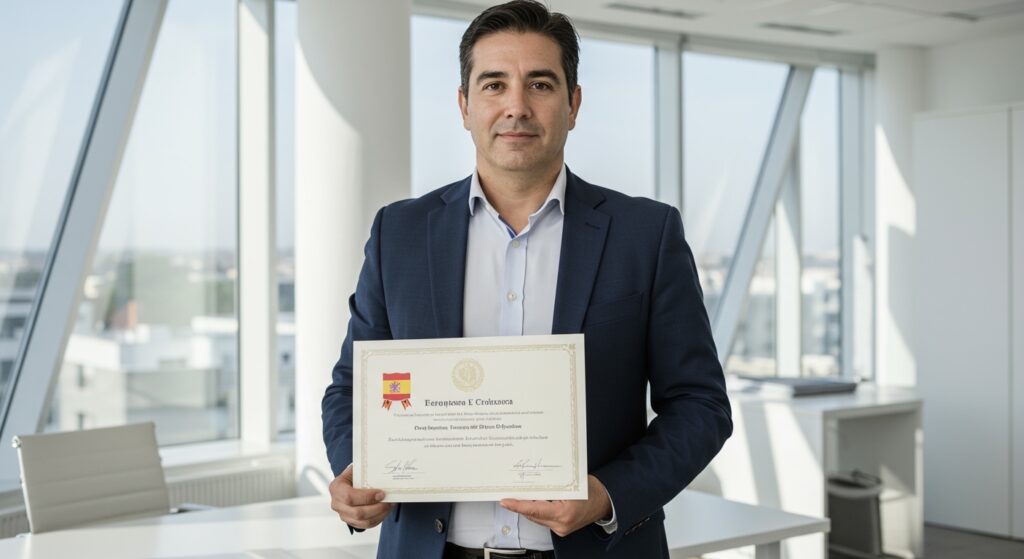
Key Takeaways: Why Get Certified?
- Professional Validation: Overcomes the “native speaker bias” where employers may doubt your formal writing or technical vocabulary.
- Higher Earning Potential: Bilingual employees with certified skills can see a salary increase of 5% to 20% in fields like healthcare, law, and customer service.
- Global Recognition: Certificates like the DELE never expire and are recognized by the Spanish Ministry of Education worldwide.
- Academic Credit: Many universities offer college credit or waive language requirements for students holding high-level certifications.
- Confidence Boost: Formalizes your linguistic identity and fills in “knowledge gaps” regarding grammar and standardized spelling.
Are Spanish Proficiency Certifications Worth It for Heritage Speakers?
In my years of consulting for bilingual recruitment, I have seen highly talented heritage speakers lose out on roles because they couldn’t produce a formal report in Spanish. The reality is that heritage speakers often possess high receptive bilingualism (understanding) but may struggle with productive skills (formal writing and advanced grammar).
When you ask, “Are Spanish proficiency certifications worth it for heritage speakers?“, you must consider your career trajectory. If you aim to work in medical interpretation, legal translation, or international business, a certification is not just an “extra”—it is often a non-negotiable requirement. According to ACTFL (American Council on the Teaching of Foreign Languages), professional-level work typically requires a “Superior” or at least an “Advanced High” rating, which many heritage speakers fail to hit without targeted study of formal registers.
The Best Spanish Proficiency Exams for Heritage Speakers
Choosing the right exam depends on your goals (permanent vs. immediate results) and your location. Below is a comparison of the industry standards.
| Certification | Administering Body | Validity | Best For… |
|---|---|---|---|
| DELE | Instituto Cervantes | Lifetime | Permanent residency, academic positions, and long-term career proof. |
| SIELE | Instituto Cervantes / UNAM | 5 Years | Fast results (online), flexible scheduling, and modern business roles. |
| ACTFL (OPI/WPT) | Language Testing International | 2 Years | US-based jobs, government positions, and teacher licensing. |
| CELU | Ministry of Ed (Argentina) | Lifetime | Working or studying in South American contexts (specifically Argentina). |
Step 1: Assess Your “Standard” vs. “Dialectal” Spanish
The first step for any heritage speaker is a reality check. I’ve coached dozens of heritage learners who were shocked to realize they used “Spanglish” terms or regionalisms that are not accepted in formal exams.
- Identify Regionalisms: Understand that words like “parquear” or “troca” are common in the US but will be marked as incorrect on the DELE (where “estacionar” and “camioneta” are preferred).
- Test Your Writing: Can you write a formal 500-word essay on the impact of climate change in Spanish without using English syntax? If not, you need targeted practice.
- Take a Diagnostic: Use the SIELE Objective Test to find your current CEFR (Common European Framework of Reference for Languages) level (A1 to C2).
Step 2: Choose Your Certification Path
For most heritage speakers, the choice comes down to DELE vs. ACTFL.
- Choose DELE C1/C2 if you want a permanent credential that proves you are functionally native in all professional contexts. It is rigorous and requires a deep understanding of literature and complex social issues.
- Choose ACTFL OPI (Oral Proficiency Interview) if you are applying for a job in the United States. Many US school districts and federal agencies specifically request the ACTFL scale.
- Choose SIELE if you are in a rush. You can take the exam on a computer and get results in three weeks.
Step 3: Bridge the “Grammar Gap”
Heritage speakers often have “fossilized errors”—mistakes made for years that feel natural. To pass a certification, you must actively unlearn these.
- Master the Subjunctive: Many heritage speakers use the indicative where the subjunctive is required. Focus on “WEIRDO” (Wishes, Emotions, Impersonal expressions, Requests, Doubts, Ojalá).
- Accentuation Rules: This is the #1 area where heritage speakers lose points. Review the rules for agudas, graves, and esdrújulas.
Step 4: Practice Under Exam Conditions
Even if you are a fluent speaker, the time pressure of these exams can be grueling.
- Listening Comprehension: Practice listening to accents from regions you aren’t familiar with. If you are Mexican-American, listen to news from Spain (RTVE) or Argentina to get used to different cadences.
- Timed Writing: For the DELE, you may have to write two long-form pieces in under 90 minutes. I recommend using a timer to simulate the stress of the exam room.
- Oral Simulation: In the OPI, the interviewer will “level check” you by asking simple questions, then “probe” by asking you to handle a complicated role-play (e.g., “Complain to a landlord about a broken heater”).
Step 5: Document and Leverage Your Certification
Once you receive your results, don’t just put the paper in a drawer.
- Update LinkedIn: Add the certification to the “Licenses & Certifications” section.
- Quantify Your Skill: Instead of saying “Fluent in Spanish,” write “DELE C2 Certified (Mastery)—Professional Level Fluency.”
- Negotiate: Use your certification as a bargaining chip during annual reviews or new job offers. Prove that your ability to serve Spanish-speaking clients is a revenue-generating asset.
The Financial ROI: Is It Truly Worth the Cost?
Exam fees generally range from $150 to $250 USD. When you consider that bilingual professionals in the US earn an average of $3,000 to $5,000 more per year than their monolingual peers, the return on investment (ROI) is achieved within the first few months of employment.
In fields like Medical Interpreting, certification is the difference between an entry-level hourly wage and a specialized professional salary. In the tech sector, having a certified Spanish speaker on a product team can save companies thousands in localization consulting fees, making you an indispensable “bridge” employee.
Overcoming the “Linguistic Insecurity” of Heritage Speakers
Many heritage speakers feel like “imposters” because they didn’t learn Spanish in a classroom. I’ve heard many say, “My Spanish is just ‘home Spanish’.”
Getting a certification is the ultimate cure for this linguistic insecurity. It validates that your language—though perhaps different in dialect—is part of a global, standardized system. It turns your cultural heritage into a documented professional skill.
Expert Perspective: The Shift in Global Hiring
Expert recruiters are moving away from “self-reported” skills. A 2023 study on workplace language usage found that 60% of employers prefer candidates who provide verified test results over those who simply check a box. For heritage speakers, this shift is an opportunity. By answering the question, “Are Spanish proficiency certifications worth it?” with a resounding “Yes,” you position yourself at the top of the resume pile.
Frequently Asked Questions (FAQ)
1. Do heritage speakers always pass C2 (Mastery) level?
No. While heritage speakers usually excel in the listening and speaking portions, many struggle with the Reading and Writing sections of the C2 exam due to the highly academic and literary nature of the texts. Many heritage speakers find that starting at the B2 or C1 level is a more realistic first step.
2. Which exam is best for US Government or FBI jobs?
For most US federal and state agencies, the ACTFL OPI and WPT are the gold standards. They use the ILR (Interagency Language Roundtable) scale, which is the specific metric used by the government.
3. Does a Spanish certification expire?
The DELE certificate is valid for life. However, the SIELE and ACTFL certifications generally expire after 2 to 5 years, as they are intended to reflect your current, active proficiency level.
4. Can I take these exams online?
Yes, the SIELE and the ACTFL exams can be taken remotely with online proctoring. The DELE, however, must be taken in person at an accredited testing center on specific dates throughout the year.
5. I grew up speaking Spanish at home; do I really need to study?
Yes. You likely won’t need to study “how to speak,” but you will need to study how to take the test. Understanding the format, the timing, and the specific grammatical expectations of the evaluators is critical for success, regardless of your upbringing.