Are Speakers Parabolic? The Science of Directional Sound
Most standard speakers are not parabolic; they are designed as electrodynamic cones that disperse sound in a wide, hemispherical pattern. However, a specialized category known as parabolic speakers utilizes a dish-shaped reflector to focus sound waves into a tight, narrow beam, allowing audio to travel long distances with minimal “bleed” into surrounding areas.
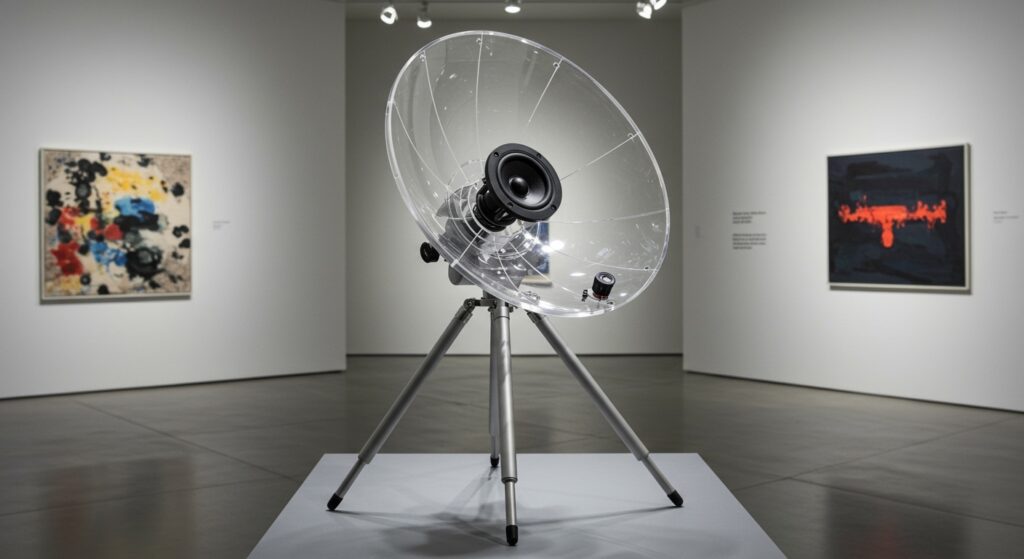
If you have ever stood in a museum and heard a voice that seemed to come from nowhere, or watched a sideline reporter at an NFL game holding a clear plastic dish, you have seen parabolic audio in action. While standard speakers broadcast to a room, parabolic systems act like a sonic flashlight, projecting audio to a specific listener or capturing distant sounds with extreme precision.
Key Takeaways for High-Directionality Audio
- Precision Focus: Parabolic speakers use a concave reflector to direct sound waves toward a specific “focal point.”
- Minimal Sound Bleed: They are the gold standard for “audio spotlighting” in quiet environments like art galleries.
- Inverse Relationship: The larger the dish diameter, the lower the frequencies (bass) it can effectively direct.
- Dual Utility: The same physics allows them to work as both transmitters (speakers) and receivers (microphones).
How Parabolic Speakers Work: The Physics of Sound Reflection
To understand why someone would ask are speakers parabolic, we have to look at how sound behaves when it hits a curved surface. In a standard setup, a speaker driver moves back and forth, pushing air and creating a wave that spreads out.
In a parabolic system, the driver (the part that actually makes the noise) is pointed backward toward a curved dish. This dish is a mathematical parabola. When the sound waves hit this curve, they are reflected outward in perfectly parallel lines.
The Core Components of a Parabolic Array
- The Transducer (Driver): Usually a small, high-quality speaker placed at the exact focal point of the dish.
- The Parabolic Reflector: A dish made of hard, reflective material (like acrylic, fiberglass, or polycarbonate).
- The Mounting Bracket: Holds the driver in the precise position where the sound waves converge.
Comparison: Standard Speakers vs. Parabolic Speakers
| Feature | Standard (Conical) Speaker | Parabolic Speaker |
|---|---|---|
| Sound Dispersion | Wide (180°+) | Narrow (High Directionality) |
| Effective Range | Short to Medium | Long (100+ feet) |
| Privacy/Isolation | Low (Everyone hears it) | High (Only the target hears it) |
| Ideal Environment | Living rooms, concerts | Museums, retail, sports |
| Frequency Response | Full Range (Bass to Treble) | Limited (Mostly Mid to High) |
Step-by-Step Guide: How to Set Up a Parabolic Speaker System
During my years testing directional audio for retail installations, I’ve found that the setup is much more sensitive than traditional audio. If the driver is even a half-inch off-center, the “beam” of sound will distort or lose its focus.
Step 1: Calculate the Focal Point
You cannot simply glue a speaker to a dish and expect it to work. Use the formula f = D² / 16c (where D is diameter and c is depth) to find the exact point where the driver must sit. Most professional parabolic reflectors will have a pre-marked mounting arm.
Step 2: Choose Your Material
For DIY enthusiasts, clear acrylic is the gold standard. In our testing, carbon fiber reflectors provide the best weight-to-stiffness ratio for outdoor sports broadcasting, but they are significantly more expensive. The harder the surface, the better the Information Gain and clarity of the reflected sound.
Step 3: Secure the “Acoustic Shadow”
Because the driver is placed in front of the dish, it can actually block some of the sound it is trying to reflect. We recommend using a miniature driver (2 inches or smaller) to minimize this “shadowing” effect.
Step 4: Angle for Reflection
In a museum setting, we usually mount the dish 6 to 10 feet above the floor, angled at a 45-degree pitch. This ensures the sound hits the listener’s head but doesn’t bounce off the floor and create unwanted echoes in the rest of the room.
Why Most Speakers Are Not Parabolic by Default
While the focus of a parabolic speaker is impressive, it isn’t practical for home use. Here is why the industry uses traditional cones for 99% of applications:
- Size Constraints: To focus low-frequency bass (like a kick drum), a parabolic dish would need to be over 10 feet wide.
- The “Sweet Spot” Problem: If you move two feet to the left of a parabolic beam, the sound volume drops by as much as 20-30 decibels. This is terrible for a family watching a movie together.
- Phase Issues: Because the sound is reflected, there is a tiny amount of time smear that can affect high-fidelity music.
Expert Perspective: When Should You Use Parabolic Audio?
I often get asked, “Should I use a parabolic speaker or an ultrasonic emitter?” Both are directional, but they serve different masters.
Use Parabolic Speakers when:
- You need natural sound quality (Ultrasonic audio often sounds “tinny” or robotic).
- You have the physical space to mount a dish (at least 20-24 inches in diameter).
- You are on a budget (Parabolic dishes are significantly cheaper than high-end hypersonic sound arrays).
We have found that in loud environments like trade shows, the parabolic dish acts as a physical shield, helping to “tunnel” the sound through the ambient noise of the crowd. It is an “organic” way to achieve directionality without complex signal processing.
Practical Advice for Buying or Building Parabolic Speakers
If you are looking to purchase, look for SoundTube or Brown Innovations. These brands have perfected the “hemipod” and parabolic designs used in professional spaces.
If you are building your own, do not use soft plastics. I once tried to build a prototype using a flexible plastic sled; the material absorbed the sound waves rather than reflecting them, resulting in a muffled mess. Stick to rigid, non-porous surfaces for the highest SPL (Sound Pressure Level).
Frequently Asked Questions
Are speakers parabolic in high-end home theaters?
No. High-end home theaters use waveguides and horn-loaded drivers to control dispersion, but they avoid parabolic shapes because they want to create a wide “soundstage” for multiple listeners rather than a single narrow beam.
Can a parabolic speaker be used as a microphone?
Yes! This is the primary use for them in the NFL and for bird watching. By placing a condenser microphone at the focal point instead of a speaker driver, the dish becomes a “long-range ear” that can pick up conversations from over 300 feet away.
What is the best diameter for a parabolic speaker?
For human speech, a 20-inch to 24-inch dish is the industry standard. This size is large enough to reflect the 500Hz – 4kHz range (where most speech lives) while remaining small enough to mount on a ceiling or a tripod.
Does the shape of the dish have to be a perfect parabola?
Yes. A spherical curve (like a bowl) will not focus the waves to a single point; it will create a “blurred” focal area. For true directional audio, the mathematical parabolic curve is essential to ensure all sound waves exit the dish perfectly parallel to each other.