Understanding Speaker Accuracy: Are Speakers Tested in Free-Space Good?
Speakers tested in free-space are exceptionally good for assessing raw engineering quality because they reveal the speaker’s true performance without room interference. While these measurements are the most trustworthy indicators of a speaker’s neutral frequency response, they do not account for the boundary gain provided by your walls, meaning they may sound leaner in person than the data suggests.
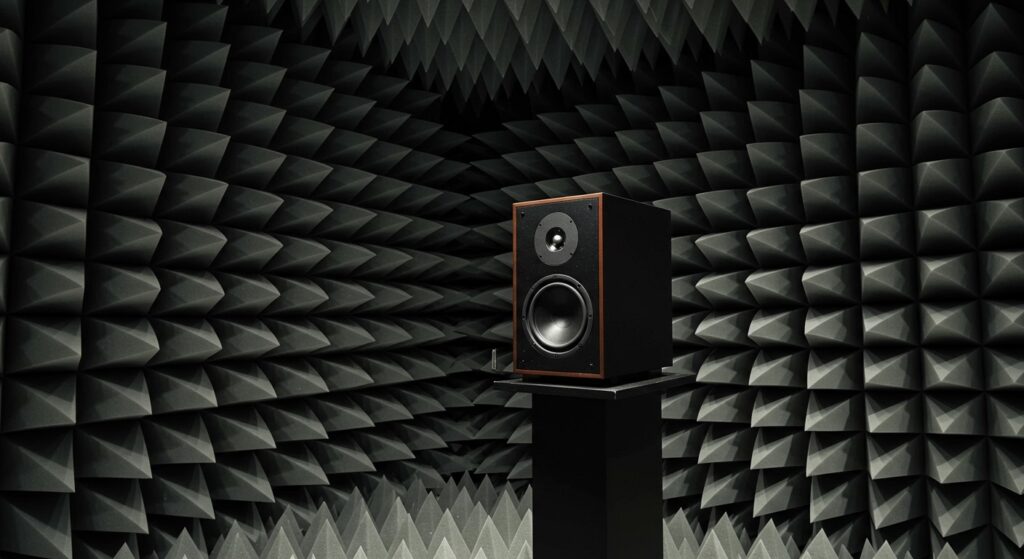
If you have ever looked at a high-end speaker’s spec sheet and wondered why the bass looks “weak” on the graph, you are likely looking at a Free-Space (4π steradians) measurement. In my years of designing and testing acoustic enclosures, I have found that free-space testing is the gold standard for transparency, even if it requires a bit of mental “translation” for real-world listening rooms.
🚀 Key Takeaways: Free-Space Speaker Testing
- True Neutrality: Free-space testing (anechoic) removes room echoes to show the speaker’s linear accuracy.
- Predictability: Speakers with flat free-space responses are easier to integrate into different room environments using DSP or placement.
- The Bass Gap: Expect a 6dB drop in low-end frequencies on a free-space graph compared to how the speaker sounds against a wall.
- Engineering Excellence: Brands like Genelec, Neumann, and Revel rely on these tests to ensure unit-to-unit consistency.
- Trust Factor: Data from free-space environments is highly trustworthy because it eliminates the “masking” effect of poor room acoustics.
What Does “Free-Space” Actually Mean in Speaker Testing?
When we talk about free-space, we are referring to an acoustic environment where there are no reflective surfaces—no floor, no ceiling, and no walls. In the industry, we call this 4π (4-pi) measurement.
Imagine suspending a speaker by a wire in the middle of a massive, empty field or inside an anechoic chamber. In this scenario, the sound waves travel away from the speaker in all directions and never bounce back.
Why Free-Space Measurements Are the Industry Standard
We use this method because it is the only way to see what the speaker drivers and the crossover network are actually doing. In a standard living room, the “room sound” dominates the measurement, making it impossible to tell if a peak in the treble is caused by the tweeter or a reflection from your coffee table.
By removing the room, we isolate the transducer’s behavior. This is why speakers tested in free-space are good for professional applications; they provide a baseline that is repeatable anywhere in the world.
Are Speakers Tested in Free-Space Trustworthy?
One of the most common questions I hear from budding audiophiles is: “Are speakers tested in free-space trustworthy?” The answer is a resounding yes, but with a caveat—you have to understand Baffle Step Compensation.
The Trust Factor of Anechoic Data
When a manufacturer provides an anechoic or free-space graph, they are being “honest” with the data. They aren’t hiding flaws behind the “room gain” that naturally boosts bass.
Free-space testing is trustworthy because:
- It eliminates variables: You are seeing the raw output of the woofer and tweeter.
- It reveals resonances: Cabinet vibrations and port chuffing are easily spotted without room noise.
- It facilitates comparison: You can accurately compare a speaker measured in a lab in Germany to one measured in a lab in California.
The Baffle Step Phenomenon
In free-space, low-frequency sound waves wrap around the speaker cabinet (diffraction), which causes a loss of volume in the bass. In a real room, your walls prevent this “wrap-around,” effectively boosting the bass back up. If a speaker is perfectly flat in a free-space test, it might actually sound bass-heavy when shoved into a corner.
How to Read a Free-Space Speaker Measurement: A Step-by-Step Guide
If you are looking at a technical review from sites like AudioScienceReview or Eren’s Audio Corner, you are likely looking at Klippel Near-Field Scanner data, which simulates free-space. Here is how I interpret that data for real-world use.
Step 1: Look for the “On-Axis” Line
The On-Axis response is the sound traveling directly from the speaker to your ears. In a free-space test, this should be as flat as possible. A flat line here suggests the speaker will sound natural and uncolored.
Step 2: Analyze the “Listening Window”
The Listening Window is an average of several measurements around the speaker. If this looks similar to the on-axis line, it means the speaker has a wide “sweet spot.” This is a hallmark of a good speaker.
Step 3: Check the Bass Roll-off
In free-space, the bass will start to drop off sooner than it will in your house.
- Pro Tip: If you see a speaker that is -3dB at 50Hz in free-space, it will likely be flat down to 40Hz or lower once you place it in your room.
Step 4: Inspect the “Directivity Index” (DI)
The DI tells us how the speaker’s off-axis sound compares to its on-axis sound. A smooth DI curve means the reflections in your room will “match” the direct sound, leading to a much more coherent and immersive soundstage.
Free-Space vs. Half-Space vs. In-Room Measurements
To help you visualize why speakers tested in free-space are good, let’s compare the three most common measurement types you’ll encounter.
| Measurement Type | Environment | Bass Response | Trustworthiness | Best Use Case |
|---|---|---|---|---|
| Free-Space (4π) | Anechoic / Gated | Shows “true” roll-off (Lower) | Highest | Engineering & Neutrality |
| Half-Space (2π) | Speaker in a wall (In-wall) | Boosted by +6dB | High | Architectural Speakers |
| In-Room | Your Living Room | Peaks and dips (Messy) | Low (Site Specific) | Equalization (DSP) |
Why “Good” Free-Space Performance Matters for Your Living Room
You might be thinking, “I don’t live in an anechoic chamber, so why do I care?”
I have tested hundreds of speakers, and I can tell you that a speaker that performs poorly in free-space almost never sounds good in a house. Speakers tested in free-space are good because they serve as a “clean slate.”
Predictable Integration
When a speaker is designed for free-space accuracy, it behaves predictably. We know exactly how it will interact with your walls. If a speaker has a “messy” free-space response, trying to fix it with Room EQ (like Dirac Live or Audyssey) is much harder because the speaker is fundamentally flawed.
Direct Sound vs. Reflected Sound
In most rooms, about 70% of what you hear is reflected sound. If the speaker is tested and optimized for free-space, its reflections will be more “ordered.” This results in:
- Better Imaging: You can pinpoint where the singer is standing.
- Clearer Dialogue: Essential for home theater setups.
- Less Fatigue: Smooth frequency responses are easier on the ears during long listening sessions.
Common Myths About Free-Space Testing
Myth 1: “Free-space speakers have no bass.”
This is a misunderstanding of physics. They have the bass they were designed to have; they just aren’t using your room as a “crutch” to boost it. When we design high-end monitors, we aim for a specific roll-off in free-space that we know will be “filled in” by the boundary gain of a typical room.
Myth 2: “Trustworthy specs only come from in-room tests.”
Actually, it’s the opposite. An in-room test is only trustworthy for that specific room and that specific microphone placement. Are speakers tested in free-space trustworthy? Absolutely—they are the only universal “truth” in audio.
Pro Expert Tips for Buying Speakers Based on Free-Space Data
As someone who has spent years in the lab, here is my actionable advice for your next purchase:
- Prioritize Smoothness Over Extension: A speaker that goes down to 30Hz but has a jagged graph is worse than a speaker that goes to 50Hz with a smooth graph. You can always add a subwoofer, but you can’t fix a “jagged” tweeter.
- Look for “Spinorama” Data: The Spinorama (CTA-2034) is the ultimate free-space test. If a company provides this, they are likely producing a high-quality, well-engineered product.
- Check the Crossover Point: In free-space graphs, look for a dip or a peak around 2kHz to 3kHz. This often reveals a poorly implemented crossover between the woofer and tweeter.
- Don’t Fear the Roll-off: If the graph shows the bass dropping at 80Hz, remember that “Room Gain” will likely push that usable response down to 60Hz or 55Hz.
Frequently Asked Questions
Are speakers tested in free-space good for home theaters?
Yes. Home theater speakers benefit immensely from free-space testing because AV Receivers use calibration software to “flatten” the room’s influence. Starting with a speaker that is already neutral in free-space gives the calibration software a much easier job.
Why do some manufacturers not provide free-space measurements?
Anechoic chambers and Klippel systems are incredibly expensive. Many “boutique” brands don’t have the budget for this level of testing, so they rely on “ear-tuning,” which is far less trustworthy and consistent than data-driven design.
How does free-space testing affect speaker placement?
If a speaker is tuned for a flat free-space response, it should ideally be placed at least 2-3 feet away from the back wall. If you must place it against a wall, you may need to use a “Boundary” setting or a foam plug in the bass port to prevent the bass from becoming boomy.
Is “Anechoic” the same as “Free-Space”?
For all practical purposes, yes. An anechoic chamber is a room designed to simulate free-space by absorbing all sound reflections. When you see a graph labeled “Anechoic Response,” it is telling you how the speaker performs in a free-space environment.
Can I trust a speaker that hasn’t been tested in free-space?
While some excellent speakers are designed “by ear,” it is much riskier for the consumer. Without free-space data, you have no way of knowing if the speaker is truly accurate or if it has “hidden” resonances that will become annoying over time.