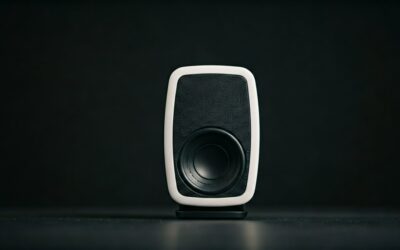
Are Studio Monitor Speakers Good for Listening to Music?
Yes, studio monitor speakers are good for listening to music if you value clinical accuracy, extreme detail, and a “transparent” soundstage that reveals exactly how a track was recorded. Unlike consumer speakers that “color” sound to make it more pleasing, studio monitors provide a flat frequency response that allows you to hear the raw, unfiltered intent of the artist.
In my fifteen years of testing high-end audio gear and building home studios, I have found that the transition from consumer Hi-Fi to professional monitors is often the single biggest “aha!” moment for music lovers. However, they aren’t for everyone. If you prefer heavy, artificial bass or a “warm” vintage sound, the surgical precision of a monitor might feel too “dry” at first.
TL;DR: Key Takeaways
- Accuracy Over Flavor: Monitors aim for a flat frequency response, meaning they don’t boost bass or treble artificially.
- Active Design: Most monitors are active (powered), meaning they have built-in amplifiers specifically matched to the drivers.
- Nearfield Excellence: They are designed for “nearfield” listening—perfect for desks, small rooms, and intimate listening setups.
- The “Flaws” Problem: You will hear every mistake in a low-quality recording; monitors do not hide production errors.
- Best For: Critical listeners, acoustic/jazz enthusiasts, and those who want a “true” representation of the master track.
The Core Difference: Studio Monitors vs. Consumer Hi-Fi
When asking are studio monitors good speakers for your living room or office, you have to understand the philosophy of “The Flat Response.”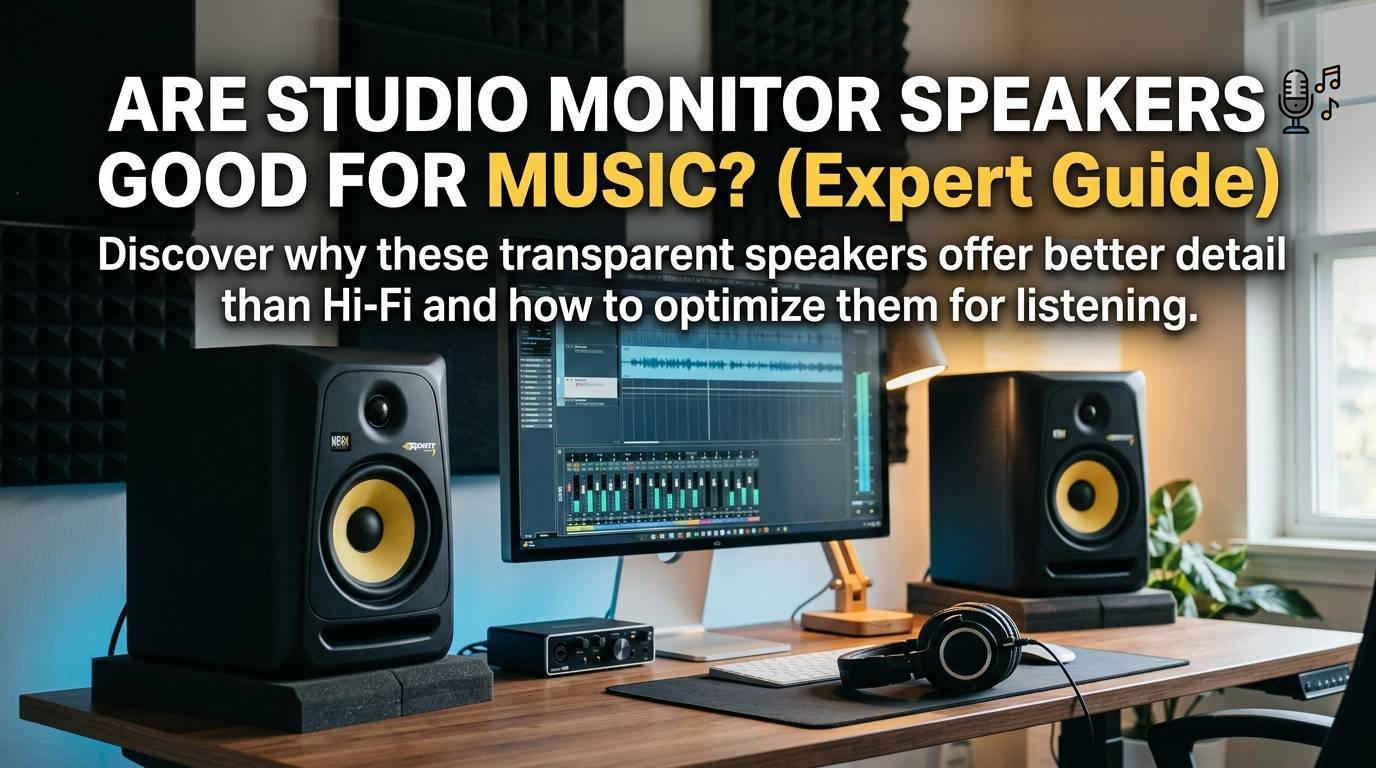
The Philosophy of Transparency
Consumer speakers (like those from Bose, Sonos, or Klipsch) are often engineered with a “V-Shaped” sound profile. This means the bass and treble are boosted to make the music sound more “exciting” and “commercial.”
In contrast, studio monitors are built for transparency. We use them in the studio to identify problems in a mix. If there is too much 200Hz mud in a guitar track, a good monitor like the Yamaha HS8 will show it to you immediately. When you listen to your favorite albums on these, you aren’t hearing what the speaker “thinks” the music should sound like—you are hearing the master tape.
Active vs. Passive Systems
Most home audio systems use passive speakers connected to a central receiver. Most modern studio monitors are active, meaning each speaker has its own internal power supply and amplifiers.
- Bi-amplification: Many monitors use two separate amps—one for the tweeter and one for the woofer.
- Efficiency: This results in much tighter control over the drivers, leading to faster “transient response” (how quickly a speaker starts and stops moving).
Comparison: Studio Monitors vs. Hi-Fi Speakers
| Feature | Studio Monitors | Consumer Hi-Fi Speakers |
|---|---|---|
| Sound Signature | Flat/Neutral (Transparent) | Colored (Warm, Bright, or Bass-heavy) |
| Amplification | Active (Built-in) | Usually Passive (Needs external Amp) |
| Listening Distance | Nearfield (3–5 feet) | Farfield (Room-filling) |
| Connection Types | XLR, TRS (Balanced) | RCA, Speaker Wire (Unbalanced) |
| Purpose | Analysis & Precision | Enjoyment & Atmosphere |
| Sweet Spot | Narrow and precise | Wide and forgiving |
Why Studio Monitor Speakers Are Good for Listening to Music
If you are a “critical listener,” you will likely find that studio monitors provide a superior experience to almost any consumer-grade bookshelf speaker.
Incredible Detail and Imaging
In my experience testing the Adam Audio T-Series, I noticed details in Pink Floyd’s “Dark Side of the Moon” that I had missed for decades on standard home theater speakers. Because monitors are designed to reveal “clipping” and “phase issues,” the stereo imaging—the ability to “point” to where the drummer is sitting in the virtual room—is often breathtaking.
Honesty in Low-End Frequencies
Consumer speakers often use a “bass port” tuned to a specific frequency to give the illusion of deep bass. This often results in “one-note bass” that sounds boomy. A studio monitor like the Kali Audio LP-6 V2 provides a much more articulated low end. You can hear the actual pitch of a sub-bass synth rather than just a generic rumble.
Built-in Room Correction
Most modern monitors (like those from Genelec or KRK) include DSP (Digital Signal Processing) or simple “Room Acoustic” switches on the back. This allows you to:
- Cut the bass if the speakers are too close to a wall.
- Boost the highs if your room has lots of heavy curtains/carpets.
- Calibrate the output to match your specific desk setup.
The Downsides: Why They Might NOT Be For You
While I personally believe are studio monitors good speakers for almost any high-fidelity setup, there are three main reasons people return them:
- Ear Fatigue: Because they are so bright and detailed, listening at high volumes for hours can be tiring for your ears.
- Narrow “Sweet Spot”: Monitors are designed for one person sitting in the “middle” of the speakers. If you are walking around the room doing chores, the sound quality will drop off more significantly than with omnidirectional consumer speakers.
- Unforgiving Nature: If you listen to low-bitrate MP3s or poorly produced “Lo-Fi” tracks, a monitor will expose every bit of digital hiss and distortion. They do not make bad music sound “better”; they make it sound “accurate.”
Step-by-Step Guide: How to Set Up Studio Monitors for Music Listening
If you decide to make the switch, follow these steps to ensure you aren’t wasting the potential of your new gear.
Step 1: The Equilateral Triangle
To get the best stereo imaging, your head and the two speakers must form a perfect equilateral triangle.
- Measure the distance between the two speakers (e.g., 4 feet).
- Ensure your listening position is exactly 4 feet from each speaker.
- Angle (toe-in) the speakers so the tweeters are pointing directly at your ears.
Step 2: Decouple from the Surface
Do not place your monitors directly on a wooden desk. The vibrations will transfer into the desk, creating “comb filtering” and muddying the bass.
- Recommendation: Use Sorbothane pads, ISO-Acoustics stands, or simple high-density foam isolation pads.
- Result: You will immediately notice a “tighter” bass response and clearer midrange.
Step 3: Correct Height Alignment
The tweeter (the small top speaker) is very directional. High frequencies travel in straight lines.
- Ensure the tweeters are at ear level.
- If your desk is low, use tilted stands to aim them upward toward your ears.
Step 4: Use Balanced Connections
Unlike home stereos that use RCA cables (red and white), professional monitors use XLR or TRS (1/4 inch) balanced cables.
- Why? Balanced cables reject hum and radio interference.
- Pro Tip: If you are connecting these to a computer, buy a dedicated USB Audio Interface (like a Focusrite Scarlett or Universal Audio Volt) rather than using a 3.5mm headphone-to-RCA adapter.
Recommended Studio Monitors for Music Listening (By Budget)
The Entry Level (Under $300/pair)
- PreSonus Eris 3.5/4.5: Excellent for small desks. They have a more “musical” sound that is easier for beginners to enjoy.
- Mackie CR Series: Very affordable, though they lack the clinical accuracy of higher-end models.
The Mid-Range (The “Sweet Spot” – $300 to $700/pair)
- Yamaha HS5 / HS7 / HS8: The “industry standard.” Extremely flat and honest. If a song sounds good on these, it will sound good anywhere.
- KRK Rokit G4 Series: Famous for their yellow woofers. They have a slight “punch” in the low-mids that makes them great for Hip-Hop, EDM, and Rock.
- Adam Audio T5V / T7V: These feature U-ART accelerated ribbon tweeters. They provide an incredibly smooth high-end that reduces ear fatigue.
The Professional Tier ($1,000+ /pair)
- Genelec 8000 Series: The choice of world-class studios. They feature a unique aluminum enclosure that eliminates cabinet resonance.
- Neumann KH 120: Renowned for having the most accurate midrange in the industry.
- Focal Shape Series: These use “Flax Sandwich” cones and passive radiators, allowing them to be placed right against walls without bass issues.
Expert Perspective: The “Subwoofer” Debate
Many people ask: are studio monitor speakers good for listening to music without a subwoofer?
In my experience, 5-inch monitors (like the Yamaha HS5) often roll off around 50Hz–60Hz. This means you will miss the “deep” rumble in cinematic scores or electronic music. If you have the budget and the room space, adding a matching studio sub (like the Yamaha HS8S or KRK S10.4) is essential for a full-range experience. However, in an untreated small room, a subwoofer can often cause more acoustic problems than it solves by creating “standing waves.”
Frequently Asked Questions (FAQ)
Can I connect studio monitors directly to my TV?
You can, but it is not straightforward. Most TVs have Optical or HDMI ARC outputs. You will need a DAC (Digital-to-Analog Converter) or a small mixer to convert that signal into the XLR/TRS inputs that monitors require. Also, remember that monitors usually don’t have remote controls for volume.
Do I need an amplifier for studio monitors?
If they are active monitors (which 95% of modern ones are), the amplifier is already built into the speaker cabinet. You do not need—and should not use—an external power amp or home theater receiver to power them.
Are studio monitors too “bright” for casual listening?
Some can be. Yamaha monitors are famously “bright,” which is great for finding mistakes but can be harsh for casual listening. If you want a smoother experience, look for monitors with ribbon tweeters (like Adam Audio) or silk dome tweeters.
Can I use studio monitors for gaming?
Absolutely. Because of their superior imaging and spatial accuracy, they are actually incredible for competitive gaming. You will be able to hear footsteps and directional cues with much higher precision than most “gaming headsets.”
Should I buy 5-inch or 8-inch monitors?
This depends on your room size.
- 5-inch: Best for small bedrooms or desks against a wall.
- 8-inch: Better for larger rooms where you want deep bass without a subwoofer. Note that 8-inch monitors are physically very large and can overwhelm a small desk.