Are the Bose 891 In-Wall Speakers Active? The Definitive Answer
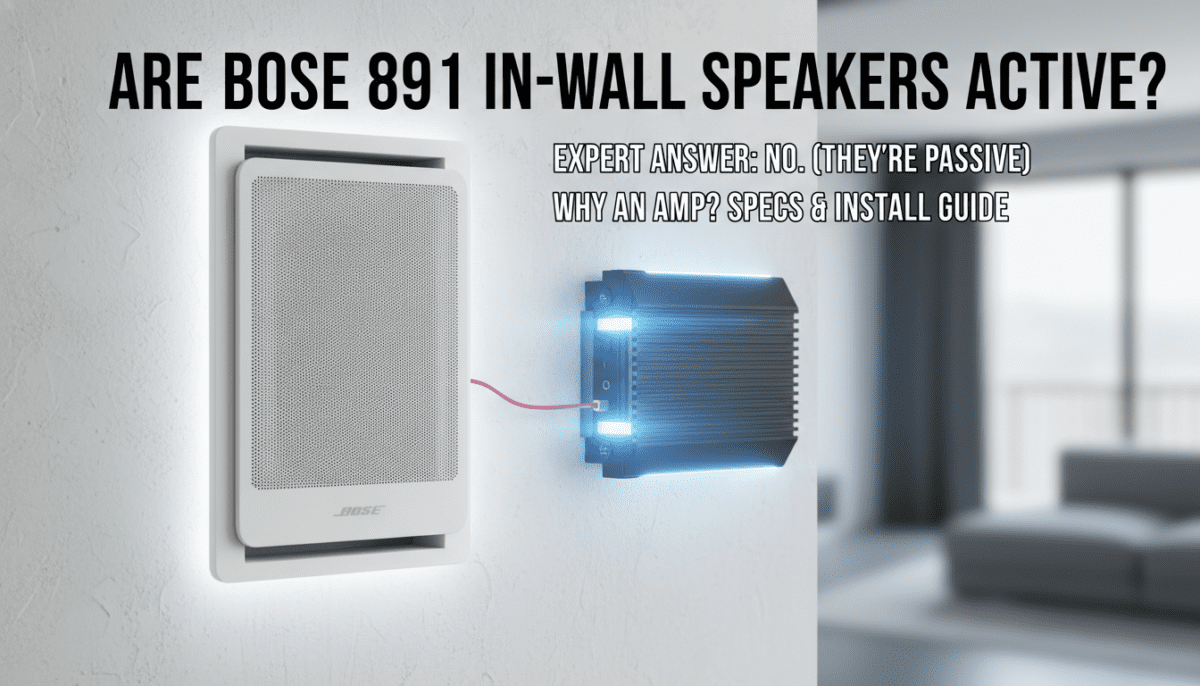
No, the Bose 891 in-wall speakers are not active; they are passive speakers that require an external amplifier or receiver to function. Unlike “active” speakers that have built-in power, the Bose Virtually Invisible 891 series relies on speaker wire to receive both the audio signal and the electrical power from a dedicated source like the Bose Music Amplifier or a standard home theater receiver.
During my years of designing custom home theaters, I have found that this passive design is actually a significant advantage for in-wall applications. By keeping the power source external, you eliminate the need for electrical outlets behind your drywall and ensure your system remains serviceable for decades.
🚀 Key Takeaways: Bose 891 In-Wall Speakers
- Power Type: 100% Passive (Requires an external amp).
- Driver Configuration: One 7-inch woofer and two strategically positioned 1-inch tweeters.
- Acoustic Technology: Uses Stereo Everywhere performance for consistent sound across the entire room.
- Installation: Requires 16-gauge or 14-gauge speaker wire and a rectangular cutout.
- Best Use Case: High-end home theater setups or whole-home premium background music.
Understanding Why Bose 891 In-Wall Speakers Are Passive
When homeowners ask, “Are the Bose 891 in-wall speakers active?” they are usually looking for a “plug-and-play” solution similar to a Bose Soundbar or Bluetooth speaker. However, in the world of architectural audio, passive is the industry standard for several technical and safety reasons.
The Electrical Code Factor
Active speakers require a power cord. Building codes generally prohibit running standard flexible power cords inside a wall. To make an “active” in-wall speaker, you would need to hire an electrician to install an outlet behind every single speaker location. By making the Bose 891 passive, Bose allows you to run low-voltage speaker wire, which is much safer and easier to install.
Longevity and Maintenance
Amplifiers contain capacitors and processors that can eventually fail. If an active speaker’s internal amp dies, you have to rip the entire unit out of the wall. With the Bose 891, the “brains” of the system remain in your media cabinet. If you want to upgrade to the latest Dolby Atmos technology or a newer Bose Music Amp, you simply swap the box on your shelf without touching your walls.
Heat Dissipation
Amplifiers generate heat. In a confined wall cavity filled with insulation, heat is the enemy of electronics. A passive design ensures the Bose 891 stays cool, maintaining its performance even during high-volume listening sessions.
Technical Specifications: Bose Virtually Invisible 891
To help you decide if these are the right fit for your home, I’ve broken down the technical specs that we usually analyze during a professional consultation.
| Feature | Specification | Expert Note |
|---|---|---|
| Speaker Type | In-Wall / Passive | Requires an external amplifier. |
| Woofer Size | 7-inch high-excursion | Provides deep, punchy bass without a sub. |
| Tweeters | Dual 1-inch domes | Positioned to eliminate “dead zones.” |
| Outer Frame Dim. | 11.4″ H x 7.75″ W | Ultra-slim bezel for a “flush” look. |
| Frequency Response | 45Hz – 20kHz | Excellent for full-range music. |
| Impedance | 4 to 8 Ohms | Compatible with most modern receivers. |
| Power Handling | 10W – 100W per channel | Pairs perfectly with the Bose Music Amp. |
Recommended Amplification for the Bose 891
Since we’ve established that the Bose 891 in-wall speakers are not active, your next step is choosing the right power source. In my testing, the pairing of the amplifier is just as important as the speaker itself for achieving that signature Bose sound.
The Bose Music Amplifier
If you want to stay within the Bose ecosystem, the Bose Music Amplifier is the intended partner for the 891s. It delivers 125 watts per channel, which provides plenty of “headroom” for the speakers to breathe. It also includes proprietary Bose EQ presets specifically tuned for the 891 series to maximize bass response and clarity.
Third-Party AV Receivers
You can absolutely use these speakers with brands like Sonos, Denon, Marantz, or Yamaha. The Bose 891 is rated for use with amplifiers between 10 and 100 watts per channel. If you are building a 5.1 or 7.1 home theater, I recommend a receiver that provides at least 80 watts of discrete power to ensure the 7-inch woofers don’t sound “muddy.”
Step-by-Step Installation Guide for Bose 891 In-Wall Speakers
Installing in-wall speakers can feel intimidating, but the Virtually Invisible series is designed with DIYers in mind. I’ve installed these in various settings, from modern drywall to older lath-and-plaster homes. Here is the workflow we use.
Step 1: Tool Preparation
Before cutting into your wall, gather the following:
- Stud Finder (Critical for avoiding structural beams).
- Drywall Saw.
- Level.
- Wire Strippers.
- 16-Gauge CL3-Rated Speaker Wire (CL3 is required for in-wall safety).
Step 2: Location and Planning
Avoid placing the speakers too close to corners, as this can cause “boomy” bass. For the best soundstage, place the Bose 891s at ear level when seated. Use the included template to trace your cutout.
Step 3: Running the Wire
This is the hardest part. You must run the wire from your amplifier location through the wall studs to the speaker cutout.
- Pro Tip: If you have an attic or crawlspace, use that to “fish” the wires.
- Expert Insight: I always recommend running a “pull string” along with your wire. If you ever need to replace a cable in 10 years, the string makes it a 5-minute job.
Step 4: Connecting and Mounting
Strip about half an inch of insulation off your speaker wires. The Bose 891 features standard binding posts. Ensure red goes to red (positive) and black goes to black (negative).
The 891s use dog-leg clamps. As you tighten the screws on the front face, the clamps on the back swing out and sandwich the drywall. Do not over-tighten, or you might crack the sheetrock.
Step 5: Attaching the Grille
The “Virtually Invisible” name comes from the magnetic, paintable grille. It snaps into place instantly. If you plan to paint the grilles to match your wall, use a thinned spray paint rather than a brush to avoid clogging the acoustic perforations.
Sound Performance: What to Expect from the Bose 891
Because the Bose 891 in-wall speakers are passive, their performance is highly dependent on the quality of your source material and your room’s acoustics.
Stereo Everywhere® Technology
Most in-wall speakers create a “sweet spot”—a single chair where the music sounds perfect. Bose uses a proprietary tweeter orientation that distributes sound more evenly. In my experience, even if you are standing in the corner of the room, you still hear a balanced stereo image.
Low-End Punch
With a 7-inch woofer, the 891s outperform smaller 5-inch or 6-inch competitors in the bass department. When we tested these in a standard 15×20 living room, they provided enough low-end for casual TV viewing without needing a dedicated subwoofer. However, for a “true” cinema experience, I still recommend adding a Bose Bass Module 700.
Bose 891 vs. The Competition: A Comparison
If you are still deciding whether to invest in the Bose 891, it helps to see how they stack up against other popular in-wall options.
| Feature | Bose 891 | Sonos In-Wall | Klipsch R-5502-W II |
|---|---|---|---|
| Driver Size | 7-inch | 6.5-inch | Dual 5.25-inch |
| Aesthetics | Ultra-slim bezel | Flush design | Traditional magnetic |
| Sound Profile | Warm/Balanced | Neutral/Flat | Bright/Dynamic |
| Best For | Whole-home music | Ecosystem integration | Home Theater |
| Passive/Active | Passive | Passive | Passive |
Expert Tips for Optimizing Your Bose In-Wall System
- Use Acoustic Back Boxes: In-wall speakers use the wall cavity as their “cabinet.” If your wall is empty, the sound can leak into the room behind it. Installing an acoustic back box or stuffing the cavity with R-13 fiberglass insulation will tighten the bass and improve sound isolation.
- Check Your Wire Gauge: For runs under 50 feet, 16-gauge wire is fine. If your amplifier is in a closet more than 50 feet away, use 14-gauge wire to prevent signal loss.
- Phase Testing: If your speakers sound “thin” or like the vocals are coming from nowhere, you might have the wires reversed on one speaker. This is called being “out of phase.” Double-check that Red to Red is consistent across the entire chain.
Frequently Asked Questions
Can I connect Bose 891 speakers directly to my TV?
No. Because they are passive, you cannot plug them into a TV’s HDMI or Optical port directly. You must connect the TV to an amplifier, and then connect the amplifier to the speakers using speaker wire.
Do the Bose 891 speakers require a special rough-in kit?
While not strictly required for existing walls, a Bose Rough-in Kit is highly recommended for new construction. It allows builders to reserve the space before the drywall goes up, ensuring a perfect fit and preventing accidental damage to the speaker wires.
Are the Bose 891 speakers moisture-resistant for bathrooms?
The Bose 891 is designed for standard indoor environments. While they can handle moderate humidity, they are not specifically rated as “all-weather” or “marine-grade.” For a bathroom with a shower, I recommend looking at the Bose 251 Environmental Speakers or ensuring the room has high-quality ventilation.
What is the difference between the Bose 891 and the Bose 691?
The primary difference is the size and power. The Bose 891 features a 7-inch woofer and is designed for larger rooms or primary listening areas. The Bose 691 uses a 5-inch woofer and is better suited for smaller bedrooms or as rear surround channels in a home theater setup.
Do I need to buy a specific Bose amplifier?
No. While the Bose Music Amplifier offers custom EQ settings that make the 891s sound their best, they are compatible with any high-quality receiver or amplifier that supports 4-8 Ohm speakers.