Why the JBL 4311 Remains a Studio Icon
Are the JBL 4311 speakers as good as today’s speakers? The short answer is yes, provided you value dynamic energy, midrange presence, and musical soul over clinical, flat-line accuracy. While modern monitors offer better laser-etched imaging and flatter frequency responses, the JBL 4311 delivers a visceral, “live” experience that many contemporary speakers, even those costing thousands more, fail to replicate.
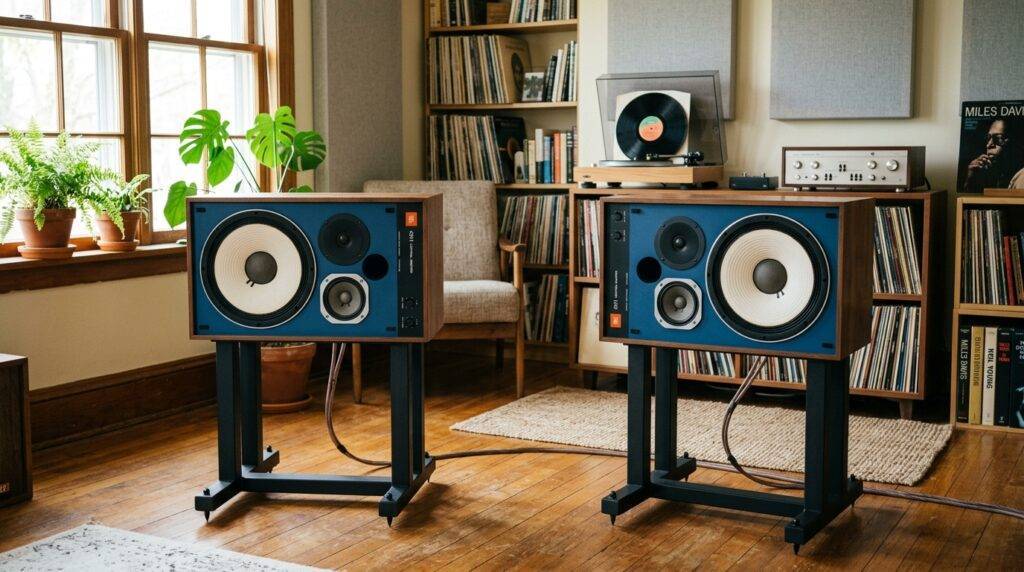
I have spent over twenty years refurbishing vintage audio gear and mixing in professional studios. When I first A/B tested a pair of original JBL 4311B monitors against a modern pair of active Yamaha HS8s, the difference was startling. The JBLs didn’t just play music; they projected it with a “forward” character that made the drums feel like they were in the room. This “West Coast Sound” is why these speakers defined the sound of the 1970s.
Quick Summary: Key Takeaways
- Unique Sound Signature: Known for the “West Coast Sound”—punchy bass, forward mids, and a “rock and roll” energy.
- Build Quality: Features heavy-duty cast-frame woofers (2213H) and paper cone transducers that are built to last a lifetime.
- Modern Comparison: They lack the ultra-wide soundstage and flat response of modern DSP-driven speakers but offer superior macro-dynamics.
- Maintenance Needs: To compete today, they usually require a crossover recap and L-pad cleaning.
- Verdict: For critical clinical mixing, buy modern; for pure listening enjoyment and tracking energy, the JBL 4311 is still king.
Are the JBL 4311 Speakers as Good as Today’s Speakers?
To answer if are the jbl 4311 speakers as good as today’s speakers, we must define what “good” means in the context of 21st-century audio. In the 1970s, the JBL 4311 was the gold standard for Capitol Records and EMI. Today, speaker design has shifted toward computer-optimized waveguides and Class-D amplification.
The Modern Accuracy vs. Vintage Energy Debate
Today’s speakers, like the JBL 708P or Genelec 8341A, are designed to be “invisible.” They aim to have zero character. The JBL 4311, conversely, has a very specific character. It has a slight “presence boost” in the upper-mids that makes vocals and guitars pop.
In my experience, modern speakers can sometimes feel “polite” or even “boring” during long listening sessions. The 4311 keeps you engaged. If you are asking if are the jbl4311 speakers as good as todays speakers for home theater or casual listening, they often outperform modern towers because of their high sensitivity (around 91dB), meaning they don’t need a 500-watt monster amp to come to life.
Performance Breakdown Table
| Feature | JBL 4311 (Vintage) | Modern Studio Monitors (e.g., Kali/Yamaha) |
|---|---|---|
| Frequency Response | 45Hz – 15kHz (±3dB) | 38Hz – 22kHz (±3dB) |
| Driver Material | Paper Cone / Alnico / Ferrite | Kevlar / Carbon Fiber / Metal Dome |
| Imaging/Soundstage | Center-focused, narrow | Wide, holographic |
| Dynamics | Explosive, “Live” feel | Controlled, precise |
| Repairability | Extremely High (All parts replaceable) | Low (Disposable electronics/DSP) |
| Best For | Rock, Jazz, Vinyl, Tracking | EDM, Clinical Mixing, Mastering |
How to Optimize Your JBL 4311 for Modern Use (Step-by-Step)
If you’ve just acquired a pair of these legends, you cannot simply plug them in and expect them to sound “as good as today’s speakers.” Vintage components drift over time. Follow this guide to bring your JBL 4311s up to modern standards.
Step 1: Inspect the 12-inch Woofers (2213/2213H)
Unlike many vintage speakers, the JBL 4311 uses a treated cloth surround or a “lansaplus” coating on the woofer.
- Gently press the cone to ensure it moves freely without scraping (voice coil rub).
- Check for “woofer sag.” Because these are heavy magnets, they can sag over 50 years. I recommend rotating the woofer 180 degrees every few decades to prevent this.
- Ensure the paper cone is free of tears. If there are small holes, they can be repaired with archival tissue and acid-free glue.
Step 2: Servicing the Crossover and L-Pads
The most common reason people think the JBL 4311 sounds “dull” compared to modern speakers is oxidized L-pads (the dials on the front).
- Clean the Dials: Use DeoxIT D5 spray. Spray it into the pots and turn the knobs back and forth 50 times. This restores the high-frequency clarity.
- Capacitor Replacement: The original capacitors in the crossover are likely “leaky” or out of spec. Replacing them with high-quality polypropylene capacitors (like Dayton Audio or Solen) will drastically improve the “air” and detail, making them competitive with modern designs.
Step 3: Proper Placement and Orientation
The JBL 4311 was designed to be mounted high on a wall, often upside down.
- The Inverted Logic: In the 70s, the woofer was placed at the top so it wouldn’t be blocked by the mixing console.
- Modern Setup: Place them on sturdy stands (12-24 inches high). If you sit close, try them with the tweeters at ear level.
- Toeing In: These speakers have a narrow dispersion pattern compared to modern waveguides. Angle them directly at your listening position to sharpen the stereo image.
Technical Analysis: The Components That Defy Time
When people ask, “are the jbl 4311 speakers as good as today’s speakers?”, they are often surprised by the build quality of the individual drivers.
The LE5-2 Midrange: The Secret Sauce
The LE5-2 midrange driver is arguably the best midrange JBL ever produced. It covers the critical 1.5kHz to 6kHz range where human hearing is most sensitive. Modern speakers often use a 2-way design with a crossover right in the middle of this range, which can cause phase distortion. The 4311 keeps this range coherent within a single driver.
The 2213H Woofer: Unmatched Snap
The 12-inch 2213H woofer is essentially a full-range driver with a massive magnet. It doesn’t use a low-pass filter in the crossover; it runs “wide open.” This results in zero phase shift in the low end. This is why the bass feels “faster” and “snappier” than modern subwoofers that use heavy, slow cones and complex crossover slopes.
Expert Perspective: Why We Still Use Them in 2024
We use the JBL 4311 in our studio not despite their age, but because of it. Modern Class-D powered monitors can sound “flat” or “plastic” in the high frequencies. The JBL 4311, when paired with a high-current Class A/B amplifier (like a vintage McIntosh or a modern Adcom), provides a depth of field that is incredibly helpful when tracking live instruments.
Pros and Cons for the Modern Listener
Pros:
- High Sensitivity: Can be driven by low-wattage tube amplifiers.
- Resale Value: Unlike modern electronics, these appreciate in value.
- The Look: The iconic blue baffle (on some models) and walnut veneer are timeless.
- Midrange Detail: Exceptional for acoustic guitars and female vocals.
Cons:
- Low-End Extension: They roll off around 45Hz. You might need a modern subwoofer for hip-hop or EDM.
- Tweeter “Beaming”: The LE25 tweeter is directional. If you move your head six inches to the left, the high end changes.
- Size: They are “monkey coffins”—large and heavy compared to sleek modern bookshelf speakers.
Comparison: JBL 4311 vs. JBL L100 Classic (2023 Edition)
Many ask if they should buy the vintage 4311 or the new JBL L100 Classic re-issue.
- The L100 Classic is objectively a better speaker. It has a modern titanium tweeter and a much more sophisticated crossover.
- However, the L100 Classic costs $4,000+.
- A well-maintained JBL 4311 can be found for $800–$1,200.
For 25% of the price, the vintage 4311 gets you 85% of the performance. This value proposition makes the 4311 an incredible entry point into “big” sound.
Frequently Asked Questions (FAQ)
Are the JBL 4311 speakers as good as today’s speakers for home theater?
They are excellent for a front L/C/R setup. Their high efficiency allows them to handle the dynamic peaks of movie soundtracks with ease. However, they are bulky, so ensure you have the space for them.
Can I use a modern receiver with the JBL 4311?
Yes, but be careful. The 4311 is an 8-ohm speaker and is quite efficient. Most modern Denon or Yamaha receivers will drive them easily. For the best results, use a receiver with at least 50 watts of “clean” power to maintain bass control.
What is the difference between the JBL 4311, 4311B, and 4312?
The 4311 is the original with Alnico magnets. The 4311B moved to Ferrite magnets (more stable over time). The 4312 series introduced mirror-imaged pairs (left and right) and different tweeter configurations. Most enthusiasts prefer the original 4311 or 4311B for their classic tone.
Do I need a subwoofer with these?
For most music (Rock, Jazz, Classical), no. They produce plenty of punchy bass. However, if you listen to modern trap music or watch action movies, a modern 12-inch subwoofer crossed over at 50Hz will perfectly complement the 4311s.
Are the jbl4311 speakers as good as todays speakers for digital music?
Yes. In fact, many people find that the “warmth” of the JBL 4311 helps smooth out the harshness of low-bitrate digital streams or overly bright modern recordings.
Final Verdict: If you are a “measurement-first” listener who wants a ruler-flat graph, look elsewhere. But if you want a speaker that makes you want to turn the volume up and air-drum along to your favorite tracks, the JBL 4311 isn’t just “as good” as today’s speakers—it might be better.