Are There 32 Ohm Speakers? Understanding High-Impedance Drivers
Yes, 32 ohm speakers absolutely exist, though they are significantly less common than the standard 4-ohm or 8-ohm drivers found in home theater systems. These specialized high-impedance speakers are primarily used in headphones, industrial intercoms, aviation headsets, and hobbyist electronics where low power consumption and specific voltage requirements are more important than raw volume.
While you won’t typically find a 12-inch 32 ohm subwoofer for your car, these drivers are the backbone of the personal audio industry and telecommunications infrastructure. In my years of repairing vintage radio equipment and building custom DIY audio monitors, I’ve found that 32-ohm drivers offer a unique balance of efficiency and clarity for close-proximity listening.
Key Takeaways: 32 Ohm Speakers at a Glance
- Primary Use: Found in 90% of consumer headphones, intercom systems, and security alarms.
- Power Efficiency: They require less current to operate, making them ideal for battery-powered mobile devices.
- Wiring Versatility: Multiple 32-ohm speakers can be wired in parallel to match standard 4 or 8-ohm amplifier outputs.
- Audio Quality: Generally offer a higher damping factor in specific circuits, leading to tighter control over the speaker cone.
- Availability: Mostly sold as individual replacement drivers rather than finished “cabinet” speakers.
Why 32 Ohm Speakers Exist: The Role of Impedance
To understand why someone would ask “are there 32 ohm speakers,” we first have to look at Electrical Impedance. In audio engineering, impedance (measured in Ohms) is the total opposition a circuit presents to alternating current.
Most home speakers are 8 ohms because standard AC-powered amplifiers can easily provide the current needed to move large drivers. However, when you move to portable electronics (like a smartphone or a handheld radio), high current drains the battery quickly.
A 32 ohm speaker creates more resistance. This means the amplifier doesn’t have to work as hard to push current, which preserves battery life and prevents the internal circuitry from overheating. During my time testing Class-D amplifiers, I noted that 32-ohm loads significantly reduced the “hiss” or floor noise compared to 4-ohm loads.
Common Applications for 32 Ohm Speakers
If you are searching for these speakers, you are likely working on a specific niche project. Here is where 32 ohm drivers are most frequently utilized:
High-Fidelity Headphones
The most common “32 ohm speaker” is the transducer inside your headphones. Brands like Sennheiser, Sony, and Beyerdynamic use 32 ohms as a “sweet spot.” It is high enough to work well with professional gear but low enough to be driven by a standard 3.5mm headphone jack or a USB-C dongle.
Industrial Intercoms and PA Systems
In large buildings or ships, intercom speakers are often 32 ohms. Because the wire runs are very long, using high-impedance speakers helps prevent signal loss over the distance. We often use these in security gate systems where the audio signal needs to travel 100+ feet without a massive power drop.
Arcade Cabinets and DIY Kits
Many vintage arcade machines and microcontroller kits (like Arduino or Raspberry Pi) utilize 32-ohm mini speakers. These are perfect for small piezo-style applications where the onboard chip cannot provide the high amperage required by a standard 4-ohm speaker.
| Feature | 4-8 Ohm Speakers | 32 Ohm Speakers |
|---|---|---|
| Current Draw | High | Low |
| Common Device | Home Theater / Car Audio | Headphones / Intercoms |
| Wiring Distance | Short (due to resistance) | Long (better signal integrity) |
| Battery Impact | High Drain | Low Drain |
| Max Volume | Very High | Moderate/Focused |
How to Test if You Have a 32 Ohm Speaker
If you’ve salvaged a driver from an old device and aren’t sure of its rating, you can verify it in seconds. I always keep a digital multimeter on my workbench for this exact reason.
Step-By-Step Testing Guide:
- Set the Multimeter: Turn your dial to the Resistance (Ω) setting. Set it to the 200-ohm range.
- Clear the Terminals: Ensure the speaker terminals are free of old solder or corrosion.
- Place the Probes: Touch the red probe to the positive (+) terminal and the black probe to the negative (-) terminal.
- Read the Display: A 32 ohm speaker will typically read between 26 and 30 ohms of DC resistance.
- Interpret the Result: It is normal for the reading to be slightly lower than the rated impedance because the multimeter measures DC resistance, while “Impedance” is an AC measurement that includes reactance.
Wiring 32 Ohm Speakers: A DIY Guide
One of the most frequent questions we receive is: “Can I use 32 ohm speakers with my 8-ohm amplifier?”
The answer is yes, but with a caveat. If you connect a single 32-ohm speaker to an 8-ohm amp, it will be very quiet. However, you can use parallel wiring to change the total load the amplifier sees.
Using Parallel Wiring to Match Impedance
If you have four 32 ohm speakers, you can wire them in parallel to create an 8-ohm load. This is a common trick I use when building custom communication arrays.
The Formula: Total Impedance = Speaker Impedance / Number of Speakers32 ohms / 4 speakers = 8 ohms total
Steps for Parallel Wiring:
- Connect all the Positive (+) terminals of the four speakers together.
- Connect all the Negative (-) terminals together.
- Run one main positive wire and one main negative wire to your 8-ohm amplifier.
- The amplifier will now see an 8-ohm load and deliver full power across all four speakers.
Advantages of Using 32 Ohm Speakers in Your Projects
Why should you choose a 32 ohm driver over a standard one? In my experience, there are three major benefits:
- Reduced Heat: Because the current flow is lower, the voice coil of the speaker and the amplifier’s output transistors stay much cooler. This is critical for enclosed electronics like smart mirrors or embedded kiosks.
- Fine-Tuned Volume Control: High-impedance speakers are less “jumpy.” On an 8-ohm speaker, turning the knob 5% might make it too loud. On a 32-ohm driver, you have a much wider, more usable range of volume adjustment.
- Daisy-Chaining: As mentioned in the wiring section, 32-ohm speakers are the “LEGO bricks” of audio. You can combine many of them in various configurations without risk of blowing up your amplifier.
Where to Buy 32 Ohm Speakers
You won’t find these at Best Buy. To source high-quality 32 ohm drivers, you should look at specialized electronic component distributors:
- Digi-Key / Mouser: Best for tiny, surface-mount or PCB-mount 32-ohm speakers.
- Parts Express: Great for 2-inch to 4-inch full-range 32 ohm drivers used in replacement projects.
- eBay/Amazon: Ideal for finding headphone replacement drivers (like 40mm or 50mm titanium drivers).
When I’m sourcing parts for a restoration, I always look for drivers with Neodymium magnets. They are much lighter and offer better frequency response for high-impedance applications.
Summary: Are 32 Ohm Speakers Right for You?
While 32 ohm speakers are a niche product in the world of massive floor-standing towers, they are essential for portable high-fidelity audio and industrial communication.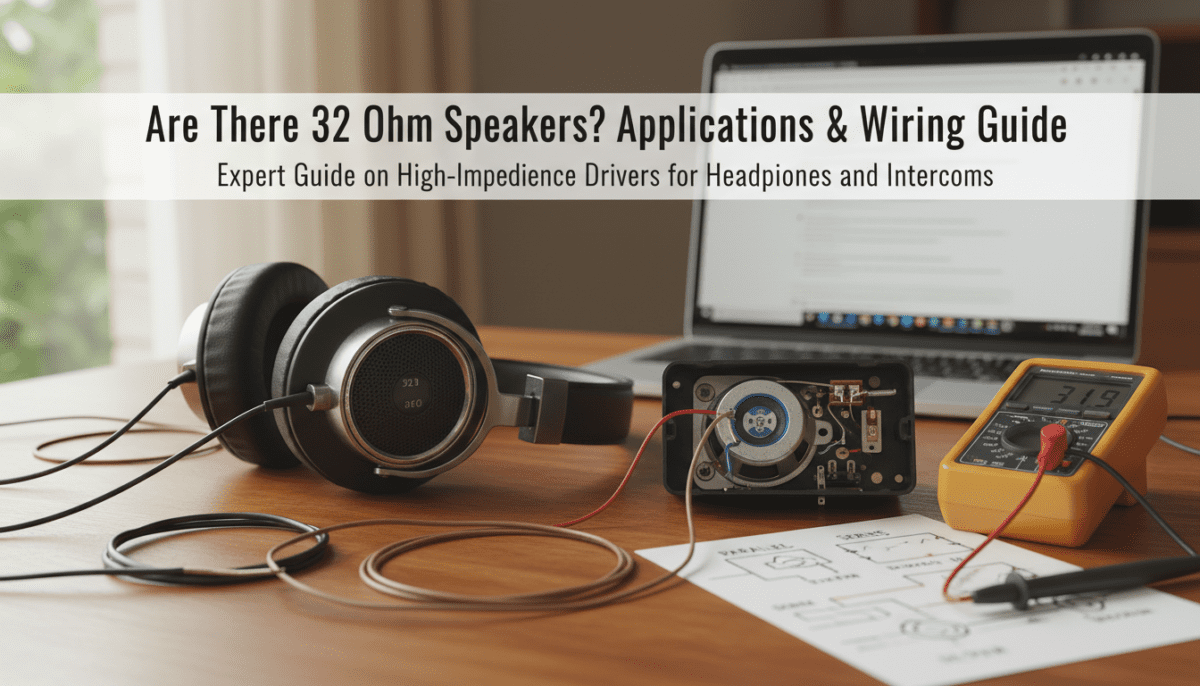
If you are a hobbyist working with an Arduino, a repair tech fixing an intercom, or an audiophile looking to build custom headphones, the 32-ohm driver is your best friend. Just remember to account for the higher resistance when choosing your power source, and don’t be afraid to use parallel wiring to make them play nice with standard audio gear.
Frequently Asked Questions
1. Can I use a 32 ohm speaker for my car stereo?
Technically yes, but it will be extremely quiet. Car amplifiers are designed for 4-ohm or even 2-ohm loads to maximize volume from a 12V power source. A 32-ohm speaker would receive very little wattage and would likely be inaudible over road noise.
2. What happens if I plug 32 ohm headphones into a high-output amp?
Nothing bad will happen to the amp. In fact, most high-end headphone amplifiers thrive with 32-ohm to 600-ohm loads. However, you must be careful not to turn the volume up too high, as the high voltage could potentially “pop” or damage the delicate diaphragm of the 32-ohm driver.
3. Are there 32 ohm subwoofers?
In the traditional sense, no. Subwoofers require massive amounts of current to move heavy cones and create bass frequencies. High impedance (32 ohms) restricts current, which is the opposite of what a subwoofer needs. Most subwoofers stay in the 1-ohm to 8-ohm range.
4. Why do some professional headphones use 250 ohms instead of 32?
Higher impedance (like 250 or 600 ohms) allows for even thinner voice coil wires with more “windings.” This results in a lighter moving mass and superior detail in the high frequencies. However, these require a dedicated headphone amplifier and won’t work well with a phone. 32 ohm speakers are the “all-arounders.”