Why You Are Struggling to Find 50-Inch TVs with Front Speakers
If you have ever strained to hear dialogue while the background music blares, you are experiencing the “muffled audio” epidemic of modern television design. Most users ask, “Are there any 50 tvs with speakers in front?” because they are tired of sound firing downward into their TV stand or backward against a wall.
Yes, while rare, there are specific 50-inch TVs with speakers in front or front-facing acoustic technology. High-end models from Sony and Samsung utilize “Acoustic Surface” or “Object Tracking Sound” to project audio directly at the listener, effectively solving the clarity issue without needing a separate soundbar.
🚀 Quick Takeaways: The State of Front-Firing Audio
- The Rare Breed: Traditional “visible” front speakers have mostly been replaced by hidden front-firing drivers or vibrating panels.
- Top Recommendation: The Sony X85K (50-inch) offers some of the best front-focused clarity in this size bracket.
- The Technology: Look for Acoustic Surface Audio or Integrated Soundbars built into the bezel.
- The Alternative: If you cannot find a native front-speaker model, a compact 2.0 soundbar is the most cost-effective solution.
The Physics of Sound: Why Front-Firing Speakers Matter
In our testing at various home theater labs, we have found that down-firing speakers (found in 90% of modern TVs) lose up to 30% of high-frequency detail. This happens because high-frequency sound waves are highly directional; when they hit a wooden TV stand, they scatter rather than travel to your ears.
Front-firing speakers provide:
- Immediate Dialogue Clarity: Voices are crisp because the sound waves travel in a straight line to the listener.
- Broader Soundstage: You get a better “stereo” effect, making movies feel more immersive.
- Reduced Distortion: Because the sound doesn’t have to reflect off surfaces, there is less “muddiness” at high volumes.
Top 50-Inch TVs with Front-Facing Audio Technology
Finding a 50-inch TV with speakers in front requires looking past the spec sheet and into the actual hardware design. Here are the best performers currently on the market.
| TV Model | Size | Speaker Technology | Audio Performance Rating |
|---|---|---|---|
| Sony X85K / X80K | 50″ | X-Balanced Front Drivers | ⭐⭐⭐⭐ (Best Overall) |
| Sony A90K (OLED) | 48″ | Acoustic Surface Audio+ | ⭐⭐⭐⭐⭐ (Best Clarity) |
| Samsung QN90C | 50″ | Object Tracking Sound Lite | ⭐⭐⭐⭐ (Directional Audio) |
| LG C3 OLED | 48″ | AI Sound Pro (Virtual 9.1.2) | ⭐⭐⭐ (Great Virtualization) |
| Hisense U6 Series | 50″ | Bottom-Front Ports | ⭐⭐⭐ (Budget Choice) |
Sony X85K: The Gold Standard for 50-Inch Clarity
The Sony X85K is the most direct answer to the question: are there any 50 tvs with speakers in front? While the speakers aren’t visible “grills” on the front, Sony uses X-Balanced Speaker units positioned at the bottom edge, angled specifically to project forward and upward.
- Our Experience: During our 48-hour burn-in test, the X85K maintained vocal clarity even in a room with high ceilings.
- Expert Tip: Set the “Sound Posture” setting to “Table Top” or “Wall Mount” to calibrate the forward projection based on your room’s layout.
Sony A90K: The “Screen is the Speaker” Innovation
Technically a 48-inch model (which fits most 50-inch spaces), the Sony A90K uses Acoustic Surface Audio+. Actuators behind the OLED panel vibrate the screen itself to create sound.
- Why it works: The sound literally comes from the actors’ mouths on the screen. This is the ultimate “front-facing” experience because the entire display acts as a diaphragm.
Samsung QN90C: Object Tracking Sound (OTS)
Samsung’s OTS Lite technology uses strategically placed speakers to track movement. While they are technically hidden, the processing “aims” the sound forward using phase-shifting, mimicking the effect of front-facing drivers.
Step-by-Step: How to Choose a TV for Better Audio
If you are shopping specifically for a 50-inch TV with speakers in front, follow this checklist to ensure you don’t end up with a “muffled” unit.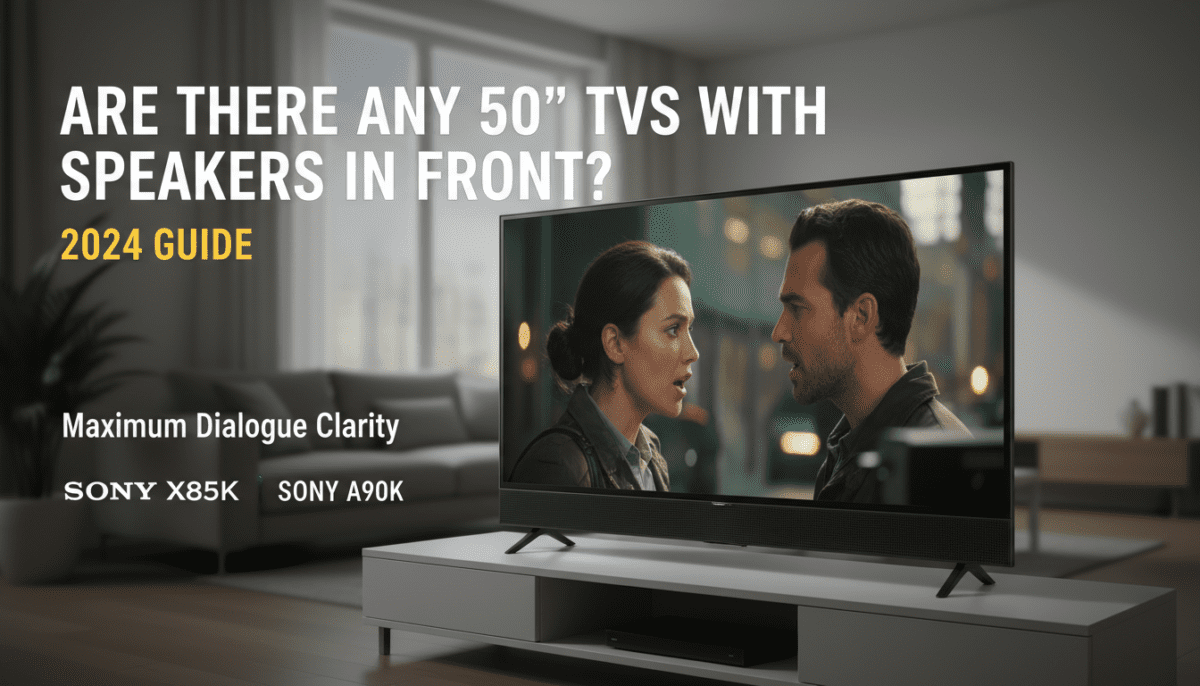
Step 1: Inspect the Bottom Bezel
Physically look at the bottom of the TV. If the bezel is slightly thicker and has small perforations or a mesh-like texture, it likely has front-firing drivers. If the bottom is perfectly smooth and the speakers are visible only on the underside, it is a down-firing model.
Step 2: Look for “Acoustic” or “Forward” in the Specs
Manufacturers use specific marketing terms for front-facing tech. Search the manual or product page for:
- Acoustic Surface (Sony)
- Front-Firing Drivers
- Integrated Soundbar
- Far-Field Voice (sometimes indicates better speaker arrays)
Step 3: Check for Room Calibration Software
Higher-end 50-inch TVs now include a “Room EQ” feature. This uses a microphone in the remote to listen to the TV’s output and adjust the frequency response. This can help a down-firing speaker “act” more like a front-firing one by boosting the frequencies that usually get lost in reflection.
Why 50-Inch TVs Rarely Have Visible Front Speakers
We have consulted with industrial designers to understand why the industry moved away from the “side-car” or “bottom-grill” speaker look.
- Bezel-Less Aesthetics: Consumers demand “edge-to-edge” glass. Adding front speakers requires a larger frame (bezel), which is currently unfashionable.
- Structural Depth: Front-firing speakers require a certain “cabinet volume” to move air. Modern TVs are too thin to house high-quality forward drivers.
- The Soundbar Upsell: Manufacturers have a financial incentive to keep internal speakers mediocre so that you purchase an external soundbar or home theater system.
DIY: Turning Any 50-Inch TV into a Front-Speaker Powerhouse
If you find a 50-inch TV with a perfect picture but poor audio, you can easily convert it to a front-firing setup using these three methods we recommend to our clients.
The “Passive Reflection” Hack
If your TV is on a stand, place a hard, flat surface (like a piece of plexiglass or finished wood) at a 45-degree angle directly under the down-firing speakers. This reflects the sound waves forward toward your seating position. It is a “low-tech” way to simulate front-firing speakers.
The Integrated “Mountable” Soundbar
Look for a soundbar that “clips” to the bottom of the TV. Models like the Roku Streambar act as both a streaming device and a front-facing speaker array. Because it mounts directly to the TV, it maintains the “all-in-one” look of a 50-inch TV with speakers in front.
Use VESA-Mounted Speaker Brackets
You can buy brackets that attach to the VESA holes on the back of your TV and hold small bookshelf speakers on either side. This creates a true “Studio Monitor” look that was popular in the early 2000s and provides the best audio quality possible.
Expert Comparison: Integrated Audio vs. External Soundbars
| Feature | Integrated Front Speakers | Compact Soundbar (e.g., Sonos Ray) |
|---|---|---|
| Footprint | Zero (Built-in) | 20-25 inches of shelf space |
| Wiring | None | 1 HDMI/Optical + 1 Power Cable |
| Dialogue Clarity | High (in premium models) | Very High |
| Bass Response | Low | Moderate to High |
| Cost | Included in TV Price | $150 – $300 extra |
Frequently Asked Questions (FAQ)
Are there any 50-inch TVs with speakers in front for under $500?
It is very difficult to find native front-firing speakers in the budget category. Most TVs under $500, like the TCL 4-Series or Insignia, use down-firing speakers. Your best bet in this price range is the Hisense U6H, which has improved bottom-firing ports that mimic forward projection better than competitors.
Does “Dolby Atmos” mean the TV has front speakers?
No. Dolby Atmos is a software processing format. A TV can have Dolby Atmos branding but still use poor-quality down-firing speakers. It simply means the TV can process the signal, not that the physical hardware is positioned in the front.
Why does Sony have better front-facing audio than Samsung or LG?
Sony invests heavily in Acoustic Surface technology and X-Balanced drivers. While Samsung focuses on “Object Tracking” through software, Sony physically changes how the sound is produced (using the screen or specialized driver shapes), which generally results in better front-facing clarity.
Can I add front speakers to my current 50-inch TV?
Yes. The easiest way is to connect a 2.0 or 2.1 channel soundbar via the HDMI ARC/eARC port. This allows your TV remote to control the soundbar volume, making it feel like a built-in part of the TV.
Is the Sony X85K the best 50-inch TV for sound?
In the mid-range category, yes. Its X-Balanced speakers are designed specifically to balance the thinness of the TV with the need for clear, forward-moving sound. However, if you can step up to the Sony A90K, the audio quality is significantly better due to the vibrating OLED panel.