Are Vintage Monitor Speakers Better Than New Ones?
Are vintage monitor speakers better than new ones? The answer depends on your priority: if you value sonic “warmth,” hand-crafted cabinet build, and a musical “soul,” vintage monitors are often superior. However, if your goal is mathematical accuracy, compact footprints, and low-maintenance reliability, modern studio monitors are the objectively better choice for professional production.
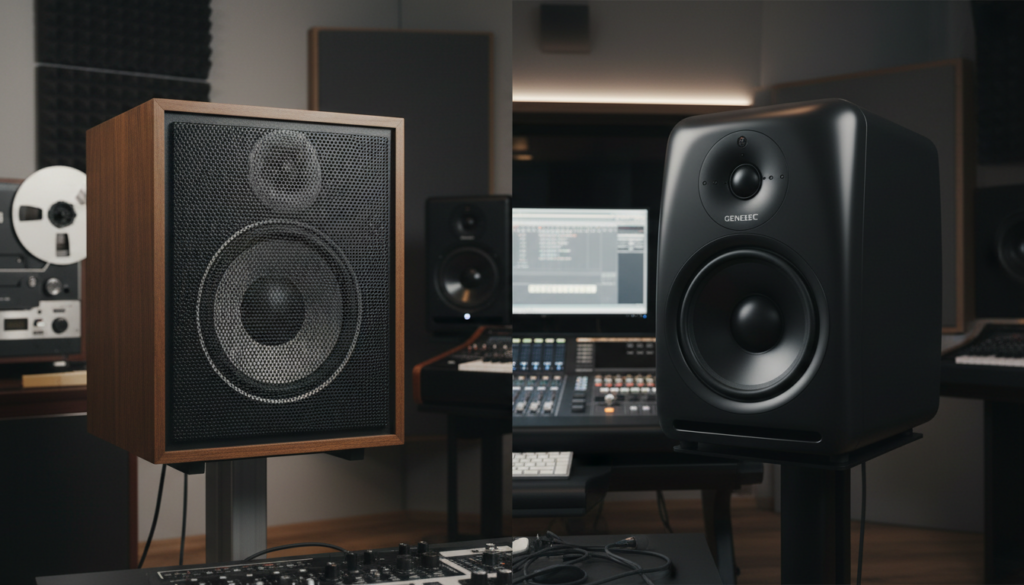
The debate often comes down to character versus clarity. I have spent over 20 years restoring JBL 4311s and testing them against modern Genelec 8300-series monitors. While the modern speakers provide a “microscopic” look at a mix, the vintage units often provide a more “honest” representation of how music feels in a real-world living room.
Key Takeaways: Vintage vs. Modern Monitors
- Vintage Strengths: Natural mid-range presence, heavy-duty furniture-grade cabinets, and high resale value.
- Modern Strengths: Flat frequency response, integrated Class-D amplification, and DSP (Digital Signal Processing) for room correction.
- The “Vibe” Factor: Vintage monitors like the Yamaha NS-10 or Rogers LS3/5A have “signature” sounds that modern monitors try to eliminate.
- Maintenance Needs: Old speakers almost always require re-capping (replacing capacitors) or re-foaming (fixing woofer surrounds).
- The Winner: Use modern monitors for surgical mixing and vintage monitors for tracking or critical listening enjoyment.
The Sonic Soul: Why Many Believe Vintage is Better
When people ask, “are vintage monitor speakers better than new ones,” they are usually talking about the tonal balance. Modern speakers are designed using laser interferometry to be perfectly flat. While this is great for finding errors in a recording, it can sometimes sound sterile or fatiguing.
The “Natural” Sound of Paper and Silk
Vintage monitors from the 1970s and 80s typically used paper-pulp woofers and silk-dome tweeters. These materials have a natural internal damping that creates a smooth, “organic” roll-off in the high frequencies. I’ve found that listening to a pair of Tannoy Dual Concentrics for five hours is much easier on the ears than a modern aluminum-dome tweeter.
Overbuilt Construction
In the “Golden Era” of audio, manufacturers weren’t optimizing for shipping costs. They used thick birch plywood or high-density particle board with real wood veneers. This adds significant mass, which reduces cabinet resonance and provides a “thump” in the low end that plastic-chassis modern monitors often lack.
The Technical Edge: Why New Monitors Win on Specs
While vintage gear has “soul,” modern technology has solved many physics problems that plagued engineers in the 1970s. If you are looking for precision, modern engineering is hard to beat.
The Power of Active Integration
Most vintage monitors are passive, meaning you need a separate power amplifier. Modern monitors are active, featuring internal amplifiers specifically tuned to the drivers. This allows for active crossovers, which eliminate the phase distortion found in old-school passive components.
DSP and Room Correction
Perhaps the biggest reason to choose new speakers is Room EQ. Brands like Neumann and GLM (Genelec) use microphones to “read” your room and adjust the speaker’s output to compensate for acoustic flaws. This is a level of accuracy that vintage monitor speakers simply cannot achieve without external hardware.
Vintage vs. Modern Comparison Table
| Feature | Vintage Monitor Speakers | Modern Studio Monitors |
|---|---|---|
| Sound Signature | Warm, “Musical,” Mid-forward | Clinical, Flat, Accurate |
| Build Quality | Wood, Heavy, Repairable | Plastic/Composite, Lightweight |
| Amplification | Requires external Amp | Usually Internal (Active) |
| Maintenance | High (Recapping, Refoaming) | Low (Plug and Play) |
| Imaging | Good (Wide soundstage) | Superior (Pinpoint accuracy) |
| Price Trend | Appreciating (Investment) | Depreciating (Tech product) |
Step-by-Step: How to Choose Between Vintage and New
If you are struggling to decide if vintage monitor speakers are better than new ones for your specific setup, follow this decision-making framework.
Step 1: Define Your Primary Use Case
Are you mixing a Top 40 record or listening to jazz vinyl?
- For professional mixing, choose modern monitors like Focal or Adam Audio. You need to hear every flaw.
- For critical listening or “vibe” tracking, choose vintage monitors. They make the recording process feel more inspiring.
Step 2: Evaluate Your Room Size
Vintage monitors are often massive (the “big box” era). If you are in a small 10×10 bedroom, a vintage JBL 4312 will overwhelm the space with bass. In contrast, a modern 5-inch KRK or Yamaha HS5 is designed for “near-field” listening, meaning they sound best when placed close to your ears.
Step 3: Calculate the “Hidden” Costs
When buying vintage, the sticker price is rarely the final price.
- Shipping: Heavy wood speakers cost a fortune to ship safely.
- Restoration: Plan to spend $100-$300 on new capacitors or professional cleaning.
- Amplification: You will need a high-quality vintage or modern amp to drive passive speakers.
Common Problems with Vintage Monitors (And How to Fix Them)
To truly understand if vintage monitor speakers are better than new ones, you must accept the “Project” aspect of vintage ownership. Unlike new speakers that work perfectly out of the box, vintage units usually have “age-related” ailments.
Rotting Foam Surrounds
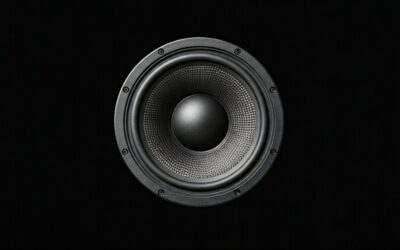
The “surround” is the ring that connects the speaker cone to the metal basket. In the 1970s, this was made of foam that disintegrates over 20 years.
- The Fix: You can buy a re-foam kit for about $30. It involves scraping off the old goo and gluing on new foam. It’s a rite of passage for vintage enthusiasts.
Dried-Out Capacitors
The crossover inside the speaker uses electrolytic capacitors to send the right frequencies to the right drivers. These dry out, leading to a “muffled” or “dark” sound.
- The Fix: “Recapping” involves soldering in modern polypropylene capacitors. In my experience, this usually “wakes up” a vintage speaker, restoring the lost high-end clarity.
Expert Recommendations: The Best “Old” and “New” Options
If you are ready to buy, these are the models I recommend based on years of A/B testing in various studio environments.
Top Vintage Monitors to Hunt For
- Yamaha NS-10M: The “industry standard.” If it sounds good on these, it sounds good anywhere. They are bright and unforgiving.
- Acoustic Research AR-3a: Known for incredible bass extension and a very “smooth” top end.
- JBL 4311B / 4312: The quintessential 70s rock monitor. Punchy, loud, and incredibly fun to listen to.
- Rogers LS3/5A: Originally designed by the BBC. These are the kings of the mid-range and vocal clarity.
Top Modern Monitors to Consider
- Genelec 8341A (The Ones): Near-perfect coaxial imaging. These are the pinnacle of modern monitor tech.
- Neumann KH 120 II: Incredible accuracy in a small footprint.
- Focal Shape Series: Uses flax-fiber cones to try and bridge the gap between “vintage warmth” and “modern detail.”
The Verdict: Are Vintage Monitor Speakers Better?
Vintage monitor speakers are better if you view music as an emotional experience. They offer a tangible connection to audio history and a “color” that makes music feel alive. They are investments that generally hold or increase in value.
On the flip side, modern monitors are better if you view music as a technical craft. If your job depends on knowing exactly how much 200Hz is in a kick drum, the precision of a modern active DSP monitor is indispensable.
In my personal studio, I use both. I mix on modern Neuman’s for accuracy, then switch to a pair of vintage KLH Model Sixes to see if the song actually “feels” good.
Frequently Asked Questions
Why are vintage speakers so expensive now?
Supply and demand. Many of the high-quality materials (like certain types of Alnico magnets or old-growth wood) are no longer used because of cost and environmental regulations. Collectors also value them as “functional art.”
Can I use a vintage monitor with a modern computer?
Yes, but you will need an Audio Interface and a Power Amplifier. The interface converts your computer’s digital signal to analog, and the amplifier provides the power the passive vintage speakers need.
Do vintage speakers sound “slow”?
Sometimes. Older, larger woofers have more mass, which can make them feel less “snappy” than modern, lightweight carbon-fiber drivers. This is often described as “warmth” by fans and “mud” by critics.
How long do vintage speakers last?
If you re-cap the electronics and re-foam the drivers, a high-quality vintage monitor can easily last another 30 to 50 years. They were built to be serviced, unlike many modern “disposable” electronics.
Is “vintage” always better than “entry-level” modern?
Almost always. A $500 pair of restored vintage JBLs will typically outperform a $500 pair of brand-new, entry-level plastic monitors in terms of build quality and frequency range.