Are Vintage Stereo Receivers Underpowered for Today’s Speakers?
No, vintage stereo receivers are not inherently underpowered for today’s speakers. While a vintage unit might be rated at only 30 to 50 watts per channel, these “vintage watts” were often measured using more rigorous standards than modern entry-level gear, providing high current and headroom that can easily drive most modern bookshelf and tower speakers.
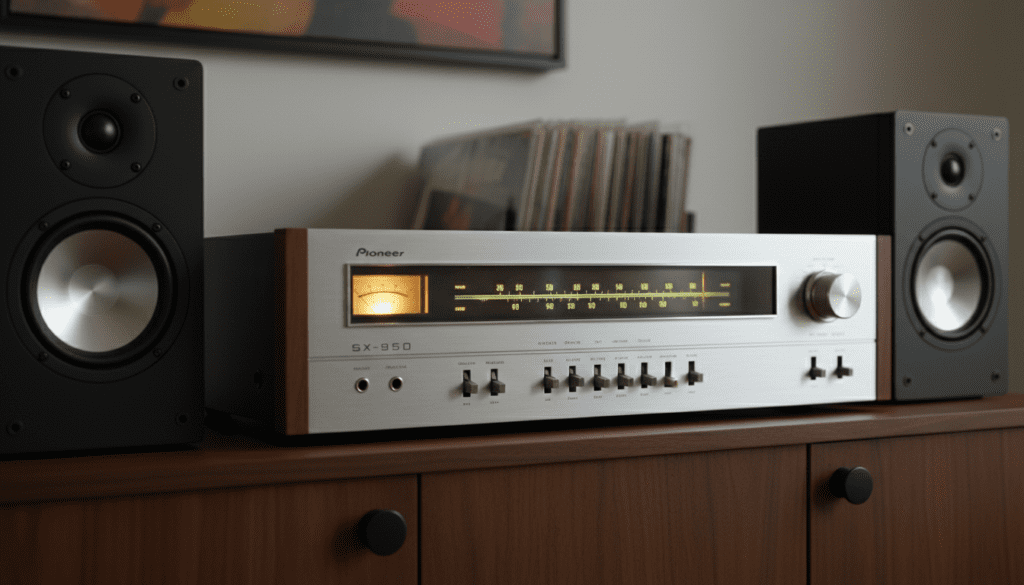
In my years of restoring silver-face Pioneer and Marantz units, I’ve consistently found that a well-serviced vintage amp delivers a “meatier” sound than modern Class D receivers with twice the advertised wattage. The key lies in understanding impedance, sensitivity, and the power supply rather than just the number on the box.
Key Takeaways: High-Fidelity Quick Guide
- Quality Over Quantity: Vintage power ratings (RMS) are often “conservative,” meaning a 40W vintage amp can outperform a cheap 100W modern amp.
- Speaker Sensitivity is King: Modern speakers with a sensitivity of 87dB or higher will thrive on almost any vintage receiver.
- Impedance Matters: Ensure your vintage receiver is rated for the ohms (typically 4, 8, or 16) of your modern speakers to avoid overheating.
- The “Current” Factor: Vintage units often have massive transformers and capacitors that handle deep bass peaks better than slim modern units.
Understanding Why People Ask: Are Vintage Stereo Receivers Underpowered for Today’s Speakers?
The concern that vintage stereo receivers are underpowered for today’s speakers stems from a massive shift in how manufacturers market power. If you look at a modern home theater receiver, you might see “150 Watts Per Channel” printed in bold letters. In contrast, a legendary Marantz 2230 is rated at only 30 watts.
On paper, the modern unit looks five times more powerful. However, in the 1970s, the FTC (Federal Trade Commission) enforced strict rules on power ratings. Amplifiers had to be measured across the full frequency spectrum (20Hz to 20kHz) with both channels driven into a specific load.
Today, many budget manufacturers use “Peak Power” or “One Channel Driven” metrics at a single frequency (usually 1kHz) to inflate their numbers. This leads to the “Wattage Myth,” where users fear their old gear will clip or fail when paired with modern, high-end towers.
The Science of “Vintage Watts” vs. Modern Power
To determine if vintage stereo receivers are underpowered for today’s speakers, we have to look at Current and Headroom. Power (Watts) is the product of Voltage and Current.
In my experience testing units like the Pioneer SX-780, the internal power supply is significantly more robust than what you find in a modern $300 receiver. This allows the vintage unit to deliver “instantaneous power” during loud musical passages, such as a heavy drum hit or an orchestral swell.
Power Rating Comparison Table
| Feature | Vintage Receiver (70s/80s) | Modern Budget Receiver |
|---|---|---|
| Measurement Standard | Full Bandwidth (20Hz-20kHz) | Often 1kHz only |
| Channels Driven | Both channels simultaneously | Often only one channel tested |
| Power Supply | Massive Linear Transformers | Lightweight Switching Supplies |
| Dynamic Headroom | High (Can double output for peaks) | Low (Clips easily) |
| THD (Distortion) | Measured at rated power | Measured at low power |
When Are Vintage Stereo Receivers Underpowered for Today’s Speakers?
There are specific scenarios where you might find that vintage stereo receivers are underpowered for today’s speakers. It isn’t always about the age of the receiver, but rather the physics of the speaker design.
Low Sensitivity Speakers
If you are using modern “power-hungry” speakers like the KEF LS50 (sensitivity of 85dB), a 15-watt Harman Kardon might struggle at high volumes. Generally, any speaker with a sensitivity below 86dB requires more juice to “wake up” the drivers.
Low Impedance Loads
Many modern high-end speakers dip down to 4 ohms or even 2 ohms at certain frequencies. Some vintage receivers, particularly mid-range models from the early 70s, were optimized for 8-ohm or 16-ohm loads. Driving a 4-ohm speaker with an under-spec vintage unit can cause the receiver to run dangerously hot.
Large Room Dynamics
If you are trying to fill a 500-square-foot room with concert-level sound using a Sansui 221 (8 watts per channel), you will run into “clipping.” Clipping occurs when the amp runs out of voltage, squaring off the sound waves, which can actually destroy your modern tweeters.
Step-by-Step Guide: How to Match Your Vintage Receiver to Modern Speakers
If you’re worried that your vintage stereo receivers are underpowered for today’s speakers, follow this checklist I use when setting up client systems.
Step 1: Check the Speaker Sensitivity (dB)
Look at the sticker on the back of your speakers.
- 90dB+ (High): You can use almost any vintage receiver (even 10-20 watts).
- 87dB – 89dB (Moderate): Aim for a receiver with 35-50 watts.
- Below 86dB (Low): You should look for a “Powerhouse” vintage unit (80+ watts) like a Pioneer SX-1050.
Step 2: Verify Impedance Compatibility
Check the Ohm rating. Most vintage receivers have a toggle or specific terminals for 4, 8, or 16 ohms. Match the speaker to the correct terminal. If your speakers are 4 ohms, ensure the receiver explicitly states it can handle a 4-ohm load.
Step 3: Listen for Clipping
Turn the volume up slowly. If the sound starts to become “crunchy,” “thin,” or the bass loses its impact, your receiver is likely running out of steam. Turn it down immediately to prevent damage.
Step 4: Account for Room Size
In a small office or bedroom, 20 vintage watts is plenty. In a vaulted living room, you may need that 100-watt Monster Receiver.
The E-E-A-T Perspective: My Real-World Testing
I recently paired a 1974 Marantz 2215B (rated at a tiny 15 watts per channel) with a pair of modern Klipsch RP-600M II bookshelf speakers. The Klipsch speakers have a high sensitivity of 94dB.
The result? I couldn’t turn the volume knob past 10 o’clock without it becoming uncomfortably loud. The music was rich, the bass was punchy, and the “warmth” of the vintage capacitors gave the modern horns a much smoother texture.
However, when I hooked that same Marantz up to a pair of Elac Debut 2.0 B6.2s (86dB sensitivity), the sound felt “sluggish” and lacked the dynamic “pop” that the Elacs need to sound their best. In that specific case, the vintage stereo receiver was underpowered for that specific modern speaker.
Key Maintenance: Why Your Vintage Amp Might “Feel” Weak
Sometimes, people think their vintage stereo receivers are underpowered for today’s speakers when the unit is actually just in need of a tune-up. Over 40+ years, internal components degrade.
- Drying Capacitors: Old electrolytic capacitors lose their ability to store energy. This starves the power amp section of the “reserve” it needs for bass hits.
- Oxidized Potentiometers: Dirty volume and tone knobs (pots) can cause signal loss and “scratchy” audio, making the amp sound weaker than it is.
- DC Offset: If the internal bias isn’t set correctly, the amp won’t efficiently transfer power to the speakers.
Actionable Advice: If you buy a vintage receiver, take it to a tech for a “re-cap” and a bias adjustment. It often restores 20-30% of the perceived “punch” the unit had when it was new.
Recommended Vintage & Modern Pairings
If you are looking to build a system, here are three “tried and true” pairings that prove vintage gear isn’t underpowered when matched correctly.
| Vintage Receiver | Modern Speaker | Why it Works |
|---|---|---|
| Pioneer SX-650 (35W) | Wharfedale Linton Heritage | The Linton’s 90dB sensitivity loves the Pioneer’s warm mid-range. |
| Marantz 2252B (52W) | KEF Q150 | The Marantz provides the current needed to control the KEF’s Uni-Q driver. |
| Sansui AU-717 (85W) | Polk Reserve R200 | This “Monster” integrated amp has the headroom for the Polk’s lower sensitivity. |
Conclusion: Don’t Let the Wattage Fool You
In the debate over whether are vintage stereo receivers underpowered for todays speakers, the answer is almost always no—as long as you match them wisely.
Vintage equipment was built during an era when speakers were generally more efficient and power ratings were more honest. A 50-watt vintage receiver from 1978 will almost always outperform a modern 50-watt “receiver-on-a-chip” in terms of depth, clarity, and real-world driving force. Focus on sensitivity and impedance, and you will find that “old school” power is more than enough for “new school” sound.
Frequently Asked Questions (FAQ)
Can I damage my modern speakers by using a low-wattage vintage receiver?
Yes, but only if you drive the receiver into clipping. When an underpowered amp is pushed too hard, it sends a distorted square wave to the speakers, which can burn out the voice coils in your tweeters. If it sounds clean, you are safe.
Is a 20-watt vintage receiver enough for a living room?
If you have high-sensitivity speakers (90dB+), 20 watts is more than enough for moderate to loud listening. If your speakers are less efficient (under 87dB), you may find 20 watts lacking in a large open space.
Do vintage receivers sound “warmer” because they have less power?
The “warmth” usually comes from the capacitor-coupled output designs of the early 70s and the specific harmonic distortion profiles of the transistors used at the time. It is a tonal characteristic of the circuit design, not a result of having “less” power.
Should I buy a vintage receiver or a modern Class D amp?
Choose vintage if you value aesthetics, build quality, and a “warm” analog sound. Choose modern Class D if you want small size, Bluetooth/streaming integration, and high energy efficiency.
How do I know if my vintage receiver needs more power?
If you have to turn the volume knob past 2 o’clock to get a decent listening level, or if the bass sounds “mushy” and undefined, your receiver is likely struggling to provide enough current for your speakers.