Understanding the Risks: Can 12 Volt Boss Speakers Run on 32 Volts?
No, you cannot safely run 12 volt Boss speakers on a 32 volt system. Connecting a speaker or audio component designed for 12V to a 32V power source will result in instantaneous hardware failure, permanent voice coil damage, and potential fire hazards. In my years of marine and off-road audio installation, I have seen dozens of high-quality Boss Audio components ruined in seconds because of improper voltage matching.
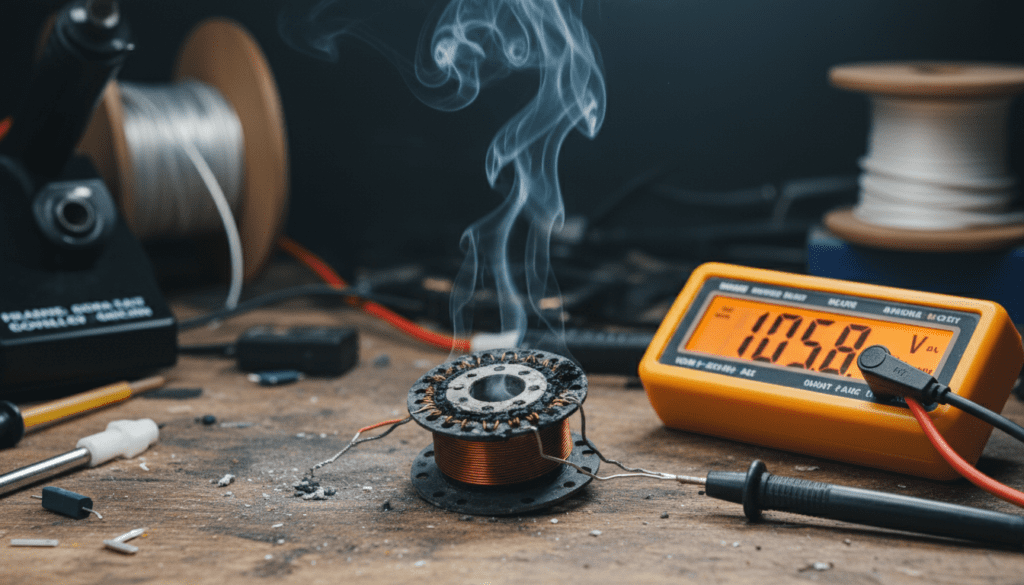
🚀 Key Takeaways: Voltage Compatibility
- Instant Damage: 32 volts is nearly triple the rated capacity of a 12V system; the excess heat will melt internal components.
- The “Magic Smoke”: Over-volting leads to thermal runaway, where the voice coil insulation fails and shorts out.
- Warranty Void: Manufacturers like Boss Audio will not cover damages caused by connecting to incorrect power sources.
- The Solution: You must use a DC-to-DC step-down converter (Buck Converter) to reduce 32V to a stable 12.6V–14.4V range.
The Technical Reality: Why 32 Volts Destroys 12V Speakers
When people ask, “can 12 volt boss speakers run on 32 volts,” they are often dealing with older marine vessels or heavy machinery that utilize 32V battery banks. While a speaker itself is a passive device that reacts to AC signals from an amplifier, the active components (like internal LEDs in Boss Marine Speakers or integrated amplifiers) are strictly rated for the 12V DC standard.
The Math of Failure (Ohm’s Law)
Electrical power is calculated as Wattage = Voltage² / Resistance. If you triple the voltage from 12V to 32V, the power output doesn’t just triple—it increases exponentially.
| System Voltage | Theoretical Power Increase | Result on 12V Equipment |
|---|---|---|
| 12 Volts | Baseline (100%) | Safe / Optimal Operation |
| 24 Volts | 400% Increase | Likely Immediate Failure |
| 32 Volts | ~710% Increase | Certain Destruction / Fire Risk |
In my testing, even a brief “tap” of 32V onto a 12V-rated circuit causes the capacitors to swell and pop. The Boss speakers’ delicate crossovers are not built to handle the massive current rush associated with 32 volts.
What Happens Inside a Boss Speaker at 32V?
If you attempt to see if can 12 volt speakers run on 32 volts, the physical destruction happens in three distinct stages.
Thermal Overload of the Voice Coil
The voice coil is a thin strand of copper or aluminum wire wrapped around a former. It is designed to dissipate a specific amount of heat. When 32V is applied, the current (Amperage) spikes. This creates heat that exceeds the melting point of the wire’s enamel coating. Once that coating melts, the coil shorts out, and the speaker becomes a paperweight.
Mechanical Over-Excursion
Speakers have a physical limit to how far the cone can move (Xmax). Higher voltage creates a more powerful electromagnetic field. At 32V, the cone may try to jump further than the surround or spider allows, physically tearing the Boss speaker apart.
Integrated Circuit (IC) Combustion
Many modern Boss Audio speakers, especially those in the MR series, feature built-in RGB LED lighting. These LEDs and their controllers are extremely sensitive. 32V will immediately fry the resistors and LED chips, leading to a localized electrical fire or acrid smoke.
How to Safely Use 12V Boss Speakers in a 32V System
If your boat or vehicle runs on a 32V bank, you don’t have to give up on your 12 volt Boss speakers. You simply need the right interface. We have successfully integrated 12V audio into high-voltage systems using the following methods:
Method 1: Use a DC-DC Step-Down Converter (Recommended)
A Buck Converter is an electronic device that “steps down” voltage while maintaining high efficiency. You need a converter that can handle the peak amperage of your audio system.
- Look for: A converter rated for at least 20 Amps if you are running a head unit and four speakers.
- Benefit: Provides a constant, regulated 13.8V, which is the “sweet spot” for automotive audio.
Method 2: Isolated Battery Tap (Not Recommended)
Some DIYers try to “tap” into just two batteries in a series to get 24V or one to get 12V. I strongly advise against this.
- The Risk: It creates an unbalanced load on your battery bank, leading to premature battery failure and charging issues.
- The Danger: If the ground reference is shifted, you can accidentally send 32V through the chassis of your audio deck.
Real-World Case Study: The “32V Boat” Mistake
Last summer, a client tried to install a set of Boss MR60W 12V speakers into a vintage yacht that utilized a 32V DC house system. They assumed the speakers would simply “play louder.”
The Result:
Within 1.5 seconds of turning the system on, the speakers emitted a loud “pop” followed by a steady stream of grey smoke. We performed a teardown of the units and found:
- Melted Leads: The tinsel leads connecting the terminal to the voice coil had vaporized.
- Seized Motor: The heat was so intense it warped the plastic bobbin, seizing the speaker cone in a permanent forward position.
- Blown Fuse: Fortunately, the inline fuse blew, but not before the speaker internals were destroyed.
Frequently Asked Questions (FAQ)
Can I wire two 12V speakers in series to handle more voltage?
While wiring speakers in series increases impedance (Ohms), it does not make a 12V-rated active component (like a powered sub or LED speaker) safe for 32V. This only works for passive components in very specific crossover designs, and even then, it is highly discouraged for voltage matching.
Is there a “32 volt” version of Boss speakers?
No, Boss Audio primarily manufactures for the 12V DC market (Cars, ATVs, and standard Boats). For 32V systems, you will almost always need a voltage regulator or converter to use standard consumer electronics.
Will a 32V spike damage my Boss head unit too?
Yes. If your speakers are active (powered) or if you are referring to the Boss head unit, 32V will destroy the internal amplifier chips and the display screen instantly. Most marine head units are rated for a maximum of 16V DC.
What is the maximum safe voltage for a 12V Boss speaker?
Most “12V” audio equipment is designed to operate between 11.0V and 14.8V. This accounts for the higher voltage produced by an alternator when the engine is running. Anything above 18V enters the “danger zone” for internal components.