Can a Car Battery Power an Amp Sub and Speakers?
Yes, a standard 12V car battery can power an amplifier, subwoofer, and speakers, provided the total wattage does not exceed the battery’s reserve capacity and the alternator’s charging output. For high-performance systems over 1,000 watts, you likely need electrical upgrades like a High-Output Alternator or an AGM secondary battery to prevent voltage drops.
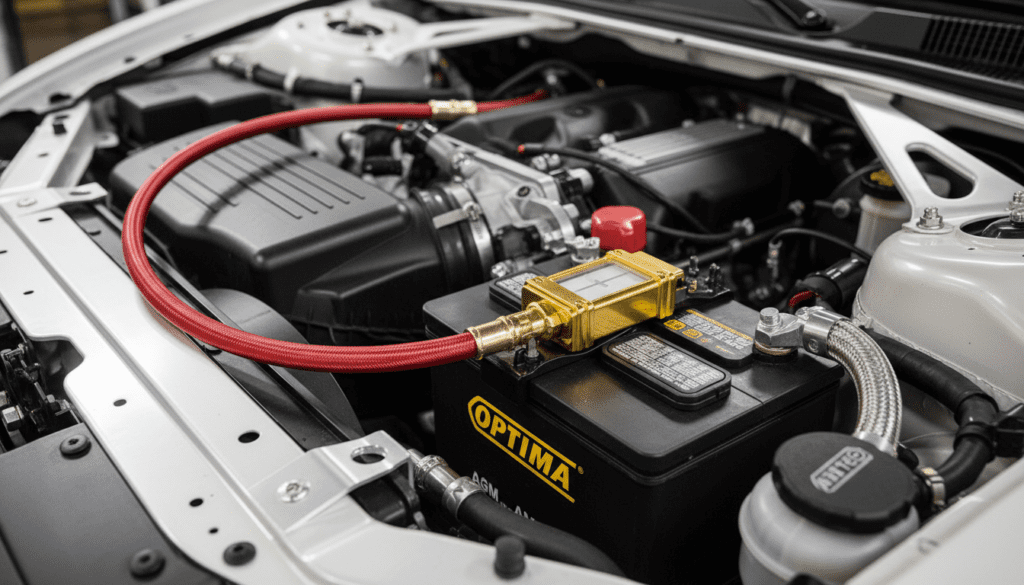
In my 15 years of installing competition-grade audio systems, I’ve seen many enthusiasts burn out their alternators or ruin their batteries by not understanding the balance between current draw and charging capacity. While your battery provides the initial “kick,” your alternator is what actually keeps the music playing while the engine is running.
🚀 Key Takeaways: Car Audio Power Essentials
- The Golden Rule: Your alternator powers the system while driving; the battery powers it when the engine is off.
- Voltage Matters: Aim for a steady 13.8V to 14.4V while the engine is running.
- The “Big Three” Upgrade: This is the most effective way to improve power delivery without replacing your battery.
- Fuse Safety: Always place a fuse within 18 inches of the battery to prevent vehicle fires.
- Efficiency: Class D Amplifiers are much more efficient than Class A/B, drawing less current for the same volume.
Understanding the Relationship: Battery vs. Alternator
To answer if your car battery can power an amp, sub, and speakers, we have to look at the electrical ecosystem of your vehicle. Think of your battery as a water tank and the alternator as the pump that refills it.
If your “tank” (battery) is draining faster than the “pump” (alternator) can refill it, your voltage will drop. When voltage drops below 12.0V, your amplifier will clip, potentially destroying your subwoofer voice coils or causing the amp to enter Protect Mode.
Battery Types for Car Audio
| Battery Type | Pros | Cons | Best For |
|---|---|---|---|
| Lead-Acid (Flooded) | Cheap, standard in most cars. | Short lifespan, leaks acid, slow discharge. | Entry-level systems (<500W). |
| AGM (Absorbed Glass Mat) | Deep cycle, fast discharge, vibration resistant. | Heavier and more expensive. | Mid-to-high end systems (1000W+). |
| Lithium (LiFePO4) | Extremely lightweight, holds steady voltage. | Very expensive, requires specific charging. | Competition systems (3000W+). |
Step 1: Calculate Your Total Current Draw
Before installing your amp and sub, you must determine if your electrical system can handle the Amperage. We use Ohm’s Law for this.
- Find the Total RMS Wattage: Look at the RMS (Root Mean Square) rating of your amplifier, not the “Peak” or “Max” power.
- Use the Formula: Amps = Watts / Volts.
- Account for Efficiency: Most Class D amplifiers are about 80% efficient.
Example Calculation:
If you have a 1,000 Watt RMS amplifier running at 13.8 Volts:
- 1,000 / 13.8 = 72.46 Amps.
- Adjusting for 80% efficiency: 72.46 / 0.80 = ~90 Amps.
If your car has a 100-Amp Alternator, and the car’s electronics (lights, ECU, AC) use 60 Amps, you only have 40 Amps left for your stereo. In this case, a 1,000W amp will eventually drain your battery even while driving.
Step 2: Choosing the Right Wire Gauge
The wire is the “pipe” through which the power flows. If the pipe is too small, the power turns into heat, and your amp and sub will starve for juice.
We recommend using OFC (Oxygen-Free Copper) rather than CCA (Copper Clad Aluminum). OFC conducts significantly more current and doesn’t corrode as easily.
Power Wire Selection Chart
| Total RMS Wattage | 0-10 Feet (Wire Gauge) | 10-20 Feet (Wire Gauge) |
|---|---|---|
| 500 Watts | 8 AWG | 4 AWG |
| 1,000 Watts | 4 AWG | 2 AWG |
| 2,000 Watts | 1/0 AWG | 1/0 AWG |
| 3,000 Watts+ | Dual 1/0 AWG | Dual 1/0 AWG |
Step 3: Performing the “Big Three” Upgrade
If you find your car battery struggling to power an amp and sub, the first professional step we take is the Big Three Upgrade. This involves replacing three factory wires with heavy-duty 1/0 gauge OFC wire.
- Battery Negative to Chassis Ground: Improves the return path for all electronics.
- Engine Block to Chassis Ground: Provides a better ground for the alternator.
- Alternator Positive to Battery Positive: Allows the alternator to charge the battery with less resistance.
Expert Insight: I’ve seen this simple upgrade increase resting voltage by as much as 0.5V to 0.8V, which is massive for amplifier performance.
Step 4: How to Connect Your Car Battery to an Amp, Sub, and Speakers
Follow these steps to ensure a safe and powerful installation.
Disconnect the Negative Terminal
Safety first. Always disconnect the battery ground before working on any electrical components to avoid short circuits.
Run the Power Wire
Route your 8, 4, or 0 gauge power wire from the battery through the firewall. Use a rubber grommet to prevent the metal edge of the firewall from cutting the wire.
Install the Fuse Holder
Mount your Inline Fuse Holder as close to the battery as possible. If the wire shorts out between the battery and the amp, the fuse will blow and prevent a fire.
Establish a Solid Ground
The ground wire is just as important as the power wire.
- Keep it short (under 3 feet).
- Scrape away the paint on the car’s chassis to expose bare metal.
- Use a star washer and a heavy-duty bolt.
Remote Turn-On and Signal
Connect the Remote Turn-On (REM) wire from your head unit to the amp. This tells the amp to turn on only when the car is running. Run your RCA cables on the opposite side of the car from the power wire to avoid electrical interference (engine hum).
Step 5: Dealing with Voltage Drops (Capacitors vs. Batteries)
If your headlights are dimming when the bass hits, your car battery cannot power the amp and sub effectively during peak demands. You have two main solutions:
Stiffening Capacitors
- What they do: Store a small amount of energy and release it instantly.
- Best for: Small systems (under 1,000W) with minor dimming.
- Expert Opinion: Capacitors are often a “band-aid.” They don’t add power; they just smooth out the ripple.
Secondary AGM Batteries
- What they do: Provide a massive reserve of current.
- Best for: Systems over 1,500W or if you listen to music with the engine off.
- Installation: Place it in the trunk near the amplifiers.
Signs Your Current Battery is Failing the Load
I recommend keeping an eye on these “red flags” to avoid being stranded with a dead car:
- Dimming Lights: Headlights or dashboard lights flicker in sync with the bass.
- Slow Cranking: The engine takes longer to start after you’ve been jamming.
- Burning Smell: This could indicate your alternator is overheating or your wiring is too thin.
- Amplifier Protection Mode: The amp shuts off during loud passages to protect itself from “low voltage” damage.
FAQ: Frequently Asked Questions
Can a stock car battery handle a 1000-watt amp?
Most stock batteries can handle a 1000-watt RMS system, but only if the engine is running and the alternator is healthy. You will likely experience some light dimming unless you perform the Big Three upgrade or use a high-quality AGM battery.
How long can I play my sub and speakers with the engine off?
With a standard lead-acid battery and a 500W system, you typically have 20–30 minutes before you risk not being able to start the car. For extended “engine-off” listening, you must install a Deep Cycle AGM battery.
Will a bigger battery make my subs hit harder?
A bigger battery doesn’t directly increase wattage, but it prevents voltage sag. By maintaining a steady 14.4V instead of dropping to 12V, your amplifier can produce its full rated power, resulting in tighter, louder, and cleaner bass.
Do I need a high-output alternator for my car audio?
If your total system power exceeds 1,500 Watts RMS and you’ve already upgraded your wiring and battery, a High-Output Alternator is the only way to truly solve power issues. It ensures your electronics are powered by the alternator rather than constantly sucking life from the battery.