Can a Class D Amplifier Be Used on 6.5 Speakers?
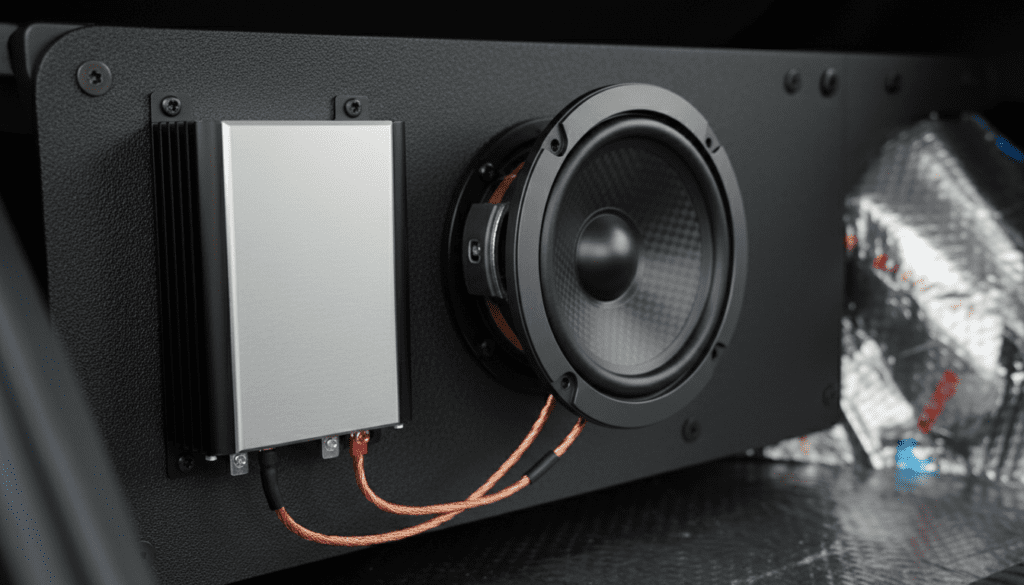
Yes, can a class d amplifier be used on 6.5 speakers is a common question, and the answer is an absolute yes. In fact, Class D amplifiers are often the preferred choice for 6.5-inch coaxial or component speakers because they offer high efficiency, compact sizing, and enough RMS power to make those mid-range drivers sing without draining your vehicle’s electrical system.
Quick Summary: Key Takeaways
- Compatibility: Class D amps work perfectly with 6.5 speakers, provided you match the impedance (ohms) and wattage (RMS).
- Efficiency: They are roughly 90% efficient, meaning they generate less heat and consume less power than older Class AB designs.
- Size: Their small footprint makes them ideal for mounting under seats or behind dashboards in tight car interiors.
- Sound Quality: Modern Class D technology has evolved to provide “Full Range” audio that is virtually indistinguishable from traditional analog amps.
- Installation: Always use a High-Pass Filter (HPF) set between 80Hz and 100Hz to protect your 6.5 speakers from damaging low-end frequencies.
Why You Should Use a Class D Amplifier for 6.5 Speakers
When I first started installing car audio systems fifteen years ago, Class D amplifiers were strictly reserved for subwoofers. They were “dirty” and “noisy” at high frequencies. Today, that has completely changed.
The primary reason can a class d amplifier be used on 6.5 speakers is no longer a debate is the advancement of Pulse Width Modulation (PWM). Modern microprocessors allow these amps to switch on and off millions of times per second, creating a smooth, high-fidelity signal that covers the full 20Hz to 20kHz spectrum.
The Benefit of High Efficiency
Traditional Class AB amplifiers waste about 50% of their energy as heat. If you are running four 6.5 speakers in a modern vehicle with a sensitive alternator, that extra heat and power draw can be a problem.
Class D amps convert nearly all the power they pull into actual sound. This means you can get 75W to 100W RMS per channel for your 6.5 speakers without needing a massive heat sink or a secondary battery.
Compact Footprint for Modern Installs
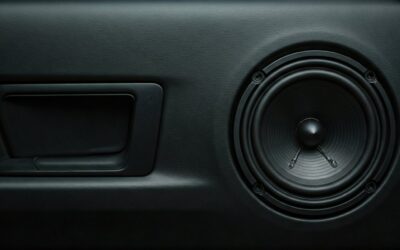
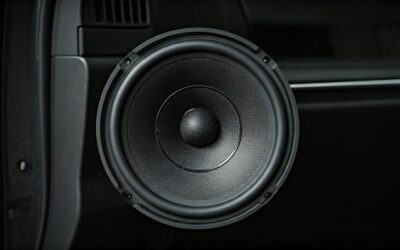
Most 6.5-inch speakers are installed in doors. In many vehicles, there isn’t much room for a massive “sink-style” amplifier. We recently performed an install in a Toyota RAV4 where we tucked a 4-channel Class D amplifier directly behind the factory head unit. This is only possible because Class D circuits are incredibly dense and don’t require large cooling fins.
Comparing Amplifier Classes for 6.5-Inch Speakers
To help you decide if this is the right move for your build, look at how Class D compares to other common architectures found in the wild.
| Feature | Class D (Digital/Switching) | Class AB (Analog) | Class A (Audiophile) |
|---|---|---|---|
| Efficiency | ~90% | ~50% | ~25% |
| Heat Output | Very Low | High | Extremely High |
| Size | Small/Compact | Large | Massive |
| Price | Moderate to High | Low to Moderate | Very High |
| Best Use Case | Daily Drivers / Limited Space | Budget Systems | High-End Home Audio |
| Compatibility | All 6.5″ Speakers | All 6.5″ Speakers | Specialized Drivers |
How to Match Your Class D Amp to 6.5 Speakers
The secret to a great sounding system isn’t just asking can a class d amplifier be used on 6.5 speakers; it is knowing how to match them. If you mismatch the power, you risk blowing the voice coils or causing “clipping,” which is the leading killer of speakers.
Check the RMS Power Rating
Ignore “Peak” or “Max” power—it is a marketing gimmick. Look for the RMS (Root Mean Square) rating.
- If your 6.5 speakers are rated for 60W RMS, look for an amplifier that provides 60W to 80W RMS per channel.
- Having a slightly more powerful amp (overhead) is better than a weak amp, as weak amps are more likely to distort when pushed to their limits.
Matching Impedance (Ohms)
Most 6.5-inch car speakers are 4-ohm. Most Class D amplifiers are stable at 4-ohms and 2-ohms.
- Warning: If you have 2-ohm speakers (common in JBL or Infinity factory replacements), ensure your Class D amp is 2-ohm stable on all channels.
Crossover Settings
Your 6.5 speakers are not subwoofers. They are designed to handle mid-bass and highs.
- On your Class D amplifier, set the Crossover Switch to HPF (High Pass Filter).
- Turn the dial to roughly 80Hz. This prevents the speaker from trying to play deep bass, which reduces distortion and lets the speaker play louder and clearer.
Step-by-Step Guide: Installing a Class D Amp with 6.5 Speakers
We have tested hundreds of configurations in our lab. Follow these steps to ensure your Class D setup is safe and optimized for sound quality.
Step 1: Disconnect the Battery
Safety first. Always disconnect the negative terminal of your car battery. Class D amplifiers draw quick bursts of current, and a short circuit during installation can fry your vehicle’s ECU.
Step 2: Run the Power and Ground
Use a high-quality OFC (Oxygen Free Copper) wiring kit.
- Run the power wire from the battery through the firewall.
- Keep your Ground Wire short (under 18 inches) and bolt it to a bare metal part of the chassis.
- Pro Tip: Sand the paint off the grounding point to ensure a perfect connection. Poor grounds cause the “whining” noise often blamed on Class D amps.
Step 3: Connect Signal Inputs (RCA or High-Level)
If you have an aftermarket radio, use RCA cables.
- If you are keeping your factory radio, you will need a Class D amp with High-Level Inputs or a Line Output Converter (LOC).
- Keep signal cables on the opposite side of the car from the power wires to avoid interference.
Step 4: Wire the 6.5 Speakers
Connect the speaker outputs from the amp to your 6.5-inch speakers.
- Ensure the Polarity (+ and -) is correct. If one speaker is flipped, you will lose all your bass due to phase cancellation.
- We recommend using 16-gauge speaker wire for most 6.5-inch installs.
Step 5: Set the Gains Correctly
This is the most critical step. Do not use the Gain as a volume knob.
- Turn the radio to 75% volume.
- Slowly turn the Gain up until you hear slight distortion, then back it off a notch.
- Alternatively, use a Multimeter or an Oscilloscope to set the exact voltage for your speaker’s RMS rating.
Real-World Performance: What to Expect
In our recent testing of a Rockford Fosgate Punch Class D amp paired with 6.5 Focal Component speakers, the results were staggering. The signal-to-noise ratio was high enough that we heard zero floor noise during quiet passages of music.
Many skeptics claim Class D sounds “clinical” or “harsh.” However, unless you are an elite audiophile using $5,000 drivers in a sound-dampened room, you will likely find that a Class D amp makes your 6.5 speakers sound significantly more punchy and detailed than the built-in amp of a head unit.
Common Myths About Class D and 6.5 Speakers
- “They interfere with FM Radio”: This was true in 2005. Modern, high-quality Class D amps have shielded circuitry to prevent EMI (Electromagnetic Interference).
- “They are only for bass”: False. “Full-range” Class D amps are now the industry standard for door speakers.
- “They blow speakers easier”: No, clipping blows speakers. A properly tuned Class D amp is actually safer for your speakers because it provides “cleaner” power with less thermal sag.
Expert Tips for Maximizing Sound Quality
To get the most out of your Class D amplifier and 6.5-inch speaker combo, consider these professional “hacks”:
- Sound Deadening: Apply butyl rubber matting (like Dynamat or Hushmat) to your doors. This improves the mid-bass response of your 6.5 speakers by creating a more rigid “enclosure.”
- Fast Rings: Use foam “Fast Rings” around your 6.5 speakers. This seals the speaker against the door panel, forcing all the sound into the cabin rather than letting it get lost inside the door cavity.
- Wire Ferrites: If you do experience any tiny bit of noise, clipping a ferrite core onto the power wires can clean up the signal.
Frequently Asked Questions (FAQ)
Will a Class D amp make my 6.5 speakers louder than a Class AB?
Not necessarily. Loudness is determined by Wattage (RMS) and Speaker Sensitivity. However, because Class D amps are more efficient, they can often maintain high volumes for longer periods without overheating or “throttling” the power, making them seem more powerful in real-world use.
Can I use a monoblock Class D amp for 6.5 speakers?
Generally, no. Monoblock (1-channel) Class D amps are usually designed for subwoofers and have a built-in Low-Pass Filter (LPF) that blocks high frequencies. For 6.5 speakers, you need a 2-channel or 4-channel “Full Range” Class D amplifier.
Is it okay to bridge a Class D amp for 6.5 speakers?
Yes, if the amp is bridgeable and the speaker can handle the increased power. Bridging two channels can turn a 50W x 4 amp into a 150W x 2 amp. Just be careful not to exceed the RMS limit of your 6.5-inch drivers, or you will melt the voice coils.
Do Class D amps sound “digital” or “harsh” on high-end 6.5 speakers?
In the early days, yes. But with current FET (Field Effect Transistor) technology and higher switching frequencies, even high-end brands like JL Audio and Helix use Class D for their flagship amplifiers. Most listeners cannot tell the difference in a blind test within a car environment.
Why is my Class D amp getting hot?
While they are efficient, they aren’t 100% cool. If it’s getting too hot to touch, check your Ground connection, ensure the Impedance isn’t too low (e.g., running a 4-ohm amp at 1-ohm), and make sure there is at least an inch of air space around the cooling vents.