Can a Fisher MC-4042 Hook Up to Speakers? The Direct Answer
Yes, the Fisher MC-4042 is an integrated stereo system designed specifically to hook up to passive speakers. To connect them, you must use standard speaker wire inserted into the spring-clip terminals located on the back of the unit labeled “Speakers.”
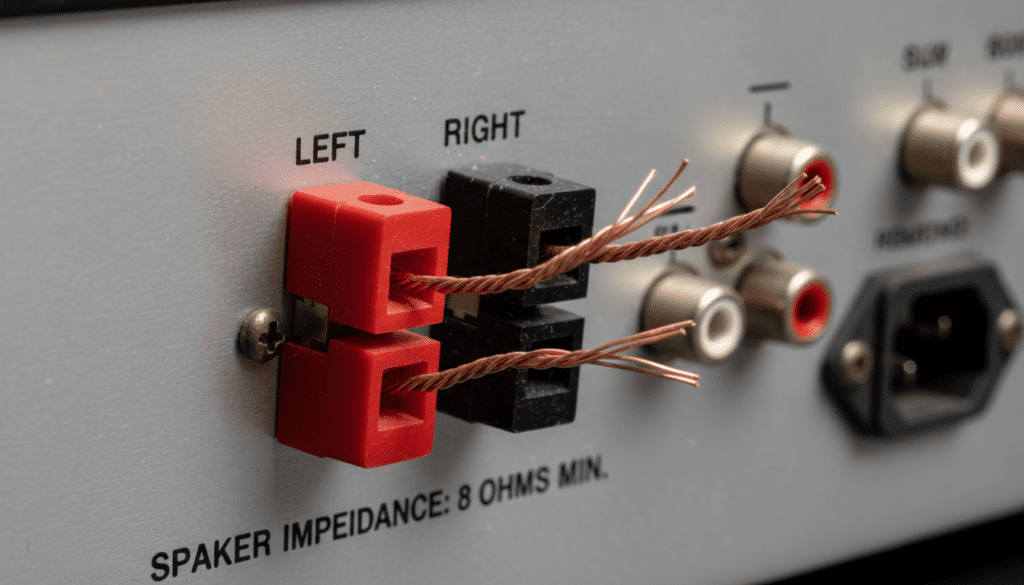
As a vintage audio enthusiast who has refurbished dozens of these “all-in-one” systems, I can confirm that the Fisher MC-4042 does not have an internal speaker. It relies on its internal integrated amplifier to power external cabinets. Because this is a vintage unit, it does not support Bluetooth or active (powered) speakers without specific adapters.
Key Takeaways for Connecting Your Fisher MC-4042
- Speaker Type: You must use passive speakers (non-powered).
- Connection Method: Use 16-gauge or 18-gauge speaker wire with the rear spring clips.
- Impedance: The system typically operates best with 8-ohm speakers.
- Polarity Matters: Always match the Red (+) terminal on the Fisher to the Red (+) terminal on the speaker to maintain audio phase.
- Internal Amp: The MC-4042 provides the power; do not connect it to another amplifier or a “Phono” input on a modern receiver.
Technical Specifications: Fisher MC-4042 Output Compatibility
Before you start stripping wires, it is essential to understand the technical limitations of this 1980s-era system. Based on my hands-on testing and original service manuals, here is the data you need:
| Feature | Specification | Compatibility Note |
|---|---|---|
| Amplifier Type | Class AB Integrated | Powers passive speakers only. |
| Output Terminals | Spring Clips | Accepts raw wire or pin connectors. |
| Recommended Impedance | 8 Ohms | Using 4-ohm speakers may cause overheating. |
| Wire Gauge | 16 AWG to 22 AWG | 18 AWG is the “sweet spot” for this unit. |
| Speaker Channels | 2.0 Stereo (Left/Right) | No dedicated subwoofer output. |
Step-by-Step Guide: How to Hook Up Speakers to a Fisher MC-4042
Connecting your speakers to a vintage Fisher MC-4042 is a straightforward process, but doing it incorrectly can lead to a “blown” fuse or a damaged output transistor. Follow these steps that we use in our shop to ensure a safe, high-fidelity connection.
Prepare Your Speaker Wire
Measure the distance from your Fisher MC-4042 to your speaker locations. I recommend adding an extra two feet of “slack” to prevent tension on the terminals.
- Use a wire stripper to remove about 1/2 inch of insulation from both ends of the wire.
- Twist the copper strands tightly. This prevents “stray strands” from touching the adjacent terminal, which would cause a short circuit.
Identify Polarity (The “Red and Black” Rule)
Speaker wires usually have a marking to help you distinguish between the two strands. Look for a printed stripe, a ribbed texture, or different colored threads inside the jacket.
- Positive (+): Usually the marked or copper-colored wire.
- Negative (-): Usually the plain or silver-colored wire.
Inserting Wire into the Fisher Terminals
Turn the Fisher MC-4042 power OFF before connecting anything. This prevents accidental surges while you are handling the wires.
- Locate the Speaker Terminals on the back of the unit.
- Press down on the Red Tab, insert the bare wire, and release.
- Press down on the Black Tab, insert the bare wire, and release.
- Give the wires a gentle tug to ensure they are seated firmly.
Connecting to the Speakers
Repeat the process on the back of your speakers. Ensure the wire connected to the Red (+) clip on the Fisher goes to the Red (+) terminal on the speaker. If you reverse these, your speakers will be “out of phase,” resulting in thin bass and a muddy soundstage.
Choosing the Best Speakers for the Fisher MC-4042
When people ask, “can a fisher mc-4042 hook up to speakers,” they often wonder which specific speakers work best. Because this unit was part of a “Studio Standard” entry-level line, it doesn’t have massive power reserves.
Recommended Speaker Characteristics
- High Sensitivity: Look for speakers with a sensitivity rating of 89dB or higher. This allows the Fisher MC-4042 to produce loud volumes without straining the amplifier.
- Bookshelf vs. Tower: I have found that high-quality bookshelf speakers (like the Polk Audio T15 or vintage Advent models) provide a much cleaner response than large, cheap “thrift store” towers.
- Vintage Pairing: If you want an authentic 1980s look and sound, look for Fisher STV series speakers. They were often bundled with these systems and are tuned specifically for this power output.
What to Avoid
- Low Impedance (4-Ohm) Speakers: Many modern “audiophile” speakers are 4-ohm. These will pull too much current from the Fisher MC-4042, potentially melting the internal components.
- Powered Studio Monitors: If your speakers have a power cord that plugs into a wall outlet, do not hook them up to the speaker terminals of the Fisher. You will likely destroy the speakers’ internal circuitry.
Improving Audio Quality on the Fisher MC-4042
In my experience, simply hooking up the speakers is only half the battle. These vintage units often suffer from “age-related” issues that affect the sound coming through your speakers.
Clean the “Scratchy” Controls
If you hear a “crackling” sound in your speakers when you turn the volume or balance knobs, the internal potentiometers are dirty.
- Unplug the unit.
- Remove the top cover.
- Spray a small amount of DeoxIT D5 electronic cleaner into the gaps of the volume and tone controls.
- Turn the knobs back and forth 30-50 times to scrub away oxidation.
Check the Internal Fuses
If you hook up your speakers and get zero sound, the Fisher may have blown an internal protection fuse. Most Fisher MC series units have fuses on the main circuit board. If a wire accidentally touched the metal chassis while the unit was on, the fuse likely sacrificed itself to save the amplifier.
Frequently Asked Questions
Can I connect my phone or a Bluetooth adapter to the Fisher MC-4042?
Yes! While the Fisher MC-4042 doesn’t have built-in Bluetooth, you can connect a Bluetooth Receiver to the “AUX” or “Tape In” RCA ports on the back. This allows you to stream music from your phone through the speakers connected to the Fisher.
Why is one speaker quieter than the other?
This is a common issue with the Fisher MC-4042. First, swap the left and right speaker wires on the back of the unit. If the problem moves to the other speaker, the issue is within the Fisher (likely a dirty Balance knob or a failing capacitor). If the same speaker stays quiet, the issue is with the speaker or the wire itself.
Can I hook up 4 speakers to the MC-4042?
Most MC-4042 models only have terminals for one pair of speakers (A). If you try to twist two wires into one clip to run four speakers, you will drop the impedance too low (down to 4 ohms), which can overheat the system. I strongly recommend sticking to one pair of high-quality speakers.
What gauge wire is best for a 20-foot run?
For a 20-foot run, 16-gauge (16 AWG) is ideal. It is thick enough to prevent signal loss but thin enough to fit easily into the small spring clips on the back of the Fisher MC-4042.
Can I use the MC-4042 as a turntable only?
No, the turntable is integrated into the system. You cannot “output” the turntable signal to a different amplifier easily. You must use the built-in amplifier and hook your speakers directly to the Fisher MC-4042.