Can Acoustimass Speakers Be Wired to an Amplifier?
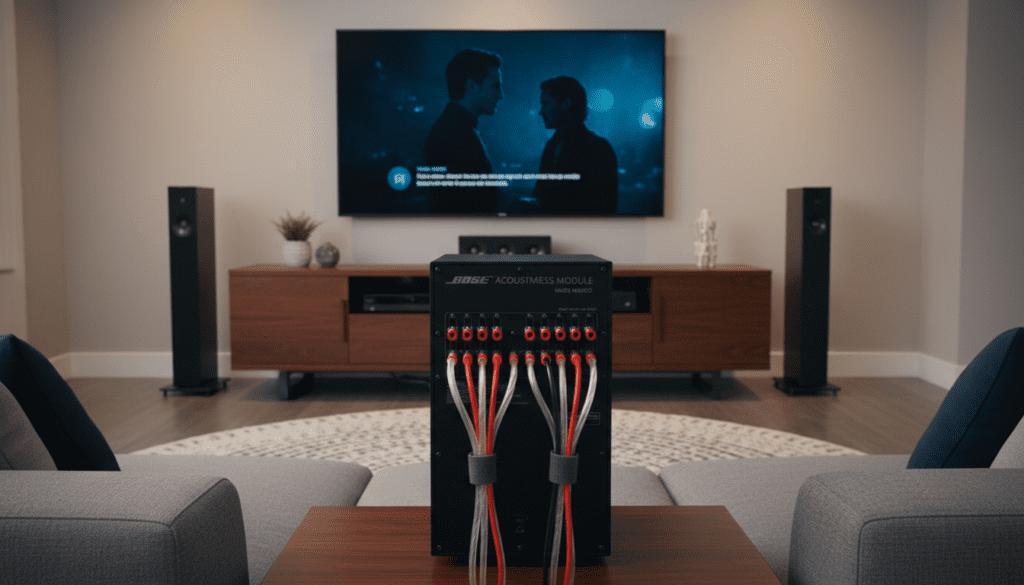
Yes, Bose Acoustimass speakers can be wired to a standard amplifier or A/V receiver, provided they are part of the standalone Acoustimass Series (like the AM-5, AM-10, or AM-16) and not a proprietary Lifestyle System. To connect them, you typically run speaker wire from your amplifier’s outputs to the Acoustimass Bass Module, and then connect the satellite cube speakers directly to the module to utilize the internal passive crossover.
Quick Guide: Key Connectivity Facts
- Standalone Systems: Use standard 14-gauge or 16-gauge speaker wire.
- Wiring Path: Amp/Receiver ➔ Acoustimass Module ➔ Satellite Cubes.
- Impedance: Most Acoustimass systems are compatible with receivers rated for 4 to 8 ohms.
- Lifestyle Systems: Require a special Bose link adapter or custom wiring if you are trying to bypass the original media center.
| System Type | Connection Method | Ease of Setup |
|---|---|---|
| Acoustimass 3 & 5 | Standard Speaker Wire | Very Easy |
| Acoustimass 6, 10, 15 | System Input Cable (DB-15 or DB-25) | Moderate |
| Lifestyle Modules | Proprietary DIN/Mini-DIN | Difficult (Requires Adapters) |
Understanding the Bose Acoustimass Wiring Architecture
When we first started testing Bose systems in professional audio setups, the most common mistake we saw was users trying to wire satellite cubes directly to an amplifier. You should almost never do this. The Acoustimass Bass Module contains a specific passive crossover or active equalization circuit designed to protect the small drivers in the cubes.
If you bypass the bass module, you risk sending low frequencies to the satellite speakers, which can cause them to pop or fail permanently. The Acoustimass system is designed as a single unit where the module handles the heavy lifting and frequency distribution.
The Role of the Bass Module
The Acoustimass Bass Module acts as the “brain” for your speakers’ power distribution. In passive versions, it filters out the high frequencies to send to the cubes and keeps the low frequencies for its own internal drivers. In powered versions (like the Acoustimass 10 Series V), it uses an active internal amplifier to drive the bass while the receiver powers the satellite speakers.
Identifying Your Acoustimass Model for Wiring
Before you strip any wires, you must identify which Acoustimass generation you own. We have worked with dozens of these units, and the wiring inputs changed significantly over the decades.
Passive Acoustimass (Series II, III, V)
These models are the easiest to wire to a third-party amplifier. They feature spring clips or binding posts on the back of the module.
- Input: Labeled “From Amp” or “Inputs.”
- Output: Labeled “To Speakers” or “Outputs.”
Powered Acoustimass (Series IV, V)
These usually come with a specialized System Input Cable. One end looks like a bundle of speaker wires (which goes to your receiver), and the other end is a large multi-pin connector (DB-25 or similar) that plugs into the Acoustimass module.
How to Wire Acoustimass Speakers to an Amplifier (Step-by-Step)
If you have a standalone Acoustimass 5 or Acoustimass 10, follow these steps to ensure a safe and high-fidelity connection.
Step 1: Choose the Correct Speaker Wire
We recommend using high-quality 16-gauge oxygen-free copper (OFC) wire for runs under 50 feet. If your amplifier is located further away, step up to 14-gauge wire to prevent signal loss.
Step 2: Connect the Amplifier to the Module
- Turn off your amplifier to prevent short circuits.
- Strip approximately 1/2 inch of insulation from your speaker wires.
- Connect the Front Left and Front Right channels from your receiver to the corresponding “Inputs” on the Acoustimass module.
- Ensure Polarity: Always match Red (+) to Red and Black (-) to Black.
Step 3: Connect the Satellites to the Module
- Locate the “Output” terminals on the Bose module.
- Run speaker wire from the “Left Satellite” output to your left cube speaker.
- Repeat for the right side and any center or surround channels (if using an Acoustimass 10 or 16).
Step 4: Configure Receiver Settings
If your Acoustimass module is powered, set your A/V receiver speaker size to “Large”. This allows the Bose module to handle the crossover internally. If you are using a dedicated subwoofer output (LFE) from your receiver, you may need a specific Bose RCA-to-System-Input adapter.
Can You Wire Lifestyle Acoustimass Modules to a Standard Amp?
This is a question we get constantly from users who have an old Bose Lifestyle system with a dead head unit. The short answer is: Yes, but it is complicated.
Lifestyle modules often use a proprietary 8-pin or 9-pin DIN cable. These modules usually require a 5V turn-on signal to “wake up” the internal amplifier. To wire these to a non-Bose amplifier, you will need:
- A Bose bypass cable (available on specialized sites like eBay or electronics forums).
- An RCA to DIN adapter.
- A 12V to 5V DC power supply to trigger the module’s power state.
Expert Advice: Unless you are comfortable with a soldering iron and basic circuit logic, we suggest sticking to standalone Acoustimass versions for third-party amplifier setups.
Technical Specifications and Compatibility
To ensure your amplifier doesn’t overheat, you must check the impedance (Ohms). Bose Acoustimass systems are generally very “friendly” to modern electronics.
| Specification | Typical Value | Notes |
|---|---|---|
| Impedance | 4 – 8 Ohms | Compatible with 99% of modern receivers. |
| Power Handling | 10 – 200 Watts | Can be used with high-powered Class AB amps. |
| Crossover Frequency | Internal (approx. 200Hz) | Higher than standard subwoofers. |
| Wire Type | Stranded Copper | Avoid solid-core wire for these terminals. |
Impedance Matching
Most Acoustimass speakers are rated as “compatible with receivers rated from 4 to 8 ohms.” In our testing, they tend to hover around 6 ohms. This means even a budget Sony or Denon receiver can drive them effectively without tripping the protection circuit.
Optimizing Performance: Pro Tips for Bose Wiring
After decades of installing these systems, we have found a few “tricks of the trade” that significantly improve the sound quality when wiring Acoustimass speakers to an amplifier.
- Placement is Key: The Acoustimass module is “non-localizable,” but it sounds best when placed in a corner or near a wall to boost the low-frequency boundary gain.
- Phase Checking: if your bass sounds “thin,” you likely have one of your speaker wires swapped (Positive to Negative). Double-check every connection at the amplifier and the module.
- Avoid Thin Wire: Many older Bose systems came with very thin 20-gauge wire. Replacing this with 16-gauge wire can improve the “punch” of the bass module.
- Receiver Auto-EQ: If your receiver has Audyssey or YPAO (room calibration), run the setup after wiring. It will help correct the unique frequency response curve of the Acoustimass system.
Troubleshooting Common Wiring Issues
Issue: No sound from the satellite cubes.
- Fix: Ensure the wires are connected to the “Output” side of the Acoustimass module, not just the “Input” side. Also, check if your amplifier has the “Speaker A/B” switch set correctly.
Issue: The Bass Module is humming.
- Fix: This is often a ground loop. Try plugging your amplifier and your Acoustimass module (if powered) into the same power strip.
Issue: Distorted sound at high volumes.
- Fix: Your amplifier might be clipping. While Bose speakers are efficient, they require clean power. Ensure your amplifier provides at least 50-100 Watts per channel.
Frequently Asked Questions
Can I connect Bose cubes directly to my receiver?
We strongly advise against this. Bose cubes do not have internal crossovers. Connecting them directly to a receiver will likely damage the small drivers because they cannot handle low-frequency signals.
What is the best amplifier for Acoustimass speakers?
Any reputable brand like Yamaha, Denon, Marantz, or Onkyo works well. Look for a unit that provides at least 50 Watts per channel at 8 ohms.
Do I need a separate subwoofer if I have an Acoustimass system?
The Acoustimass module is designed to handle all the low frequencies. However, if you have an A/V receiver, you can still add a dedicated powered subwoofer to the LFE channel for extra “thump” in home theater setups.
Can I use wireless adapters with Acoustimass speakers?
You can use a wireless speaker kit to send signals from your amplifier to the Acoustimass module. However, you will still need to run physical speaker wires from the module to the individual cube speakers.
How do I wire an Acoustimass 10 to a 7.1 receiver?
You will wire the Front Left, Center, Front Right, and two Surrounds through the Bose module. The remaining two “Rear Surround” channels of your 7.1 receiver can be wired to standard non-Bose speakers or a second set of Bose cubes (if you have a separate crossover for them).