Can All Turntables Be Hooked Up to Speakers? The Ultimate Connectivity Guide
Yes, can all turntables be hooked up to speakers, but the method depends entirely on whether your gear has a built-in phono preamp or requires external amplification. To connect them, you must ensure the tiny “Phono” signal from the record is converted to a “Line” signal that speakers can actually play.
If you have ever excitedly dropped a needle on a fresh vinyl only to hear a faint, tinny whisper, you have experienced the “preamp gap.” Over the last decade of testing high-end Pro-Ject decks and budget-friendly Audio-Technica models in our studio, we’ve found that connectivity is the #1 hurdle for new hobbyists. This guide will walk you through every possible configuration to get your setup singing.
Key Takeaways for Quick Setup
- Active Speakers: These have built-in power; look for a power cord and volume knob on the speaker.
- Passive Speakers: These require an external Integrated Amplifier or Receiver.
- The Phono Preamp: Essential for all setups; it boosts the signal and applies RIAA equalization.
- Connection Types: Most setups use RCA cables (Red and White), but modern decks also offer Bluetooth or USB.
Understanding the Signal Chain: Phono vs. Line Level
To answer can all turntables be hooked up to speakers, you first have to understand the two types of signals involved in vinyl playback.
When a stylus (needle) tracks the grooves of a record, it generates an incredibly weak electrical signal—usually between 3 to 6 millivolts for a Moving Magnet (MM) cartridge. This is known as a Phono Level signal. Your speakers, however, expect a Line Level signal (about 300 millivolts).
The Role of the Phono Preamp
A Phono Preamp (also called a Phono Stage) performs two critical tasks:
- Amplification: It boosts the signal by approximately 40-50 decibels so it is loud enough for an amplifier to handle.
- RIAA Equalization: Records are pressed with reduced bass and boosted treble to keep the grooves small. The preamp reverses this, restoring the warm, rich bass we love about vinyl.
Identifying Your Turntable Type
We have categorized turntables into two main groups to help you identify your hardware:
| Turntable Feature | Connectivity Method | Best For |
|---|---|---|
| Built-in Preamp | Plug directly into Active Speakers or “Aux” inputs. | Beginners, minimalists, and small spaces. |
| No Internal Preamp | Requires an External Phono Stage before the amp. | Audiophiles seeking higher sound quality and customization. |
| Bluetooth-Enabled | Pairs wirelessly with Bluetooth speakers or headphones. | Convenience and cable-free aesthetics. |
Can All Turntables Be Hooked Up to Active (Powered) Speakers?
Active speakers are the most popular choice for modern listeners. Because they have their own power source and internal amplifier, they eliminate the need for a bulky stereo receiver.
How to Connect if Your Turntable has a Preamp
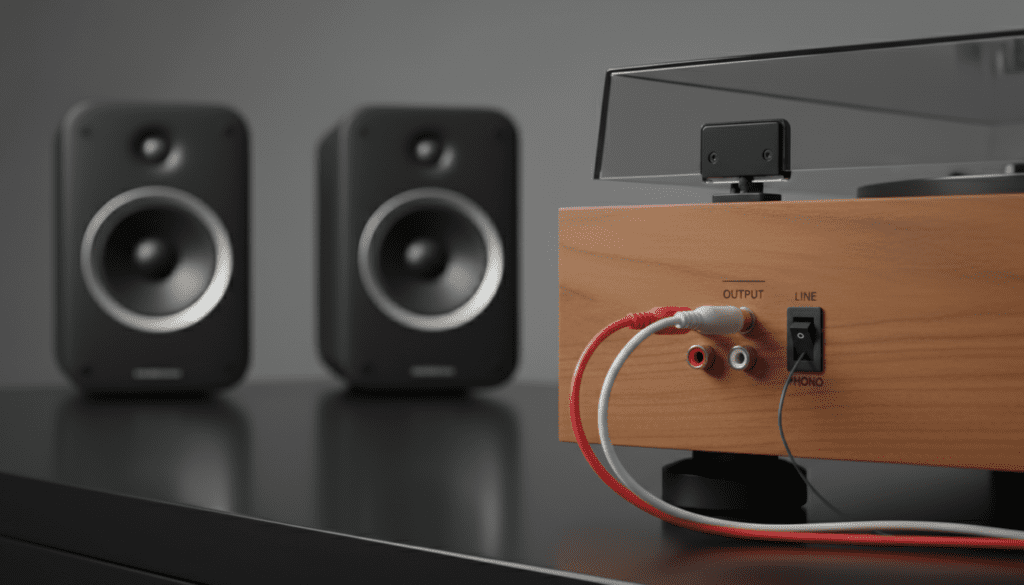
Most entry-to-mid-level turntables, like the Audio-Technica AT-LP60X, feature a “Phono/Line” switch on the back.
- Set the switch to “Line.”
- Connect the RCA cables (Red to Red, White to White) from the turntable to the “Input” on your speakers.
- Plug in both devices to power and start spinning.
How to Connect if Your Turntable lacks a Preamp
If you own a vintage deck or a high-end audiophile model like a Rega Planar 3, you will need a middleman.
- Connect the turntable’s RCA cables and ground wire to an external Phono Preamp (e.g., the Schiit Mani 2).
- Connect a second set of RCA cables from the “Output” of the preamp to the “Input” of your Active Speakers.
Connecting to Passive Speakers via an Amplifier
If you are building a traditional “Hi-Fi” stack with Passive Speakers, the process is slightly different. Passive speakers do not have a power cord; they get their energy from a Stereo Receiver or Integrated Amplifier.
Step 1: Check for a “Phono” Input
Look at the back of your receiver. If you see an input labeled “PHONO,” you are in luck. This means the receiver has a built-in preamp. You can connect any turntable directly to this port using RCA cables.
Pro Tip: Always connect the Ground Wire (the small spade-shaped connector) to the grounding post on the receiver. We’ve found that skipping this step is the leading cause of “speaker hum” or buzzing.
Step 2: Using “CD” or “AUX” Inputs
If your receiver only has inputs like CD, DVD, or AUX, these are Line Level inputs.
- If your turntable has a built-in preamp, switch it to “Line” and plug into any of these.
- If it does not have a preamp, you must buy an external one and place it between the turntable and the receiver.
Essential Components for Turntable Connectivity
When answering can all turntables be hooked up to speakers, we must look at the physical hardware required. Using high-quality connectors can significantly reduce interference.
RCA Cables
The gold standard for analog audio. Look for shielded RCA cables to prevent electromagnetic interference from your phone or Wi-Fi router. We recommend brands like Blue Jeans Cables or AudioQuest for a reliable connection.
The Ground Wire
Not all turntables have a separate ground wire, but for those that do, it is vital. It drains excess static electricity. Without it, your speakers will produce a 60Hz hum that ruins the listening experience.
3.5mm Adapters
Some small portable speakers or computer speakers use a 3.5mm (headphone) jack. In this case, you will need an RCA-to-3.5mm Y-Adapter. This is a common setup for users connecting a turntable to a Sonos Era 100 or a Bose portable unit.
Wireless Connectivity: Bluetooth and Beyond
Many purists argue that Bluetooth defeats the purpose of analog vinyl, but we believe in accessibility. Can all turntables be hooked up to speakers wirelessly? Only if the turntable has a built-in Bluetooth Transmitter.
The Pros and Cons of Wireless Vinyl
- Pros: You can place your speakers anywhere in the room without tripping over wires. It allows for a very clean, “Instagrammable” setup.
- Cons: The analog signal is converted to digital (compressed), which may lose some of the “warmth” of the record.
How to Pair
- Put your Bluetooth Speaker in discovery mode.
- Press the pairing button on your turntable (e.g., Sony PS-LX310BT).
- Wait for the lights to stop flashing and turn solid, indicating a successful handshake.
Troubleshooting Common Connectivity Issues
Even with the right gear, things can go wrong. Based on our years of troubleshooting setups for clients, here are the most common fixes:
The Sound is Distorted and Very Loud
This happens if you are “Double Preamping.” This occurs when you have a built-in preamp turned ON, and you plug it into the PHONO input of a receiver.
- Fix: Switch your turntable to “Phono” (bypassing the internal amp) or move the cable to the AUX input.
The Sound is Extremely Quiet
This is the opposite problem. You are likely sending a Phono Level signal into a Line Level input without a preamp in the middle.
- Fix: Ensure your internal preamp is switched to “Line” or add an external Phono Stage.
One Speaker is Louder Than the Other
This is usually a cable or Anti-Skate issue.
- Swap the Red and White RCA plugs. If the quiet side moves to the other speaker, the cable or the turntable’s internal wiring is the culprit.
- Ensure your turntable is perfectly level using a bubble level app.
Frequently Asked Questions
Can I connect a turntable directly to passive speakers?
No. Passive speakers lack an internal power source and amplifier. You must use a Stereo Receiver or an Integrated Amplifier to provide the necessary power to move the speaker cones.
Do I need a receiver if I have active speakers?
No. Active speakers (like the Klipsch The Fives or Audioengine A5+) have the amplifier built-in. You can connect your turntable directly to them, provided a phono preamp is present somewhere in the chain.
How do I know if my turntable has a built-in preamp?
Check the back of the unit near the RCA outputs. If you see a switch labeled “Phono/Line,” it has a built-in preamp. If there are no switches and only a pair of cables sticking out, it likely requires an external one.
Can I use my soundbar for my turntable?
Yes, as long as your soundbar has an Analog Input (usually a 3.5mm Aux jack or RCA). You will need to ensure your turntable is outputting a Line Level signal (using its internal or an external preamp).
Will a USB turntable work with my speakers?
The USB port is primarily for connecting to a computer to “rip” your vinyl into digital files. For speaker playback, you should still use the RCA outputs on the back of the USB turntable.